Why Baseball Lighting Is More Than Just Turning on the Lights
Baseball is a sport of split-second decisions — a batter tracking a 90-mph fastball, an outfielder reading a fly ball against the night sky, an umpire making a call at second base. For players, coaches, and officials, the quality of athletic field lighting isn't a background detail. It's a fundamental part of the game.
Across Nebraska's Platte River Valley, communities like Columbus, Schuyler, Norfolk, and David City have long invested in baseball and softball programs that serve players from tee-ball through adult recreation leagues. As these facilities age, many are still operating metal halide or high-pressure sodium (HPS) lighting systems that were installed decades ago — systems that produce uneven light, require lengthy warm-up times, and carry mounting energy and maintenance costs. The shift to LED sports lighting isn't just a trend. It's a measurable, practical upgrade that communities of all sizes are now embracing.
This article explores what that transition looks like for facilities in the Columbus area, why the technology has matured to a point where the decision is easier than ever, and what facility managers, parks and recreation directors, and school athletic departments should know before beginning a project.
The LED Difference: Precision, Performance, and Efficiency
Not all LED lighting is the same, and nowhere is that more apparent than in sports applications. A standard commercial LED fixture mounted on a ball field is not a sports lighting solution — it's a compromise. Purpose-built athletic field LED systems are engineered from the ground up to deliver the specific photometric performance that baseball and softball demand.
Uniform illuminance across the entire playing surface is the starting point. Properly designed systems eliminate the dark pockets near the warning track, the shadows in the outfield corners, and the uneven brightness that plagues older installations. For infielders and outfielders alike, consistent light levels mean fewer lost balls and better reaction time — a genuine safety benefit as well as a performance one.
Glare control is equally critical. Baseball lighting must be carefully aimed and shielded so that fly balls don't disappear into a wash of direct glare from poorly positioned fixtures. Sport-specific luminaires use precision optics to direct light onto the field, not into players' eyes or surrounding neighborhoods — an important consideration for urban and residential park settings common in communities like Columbus.
Energy efficiency is where the business case becomes compelling. LED systems consistently consume 50–70% less energy than the metal halide systems they replace. For a facility running night games five or six nights a week through a full spring and summer season, that reduction translates directly into lower utility bills year after year. In Nebraska, where agricultural and municipal operations are acutely cost-conscious, that ongoing operational savings matters as much as the upfront investment.
Instant on/off operation eliminates the warm-up and cool-down cycles that metal halide systems require. Fields can be lit in seconds, turned off immediately after a game ends, and brought back to full brightness for a rain delay without any waiting period. For facilities managing multiple games per evening, this flexibility is operationally significant.
What the Design Process Actually Looks Like
One of the most important things for facility managers and parks directors to understand is that a professional baseball LED lighting project is an engineered process, not a product swap. The work begins long before a single fixture is ordered.
Photometric design is the foundation. Using sport-specific software, lighting engineers model the entire field — pole placement, mounting heights, fixture aiming angles, and beam patterns — to produce a simulated light level map of the playing surface. This computer model predicts illuminance values across every square foot of the infield and outfield, allowing designers to optimize performance and identify potential problem areas before installation begins.
League and governing body compliance is built into the design from the start. Whether a facility hosts recreational youth leagues, high school varsity competition, collegiate play, or adult softball leagues, different organizations — from Little League International to the NFHS to the NCAA — publish specific footcandle requirements for their sanctioned levels of play. A properly engineered design ensures compliance at the appropriate tier, protecting both the facility and the athletes who play there.
Pole engineering and structural assessment is often an overlooked component. In many retrofit projects, existing pole infrastructure may be reused, but that determination requires engineering review. New installations require careful site planning to position poles at the correct distances and heights relative to the field geometry, taking into account foul lines, backstop placement, and setback requirements.
Controls integration rounds out the modern system. Today's sports lighting platforms offer sophisticated controls — zone-based switching, dimming capabilities for different use cases (practice versus game versus broadcast), automated scheduling, and remote monitoring via mobile apps or web dashboards. For facilities that host both youth practice sessions and competitive night games, the ability to dial in appropriate light levels for each use case is both an energy management tool and an operational convenience.
Proof That LED Upgrades Deliver: VOSS in Action Across Nebraska
VOSS has been serving Nebraska communities for decades, and the results of our lighting projects speak to a consistent pattern: well-engineered upgrades dramatically improve the environment for everyone who uses a facility, while reducing the operational burden on the staff responsible for maintaining it.
At the Salvation Army Kroc Center in Omaha, VOSS tackled a gymnasium lighting retrofit that illustrates the efficiency gains possible with a thoughtful LED redesign. The facility's year-round athletic programming was burdened by high energy consumption and frequent fluorescent lighting maintenance — sometimes on a weekly basis. VOSS designed a new lighting layout that reduced the total number of fixtures from 99 to 47, cutting energy usage in half and projecting $4,257 in annual savings. Carl Larson, the Head of Facilities, noted that the "meticulous planning" VOSS brought to the project ensured a seamless installation that transformed the space's ambiance and functionality. The same disciplined approach to sports facility lighting design applies directly to outdoor athletic fields.
At Blue Cross Blue Shield of Nebraska, VOSS completed a large parking lot lighting upgrade that reduced overall energy usage by more than 56% and leveraged utility rebates to offset project costs. While a parking lot differs from a baseball field, the underlying discipline — careful photometric layout, appropriate fixture specification, and rebate management — is exactly the expertise VOSS brings to outdoor athletic lighting projects across the region.
These Nebraska-based projects reflect a consistent reality: LED lighting upgrades, when engineered properly, deliver on their promises.
A Proven Playbook: The Page, Arizona Baseball Lighting Project
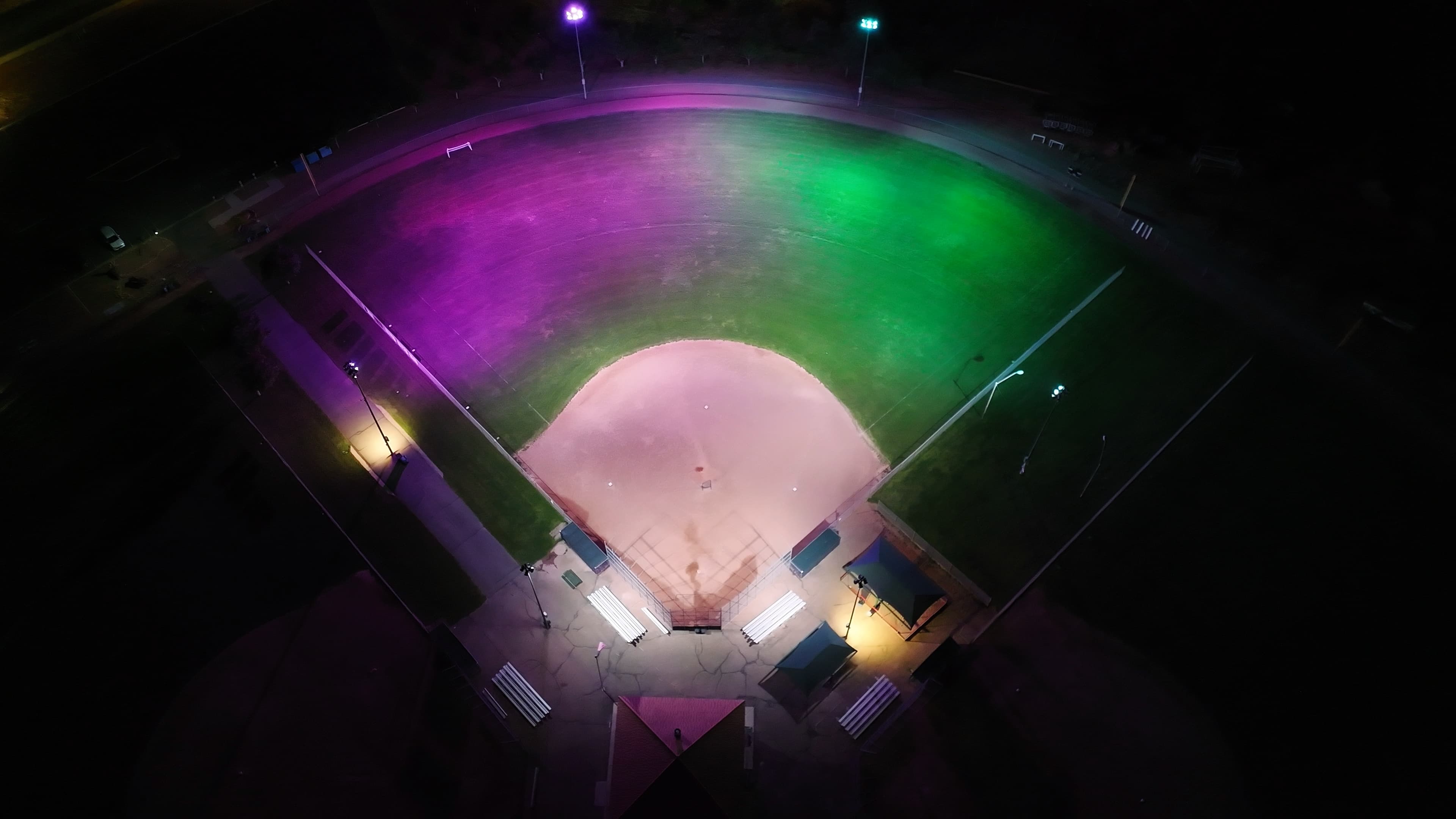
Beyond Nebraska, VOSS has demonstrated its sports lighting expertise at the competitive venue level. In Page, Arizona, VOSS completed a baseball field LED lighting project that illustrates what a well-executed upgrade looks like from concept through commissioning. The Page project serves as a meaningful reference point for facilities in the Columbus area considering similar investments — it demonstrates that VOSS brings the same engineered rigor and project management discipline to athletic field lighting that it applies across all of its lighting disciplines, regardless of the community's size or geographic location.
For Columbus-area facilities evaluating a baseball or softball lighting project, this track record matters. Choosing a lighting contractor without sports-specific experience is a risk that can result in non-compliant designs, glare problems, or systems that simply don't perform as expected. VOSS' experience with athletic field lighting — combined with our local presence through the Omaha branch — means that Columbus facilities get national expertise with regional accountability.
The Columbus, Nebraska Context: Why Now Is the Right Time
Columbus is a community of approximately 25,000 residents anchored by a strong agricultural economy and a growing manufacturing base along the Highway 30 and Highway 81 corridors. The city's parks and recreation system, school athletic programs, and community sports organizations serve a population that takes youth and adult athletics seriously. From the Pawnee Park complex to school-affiliated fields serving Columbus High School and area youth leagues, the athletic infrastructure here is active and well-used.
For parks and recreation administrators, school district facilities directors, and nonprofit athletic organization leaders in the Columbus area, the timing for an LED sports lighting investment is favorable for several converging reasons:
- LED technology maturity — The technology has advanced significantly over the past decade. Systems available today offer far better optics, longer lifespans, and more sophisticated controls than early-generation LED sports lighting. The performance gap between LED and metal halide has become decisive.
- Energy cost awareness — Nebraska utility costs, while moderate by national standards, are not immune to long-term pressure. Locking in dramatic energy reductions through LED conversion is a hedge against future rate increases.
- Rebate and incentive availability — Utility rebate programs can meaningfully offset project costs. VOSS actively manages the rebate process on behalf of clients, identifying eligible programs and handling the documentation — removing a common barrier for smaller facilities with limited administrative capacity.
- Cooperative purchasing access — Public entities in Nebraska, including school districts, municipal parks departments, and county organizations, can access VOSS services through the Nebraska ESU Co-Op, Sourcewell, BuyBoard, TIPS, AEPA, Omnia Partners, PACE, and Houston Church COOP cooperative purchasing programs. Additionally, VOSS holds an approved Nebraska state contract, enabling government entities across the state to procure lighting and electrical services in a compliant, streamlined manner — without the administrative burden of a standalone competitive bid process.
For eligible organizations in Columbus, Platte County, and surrounding communities including Columbus suburbs and nearby towns like Leigh, Platte Center, and Duncan, these procurement pathways can simplify the path from planning to project launch.
How Baseball Field Lighting Connects to the Broader Lighting Landscape
Baseball LED lighting doesn't exist in isolation. For facilities managing multiple athletic spaces — gymnasiums, tennis courts, parking areas, and outdoor fields — a comprehensive approach to lighting upgrades makes both logistical and financial sense.
Readers exploring this topic may also find value in related articles within the VOSS Latest Lighting series, including our coverage of LED Gymnasium Lighting Solutions, Pickleball LED Lighting Solutions, Tennis Court Lighting and Energy Solutions, and LED Football Stadium Lights and Sports Field Lighting Solutions. For facilities navigating the rebate landscape, our articles on Energy Audits, Incentives, and Rebate Navigation for Businesses and Parking Lot and Outdoor LED Lighting Upgrades offer additional context on how to approach the financial side of multi-phase upgrades. Together, these resources reflect a broader truth: the most impactful lighting upgrades happen when facilities think holistically, rather than field by field.
Service Availability
While VOSS offers a comprehensive suite of national services, specific capabilities may vary by location. Please contact your local branch to confirm the current availability of specific services, technology solutions, or contracting capabilities in your immediate market.
Talk to VOSS About Your Baseball Lighting Project
Whether you're managing a youth recreation complex in Columbus, overseeing athletic facilities for a Platte County school district, or planning a competitive venue upgrade anywhere across eastern Nebraska, VOSS is ready to be your lighting partner. Our team combines deep technical expertise in sports lighting design with the project management discipline and local presence to deliver results you can count on — season after season.
We invite you to start with a conversation. Tell us about your facility, your current challenges, and your goals. Our Omaha branch serves Columbus and the surrounding region, and we're ready to help you think through what a lighting upgrade could look like for your specific situation.
VOSS — Omaha Branch (402) 328-2283
Reach out today to schedule a consultation and take the first step toward a brighter, more efficient, and more competitive athletic facility.