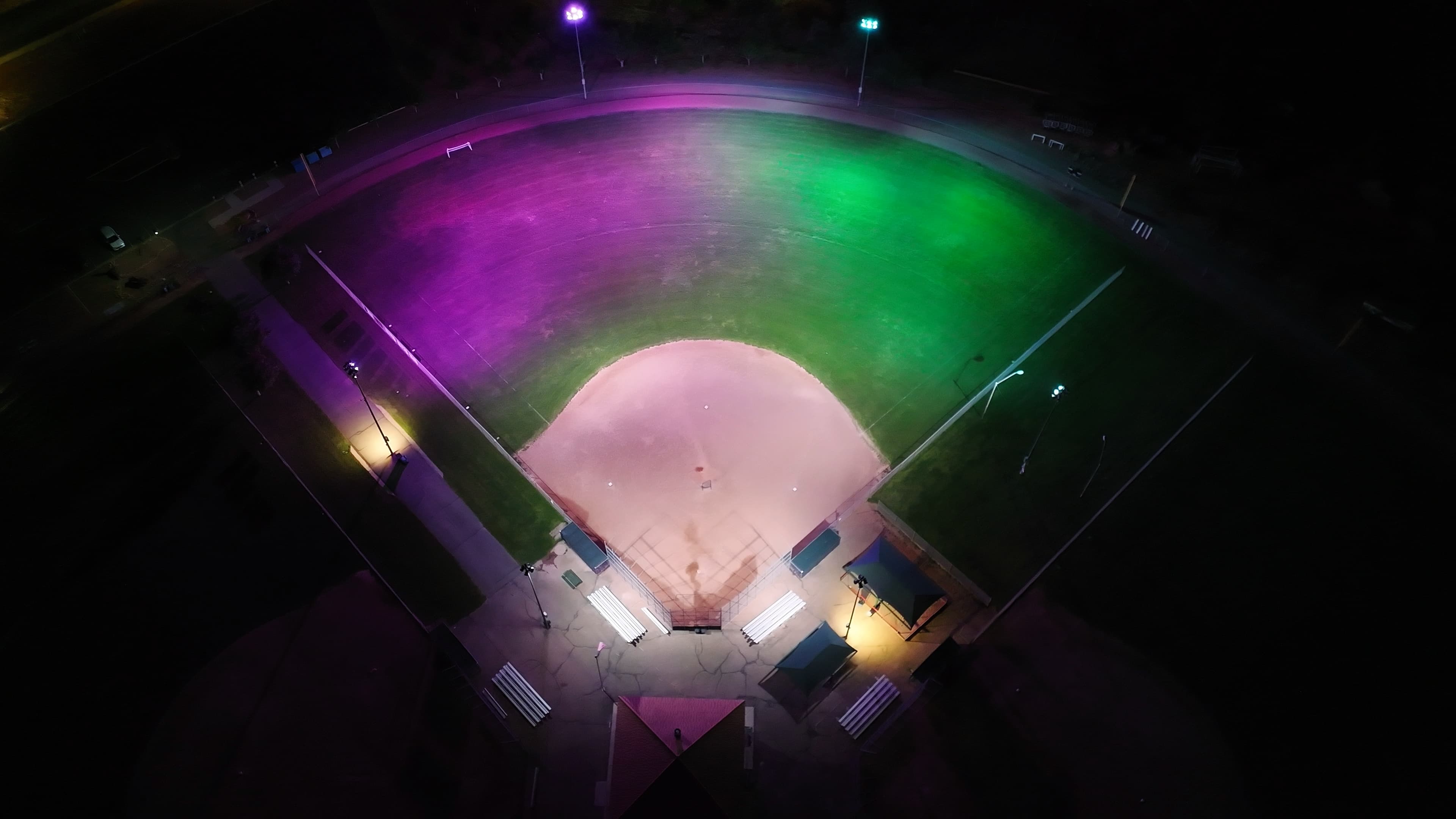
Why Baseball Lighting Deserves More Than a Generic Fix
Baseball is unlike almost any other sport when it comes to lighting. The geometry of the field — a 90-foot diamond extending into a vast outfield with no fixed boundary — creates one of the most technically demanding lighting challenges in athletics. A batter tracking a 90-mph fastball, an outfielder reading a fly ball against a night sky, an umpire calling a play at second base: each of these moments depends on consistent, uniform light with minimal glare and no dark zones.
In Bellevue, NE and throughout the Greater Omaha metro — including Papillion, La Vista, Ralston, Gretna, and Sarpy County communities — baseball is woven deeply into the fabric of local life. From youth recreational leagues at city parks to high school programs, college fields, and community athletic complexes, the region's investment in baseball infrastructure continues to grow. As that investment grows, so does the expectation for facilities that perform at a modern standard.
This article explores what facility managers, parks and recreation directors, athletic directors, and operations leaders across the Omaha region should understand about today's LED sports lighting — and why the decisions made now will shape field performance and energy costs for the next two decades.
The State of Baseball Lighting: From Metal Halide to LED
For decades, metal halide and high-pressure sodium (HPS) fixtures were the default for athletic field lighting. They were adequate — but they came with a long list of operational challenges that today's facility managers know all too well:
- Long warm-up and re-strike times — Metal halide fixtures can take 15–20 minutes to reach full brightness after being switched on, and cannot be quickly restarted after a power interruption — a serious liability during rain delays or emergency situations
- High energy consumption — Traditional field lighting systems consume significantly more electricity than modern LED equivalents, driving up monthly utility costs for parks departments, school districts, and private operators
- Inconsistent light distribution — Older technology tends to produce bright hotspots near pole bases and dimmer zones in the outfield corners, creating visibility inequities across the field
- High maintenance burden — Lamp replacements on 60- to 80-foot poles require lift equipment, specialized labor, and planned downtime — costs that accumulate year over year
- Light pollution and spill — Older optics were far less precise, meaning significant light escaped beyond the field boundary, affecting neighboring properties and generating community complaints
LED technology addresses every one of these shortcomings. Modern LED sports lighting fixtures deliver instant-on performance, dramatically reduced energy consumption, superior uniformity across the entire playing surface, and precision optics that keep light on the field — not in adjacent backyards or roadways.
For Bellevue and the broader Sarpy County area, where residential neighborhoods often border athletic parks and where municipal budgets require careful stewardship, those advantages are not abstract. They translate directly to lower utility bills, fewer maintenance calls, reduced neighbor complaints, and more usable hours on the field.
What Good Baseball Lighting Actually Looks Like
Not all LED upgrades are created equal. The quality of a baseball lighting project is determined by far more than the fixtures themselves — it depends on engineering precision, photometric design, pole placement strategy, and compliance with the governing standards for the level of play.
Illuminance Levels and Uniformity
The Illuminating Engineering Society (IES) and governing bodies including the NCAA, USA Baseball, and Little League International publish recommended lighting standards by level of play. A recreational youth field has different requirements than a high school varsity diamond, which has different requirements than a collegiate or professional venue. A properly engineered system hits the right illuminance targets — measured in foot-candles — while also achieving the uniformity ratios that eliminate the bright-spot/dark-zone problem of older systems.
For context:
- Recreational/youth fields typically require 30–50 foot-candles with moderate uniformity
- High school and competitive amateur fields generally require 50–75 foot-candles with tighter uniformity ratios
- Collegiate and professional venues may require 100–200+ foot-candles with broadcast-grade uniformity specifications
Getting this right requires photometric modeling — a software-driven design process that maps how light from each fixture reaches every square foot of the playing surface before a single pole is installed.
Glare Control
Glare is perhaps the single most important player-safety consideration in baseball lighting. A batter or outfielder staring into a poorly positioned or inadequately shielded fixture can lose track of a ball entirely — with dangerous consequences. Modern LED sports lighting fixtures use precision optics and full cutoff lens designs that direct light downward onto the field while preventing direct glare into players' lines of sight. This is not a feature to skip in the interest of cost savings.
Controls Integration
Today's best baseball lighting systems are not just fixtures on poles — they are intelligent, connected systems. Lighting controls allow operators to:
- Set field brightness by event type (practice vs. game vs. broadcast)
- Schedule automatic on/off times to eliminate waste
- Monitor energy consumption in real time
- Dim or group zones independently for infield, outfield, or bullpen areas
- Integrate with facility management systems for unified building controls
For parks and recreation departments managing multiple fields across Bellevue, Papillion, or La Vista, centralized controls can represent a significant operational efficiency gain — managing every field from a single interface rather than dispatching staff to each location.
Lessons from the Field: What Real Projects Teach Us
VOSS has completed LED lighting and electrical projects across Nebraska and the broader region, giving our team direct, hands-on insight into what works — and what to watch for.
In Omaha, our work at the Salvation Army Kroc Center is instructive for anyone managing a multi-use athletic facility. The gymnasium operated year-round for a wide range of sports and activities, and the existing fluorescent lighting system required monthly — sometimes weekly — maintenance. VOSS redesigned the lighting layout, reducing the fixture count from 99 to 47 while actually improving light quality. Energy usage was cut in half, and the facility projected $4,257 in annual savings. The project was completed on schedule and within the agreed timeframe, a priority for any facility that cannot afford extended downtime.
Similarly, our retrofit work for Blue Cross Blue Shield of Nebraska's parking lot — where outdated area lighting was creating dark spots and pedestrian safety concerns — resulted in a 56% reduction in overall energy usage. Rebate management was a key component of that project, helping offset upfront costs significantly.
These are not baseball projects — but they illustrate a consistent principle: the path from outdated lighting to a high-performance LED system requires careful design, not just fixture swaps. The same discipline applies on the baseball diamond.
Energy Savings and Financial Planning for Baseball Facilities
For facility managers and finance leaders evaluating a baseball LED lighting project, the financial case is strong — but it requires understanding the full picture.
Energy savings are the most visible component. LED sports lighting typically consumes 50–70% less electricity than the metal halide systems it replaces. For a field running 1,000 hours per year — a reasonable estimate for an active community field with practices and games — that translates to substantial annual savings on electricity costs.
Utility rebates can significantly reduce the net cost of the project. Nebraska utilities offer rebate programs for qualifying LED upgrades, and VOSS has deep experience navigating those programs on behalf of clients — identifying eligible fixtures, completing the required documentation, and managing the rebate submission process. For organizations in the Bellevue and Omaha area, working with a contractor who understands the local utility landscape is a meaningful advantage.
Cooperative purchasing programs offer another pathway for eligible public-sector organizations. Parks departments, school districts, and municipal recreation programs in Nebraska can access VOSS through several cooperative purchasing vehicles — including Sourcewell, BuyBoard, TIPS, AEPA, Omnia Partners, PACE, and the Nebraska ESU Co-Op — as well as through VOSS's approved Nebraska state contract. These programs streamline procurement, eliminate the need for individual bid processes in many cases, and allow organizations to move projects forward more efficiently.
Lifecycle cost modeling is the right framework for evaluating any sports lighting project. The upfront investment in a quality LED system — including engineered photometrics, proper pole infrastructure, and controls integration — is significantly offset by reduced energy costs, near-zero maintenance expense, and 20+ year fixture lifespans. Facilities that cut corners on the front end often find themselves dealing with underperforming systems, warranty issues, or premature replacements.
Choosing the Right Partner for Your Baseball Lighting Project
The baseball lighting market has attracted a wide range of contractors and vendors in recent years, and not all of them bring the same depth of experience. For facility managers and athletic directors evaluating proposals, a few questions can help separate capable partners from those who may overpromise and underdeliver:
- Do they provide photometric designs? Any serious sports lighting contractor should be able to produce a computer-modeled lighting plan showing predicted foot-candle levels and uniformity ratios before installation begins.
- Are they familiar with governing body standards? IES, NCAA, USA Baseball, Little League, and NFHS all publish lighting standards. Your contractor should reference these proactively, not reactively.
- Can they manage the full project lifecycle? From initial design through installation, commissioning, rebate management, and ongoing support — a full-service contractor reduces the coordination burden on your team.
- Do they have relevant local experience? Knowledge of local utility rebate programs, municipal permitting processes, and regional project logistics matters. A contractor with an established Omaha-area presence brings that knowledge to the table from day one.
- What is their approach to controls integration? Fixtures are only part of the system. A contractor who treats controls as an afterthought may leave efficiency and operational value on the table.
VOSS brings 85+ years of experience as a full-service commercial electrical contractor, with a local presence in Omaha serving Bellevue, Papillion, La Vista, Ralston, Gretna, and communities across Sarpy and Douglas counties. Our team manages every phase of sports lighting projects — photometric design, equipment procurement, installation, commissioning, rebate management, and controls integration — under one roof.
For readers interested in related topics, our content section also covers LED gymnasium lighting solutions, pickleball LED lighting solutions, tennis court lighting and energy solutions, and LED football stadium lights and sports field lighting solutions — all part of the broader conversation about how modern lighting technology is transforming athletic facilities across the region.
Service Availability
While VOSS offers a comprehensive suite of national services, specific capabilities may vary by location. Please contact your local branch to confirm the current availability of specific services, technology solutions, or contracting capabilities in your immediate market.
Talk to VOSS About Your Baseball Lighting Project
Whether you're managing a single community field in Bellevue or overseeing a multi-field complex serving Sarpy County, VOSS is ready to help you think through the right approach — from photometric design and fixture selection to controls, rebates, and procurement strategy.
We don't start with a product catalog. We start with your facility, your budget, and your goals — and work from there.
VOSS — Omaha Branch Phone: (402) 328-2283
Contact our Omaha team to schedule a consultation and learn how a professionally engineered LED lighting system can improve your baseball or softball facility for players, fans, and your bottom line.