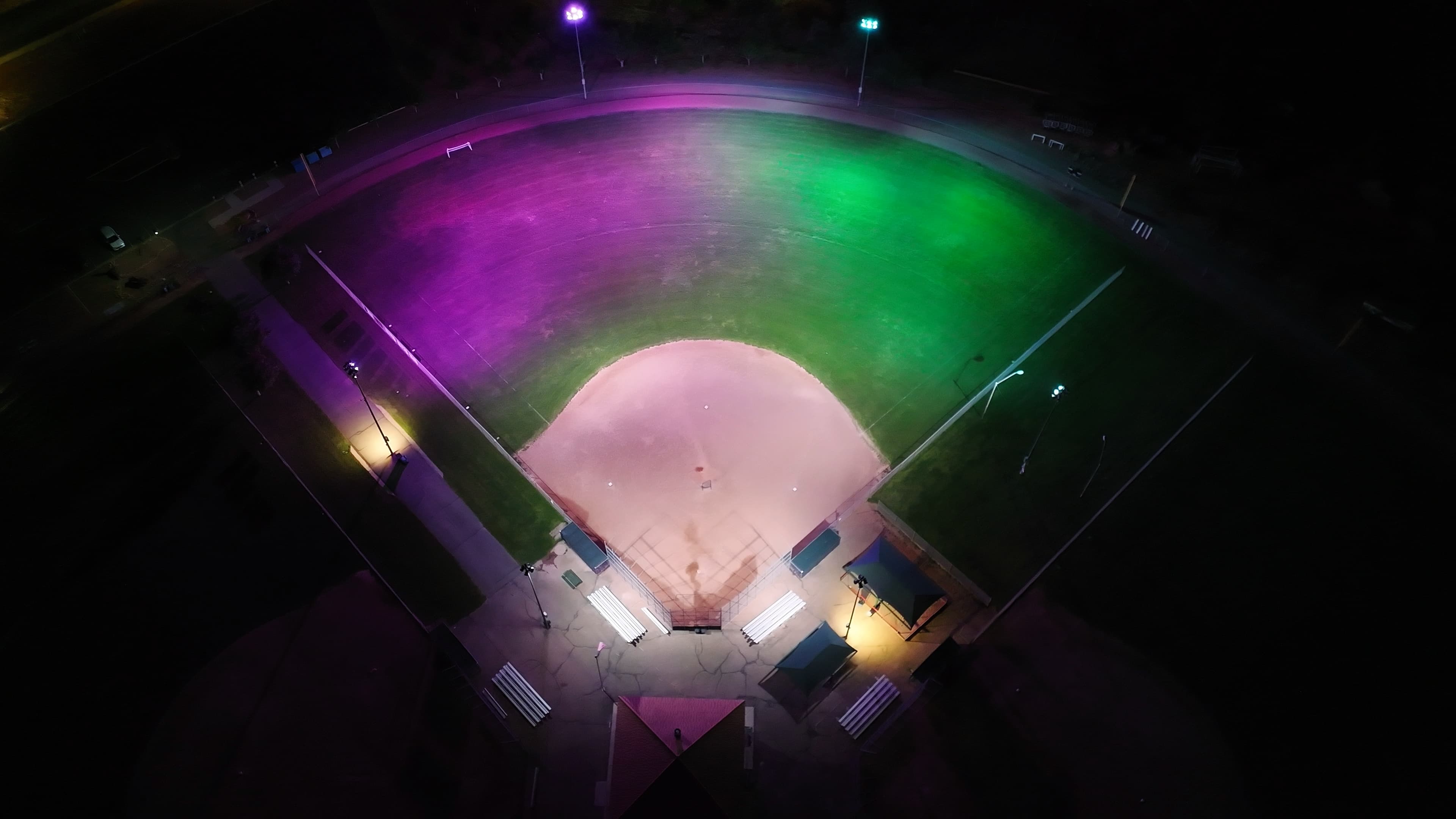
Why Baseball Lighting Is More Than Just Turning on the Lights
For anyone who has ever watched a youth player lose a fly ball in the shadows of an aging metal halide system — or seen a fast-pitch softball game called early because the field simply wasn't safe to play on — the connection between quality lighting and quality play is undeniable. Yet across Greater Oklahoma City, from Yukon's growing recreational corridors to community fields in Mustang, Edmond, and Moore, many baseball and softball facilities are still running lighting infrastructure that is decades behind the technology available today.
This is a moment of real opportunity. The rapid maturation of LED sports lighting technology, combined with increasingly favorable utility incentives and cooperative purchasing programs, has made it more practical than ever for municipalities, school districts, athletic associations, and private facility operators to invest in purpose-built lighting systems that meet the demands of modern play. At VOSS, we've spent more than 85 years working alongside facility managers, parks directors, and operations leaders across the country — and we want to share what we've learned about getting these projects right.
The State of Baseball Lighting: What's Changed and Why It Matters
Traditional sports field lighting — predominantly metal halide or high-pressure sodium (HPS) systems — was designed for an era when energy costs were lower, maintenance labor was less of a concern, and broadcast-quality illumination was the exclusive domain of professional venues. Today, those calculus factors have shifted dramatically.
LED technology has redefined what's possible at every level of the game. Modern LED fixtures deliver light output measured in foot-candles with extraordinary precision. Photometric design software allows lighting engineers to model exactly how light will fall across an infield, outfield, warning track, and dugout areas before a single pole is set in the ground. The result is more uniform illumination, reduced glare for batters and fielders, and sharper visibility under game conditions — all of which contribute directly to player safety and performance.
For facility operators, the operational advantages are equally compelling:
- Dramatic energy reduction — LED systems typically consume 50–70% less energy than equivalent metal halide installations, translating to meaningful savings on monthly utility bills
- Instant-on performance — unlike metal halide fixtures that require a warm-up and re-strike period after interruption, LED systems reach full brightness immediately — a critical advantage for managing rain delays, broadcast schedules, and late-starting games
- Extended service life — quality LED fixtures are rated for tens of thousands of hours of operation, dramatically reducing the frequency and cost of lamp replacements and bucket-truck maintenance calls
- Controls integration — modern LED systems pair seamlessly with smart lighting controls, enabling dimming, scheduling, remote monitoring, and zone management from a single platform
For context closer to home: VOSS' work at The Triangle at Classen Curve in Oklahoma City demonstrated what smart LED design can accomplish outdoors. That project doubled ground-level light levels in a commercial parking environment, eliminated unsafe dark spots, and delivered an anticipated annual electrical savings of $14,000 — with a return on investment of just over one year. While a parking lot is not a ballpark, the underlying principle is the same: precise photometric design and quality fixtures produce measurable, lasting results.
Designing for the Specific Demands of Baseball and Softball
No two sports facilities are lit exactly the same way, and baseball is among the most technically demanding applications in the sports lighting world. The geometry of the game — a batter tracking a pitched ball traveling at high speed, outfielders reading the arc of a fly ball against a dark sky, infielders reacting to ground balls across varied turf surfaces — requires a lighting design that accounts for multiple distinct zones with different illumination requirements.
Key design considerations for baseball and softball facilities include:
- Infield vs. outfield foot-candle targets — competitive play at higher levels requires significantly higher maintained foot-candle levels in the infield, where reaction times are shortest, than in the outfield
- Pole placement and mounting height — improper pole positioning creates glare angles that interfere directly with batters and fielders; engineered pole layouts are non-negotiable for compliance and performance
- Spill and glare control — particularly important for community fields in residential areas of Yukon and surrounding communities like Mustang and Bethany, where light trespass onto adjacent properties is a real concern
- League and governing body compliance — Little League International, USSSA, NFHS, NCAA, and professional organizations each publish specific lighting standards; a properly engineered design documents compliance from the outset
- Broadcast and video readiness — even at the high school and collegiate levels, HD video capture has become a standard expectation; LED systems with high Color Rendering Index (CRI) values and proper flicker management produce broadcast-quality imagery
Our work on baseball facilities is informed by direct project experience. VOSS completed a baseball field LED lighting project in Page, Arizona, delivering a sport-specific engineered solution that met league standards and improved both the competitive environment and the energy profile of the facility. That kind of real-world project experience shapes how we approach every new design — understanding that the stakes are high and the details matter.
The Yukon and Greater OKC Market: A Community Built Around Athletic Activity
Yukon, Oklahoma is a community of approximately 32,000 residents situated along the I-40 corridor west of Oklahoma City, with a strong identity built around family, schools, and athletics. The Yukon Millers — the city's beloved high school athletic tradition — reflect the community's deep investment in competitive sports at every level, and the city's parks and recreation infrastructure supports youth leagues, travel ball organizations, and adult recreational programs that keep fields lit well into the evening hours throughout the spring and summer seasons.
Across the Greater Oklahoma City metro — from Edmond and Deer Creek to the north, to Tuttle and Chickasha to the southwest, and south through Norman and Moore — there is a dense network of baseball and softball facilities serving hundreds of thousands of players and fans each season. Many of these facilities were built or last upgraded during the metal halide era, and their operators are increasingly aware that aging lighting systems carry real costs: higher utility bills, more frequent maintenance, player safety concerns, and an inability to attract higher-level tournament play that demands better illumination standards.
Oklahoma's climate also places unique stress on outdoor lighting infrastructure. Extreme summer heat, severe weather, and wide seasonal temperature swings accelerate the degradation of older fixture types. LED systems, built for resilience and rated for broad operating temperature ranges, are simply better suited to Oklahoma's conditions.
For public-sector organizations — city parks departments, school districts, and municipal recreation programs across Canadian County and the broader OKC metro — procurement doesn't have to be complicated. VOSS holds an approved state contract in Oklahoma, and eligible organizations can also access our products and services through cooperative purchasing programs including Sourcewell, BuyBoard, TIPS, AEPA, and Omnia Partners. These vehicles streamline the procurement process and ensure compliance with public bidding requirements, making it easier to move from project approval to installation without delay.
What to Expect from a VOSS Baseball Lighting Project
One of the most common questions we hear from facility managers and parks directors is: Where do we even start? The answer is straightforward: with a conversation and a site assessment.
VOSS manages every phase of a baseball or softball lighting project under one roof:
- Photometric design and engineering — we model your specific field geometry, target illumination levels, and compliance requirements before any equipment is specified
- Fixture specification and procurement — we source fixtures from industry-leading manufacturers, including MUSCO sports lighting solutions and other proven LED platforms, matched to your application and budget
- Pole and electrical infrastructure — from new pole foundations to service upgrades and conduit work, our licensed electrical teams handle the full scope
- Installation and commissioning — our field crews complete the installation and verify performance against the photometric design before handing the field back to you
- Controls integration — we can integrate scheduling, dimming, and remote monitoring capabilities that give you ongoing control over energy consumption and operational costs
- Ongoing support — with our Oklahoma City branch serving Yukon and the surrounding region, you have local expertise and responsive service available when you need it
Our work in Oklahoma spans industries and facility types — from the New Covenant Church Worship Center retrofit in Oklahoma City, where we replaced 260 failing fixtures with a virtually maintenance-free LED system, to the University of Oklahoma warehouse lighting project in Norman, which delivered approximately $6,000 per year in energy savings and transformed a previously unusable space. These projects reflect the same principles we bring to every athletic field engagement: disciplined design, quality execution, and outcomes that last.
For those exploring related lighting topics, our broader Latest Lighting content series addresses LED solutions for gymnasiums, pickleball courts, tennis courts, football stadiums, parking lots, and commercial outdoor environments — as well as guidance on utility rebates and energy audits that may help offset project costs.
Service Availability
While VOSS offers a comprehensive suite of national services, specific capabilities may vary by location. Please contact your local branch to confirm the current availability of specific services, technology solutions, or contracting capabilities in your immediate market.
Let's Talk About Your Field
Whether you're managing a single community diamond in Yukon or overseeing a multi-field complex serving the broader Canadian County area, VOSS has the experience, the engineering resources, and the local presence to help you make a confident, well-informed decision about your lighting investment.
We invite you to reach out to our Oklahoma City branch team to schedule a site consultation and learn how a purpose-built LED lighting system can transform the experience on your field — and the numbers on your utility bill.
VOSS — Oklahoma City Branch Phone: (405) 949-1919 Toll-Free: (800) 735-8677