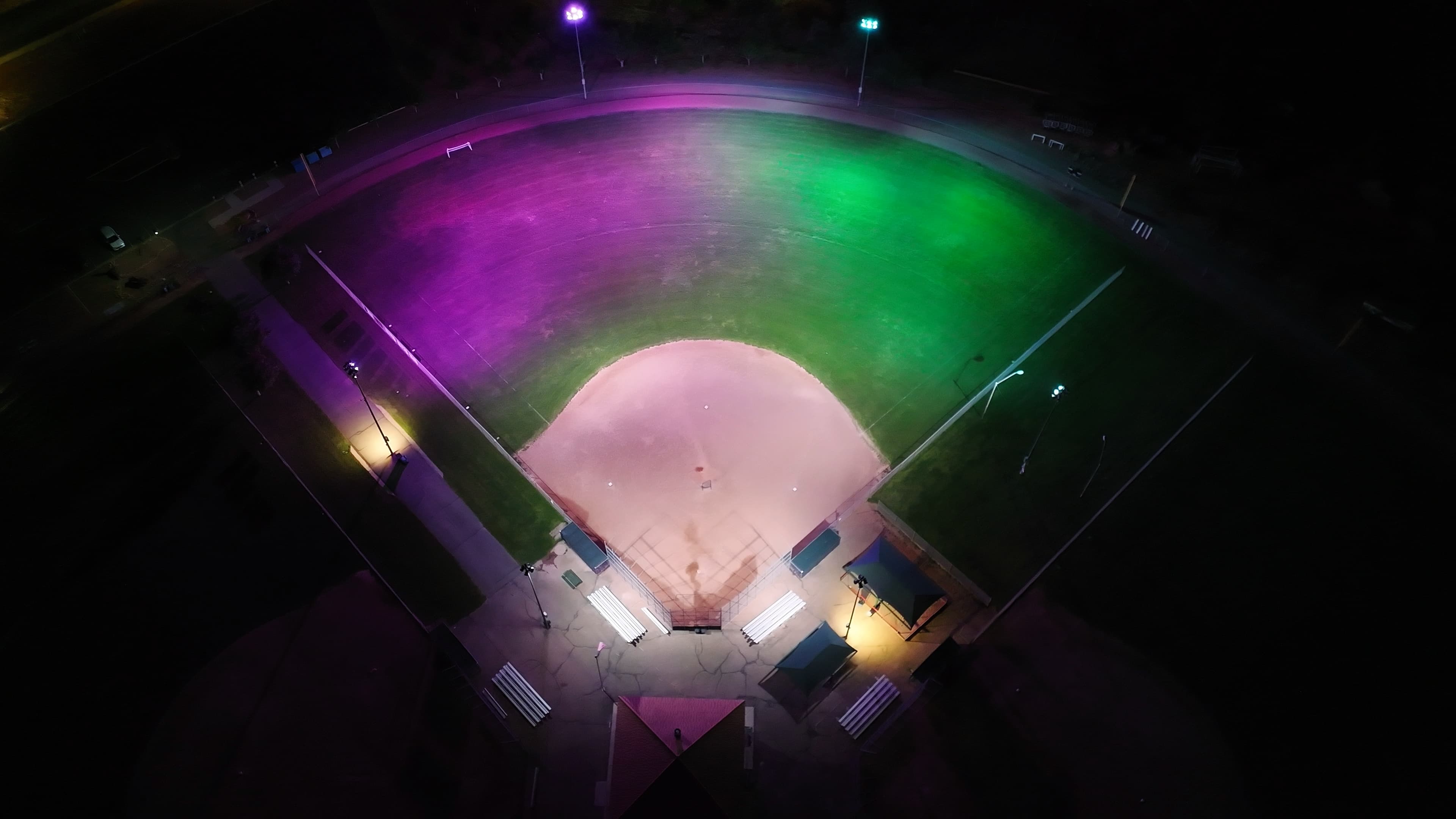
Owasso, Oklahoma has grown rapidly into one of the Tulsa metro's most active and family-centered communities. With a population of roughly 38,000 and a strong youth sports culture, the city's baseball and softball facilities see heavy use — from spring recreational leagues to competitive travel ball and high school athletics. That level of activity puts real pressure on field operators and parks administrators to deliver a safe, high-quality playing environment night after night.
Yet across the region — from Owasso's own parks to nearby communities like Collinsville, Claremore, Broken Arrow, and Jenks — many athletic fields still rely on aging metal halide or high-pressure sodium lighting systems. These legacy systems are costly to operate, slow to warm up, and increasingly difficult to maintain. The transition to LED technology isn't just a trend; it's a practical and financially sound decision that's reshaping how baseball and softball facilities are built and operated across northeastern Oklahoma.
At VOSS, we've been helping organizations across Oklahoma make this transition for decades. Our Oklahoma City branch serves facilities throughout the state, and our team brings the engineering depth and project management experience to handle baseball and softball lighting at any scale — from a four-field youth complex to a collegiate or professional venue.
What Makes Baseball Lighting Uniquely Challenging
Not all sports lighting projects are created equal, and baseball presents some of the most complex photometric challenges in the industry. A well-lit baseball field must provide consistent, uniform illumination across surfaces that extend hundreds of feet in every direction — while also controlling glare that can impair a batter's ability to track a pitch or a fielder's ability to judge a fly ball.
Key design considerations that distinguish a professional baseball lighting project include:
- Pole placement and height — The position and elevation of lighting poles must be carefully engineered to deliver adequate foot-candles across the infield and outfield without creating hot spots or shadowed zones
- Horizontal and vertical illuminance — Players and officials need light that works in three dimensions; a ball in flight must be visible against the sky and against the outfield backdrop
- Glare control — Optics must be specified to minimize spill light into batter sight lines and neighboring properties, especially in residential areas common to Owasso's park settings
- League compliance — From Little League to OSSAA-governed high school play to NCAA standards, each level of competition carries its own minimum foot-candle and uniformity requirements
- Broadcast and camera readiness — Higher-level facilities increasingly need lighting that supports video production, streaming, and high-speed cameras
Getting these variables right requires photometric modeling, experienced design engineering, and a contractor who understands both the electrical infrastructure and the sport itself. That's precisely the expertise VOSS brings to every project.
The LED Advantage: Energy, Performance, and Longevity
The shift from traditional sports lighting to LED technology delivers compounding benefits that matter to every stakeholder — parks directors managing tight budgets, athletic directors focused on player and fan experience, and school business officers tracking utility costs.
Energy Savings That Add Up Quickly
LED systems consume dramatically less energy than metal halide equivalents — often 50% to 70% less — while delivering superior light quality. For a facility running multiple fields several nights a week through a full spring and fall season, the reduction in kilowatt-hour consumption translates directly into lower utility bills. Oklahoma Gas & Electric and Public Service Company of Oklahoma serve much of the greater Tulsa region, and both have historically offered commercial energy efficiency incentive programs. Capturing available rebates can meaningfully reduce project payback periods for eligible facilities.
VOSS has a strong track record of navigating utility incentive programs on behalf of clients across Oklahoma. Our work on The Triangle at Classen Curve parking lot retrofit in Oklahoma City — where we doubled light levels, eliminated dangerous dark spots, and helped the ownership project over $14,000 in annual energy savings with a payback period of just over one year — illustrates how LED conversions deliver both safety and financial returns simultaneously. While that project was a commercial parking facility, the financial mechanics apply equally to athletic field lighting: modern LED systems reliably reduce operating costs while improving the quality of the lit environment.
Performance That Elevates the Experience
Unlike metal halide systems that require 15 to 20 minutes to reach full brightness — and can't simply be switched back on after a rain delay — LED lighting is instant on and instant off. For night games with broadcast windows, weather interruptions, or multi-field scheduling, that operational flexibility is enormously practical.
LED systems also produce a color rendering index (CRI) significantly higher than legacy sources. High CRI lighting means players perceive colors and contrast more accurately — a white ball against a twilight sky, the seams of a pitch, the trajectory of a line drive. These aren't aesthetic details; they're safety and performance factors.
Longevity That Reduces Maintenance Burden
Metal halide lamps degrade rapidly, losing meaningful lumens well before their rated end-of-life. LED systems maintain output far more consistently over time and carry rated lifespans that dwarf legacy sources. For parks departments in Owasso and surrounding communities managing multiple facilities with limited maintenance staff, dramatically reducing lamp replacement cycles is a significant operational benefit.
Our experience retrofitting the University of Oklahoma's warehouse in Norman — where we replaced deteriorating high-pressure sodium and fluorescent fixtures and achieved approximately $6,000 per year in energy savings — reinforced a principle that applies across facility types: when aging lighting infrastructure is replaced with properly specified LED systems, the long-term cost of ownership drops sharply.
Controls Integration: Smarter Operations for Busy Facilities
Modern LED sports lighting systems become even more powerful when paired with intelligent lighting controls. For baseball and softball facilities in Owasso and across the greater Oklahoma City and Tulsa corridors, controls integration offers a practical way to manage complex scheduling, reduce waste, and extend the life of the system.
Capabilities worth understanding include:
- Wireless scheduling and remote management — Field operators can control multiple fields from a single interface, adjusting schedules, dimming levels, and event modes without being physically on-site
- Dimming for multi-use scenarios — A field used for a batting practice session doesn't need the same foot-candle level as a varsity playoff game; dimming capability allows operators to right-size energy use for each event
- Occupancy-based automation — Sensors can detect when a field is unoccupied and reduce or extinguish lighting automatically, preventing the common problem of fields being lit long after the last team has left
- Integration with broader facility systems — For larger complexes, sports lighting controls can integrate with facility management platforms, creating a unified operational picture
VOSS has experience installing lighting control systems across a range of facility types in Oklahoma, including our work at New Covenant Church in Oklahoma City, where we upgraded an entire dimming infrastructure as part of a large-scale LED retrofit. The same systems-thinking approach applies to athletic facilities: the fixture is the beginning, not the end, of a well-designed solution.
Page, AZ: A Proof Point for Any Scale
One of the most instructive examples of what a thoughtful baseball LED lighting project can accomplish comes from Page, Arizona — a community that, like Owasso, serves a population deeply invested in youth and community athletics. VOSS delivered a professional-grade LED lighting solution for baseball facilities in Page that met sport-specific standards, improved player visibility, and reduced the facility's energy footprint. Projects like this demonstrate that engineering precision and energy performance aren't trade-offs — when the design is done right, you achieve both simultaneously.
For facility operators in Owasso considering a similar path, this project reinforces a key point: the right contractor brings photometric design expertise, not just fixture supply. VOSS manages the full project lifecycle — from initial site assessment and photometric modeling through pole work, electrical infrastructure, fixture installation, commissioning, and post-project support.
A Resource for the Broader Owasso and Tulsa Metro Region
This article is part of VOSS's Latest Lighting content series, which covers a wide range of lighting topics relevant to facility operators across the region. If your organization manages other athletic or recreational spaces, our related articles on Pickleball LED Lighting Solutions, Tennis Court Lighting and Energy Solutions, and LED Gymnasium Lighting Solutions explore the same principles applied to different sports environments. For organizations navigating utility incentive programs, our content on Energy Audits, Incentives, and Rebate Navigation for Businesses provides practical guidance on capturing available savings.
Facilities in Owasso, Collinsville, Claremore, Skiatook, Catoosa, and communities throughout Rogers, Tulsa, and Washington counties are all within reach of VOSS's Oklahoma operations. Whether you manage a municipal parks system, a school district athletic program, or a privately operated sports complex, our team has the experience and geographic presence to support your project.
Public Sector and Cooperative Purchasing Options
For municipalities, school districts, and public agencies in Oklahoma considering baseball or softball field lighting upgrades, VOSS holds an approved state contract in Oklahoma, providing a streamlined procurement path that satisfies public bidding requirements. Eligible organizations can also access VOSS through a range of cooperative purchasing programs, including Sourcewell, BuyBoard, TIPS, AEPA, Omnia Partners, and PACE, among others. These vehicles simplify the procurement process and allow public-sector clients to move forward with confidence and compliance.
Service Availability
While VOSS offers a comprehensive suite of national services, specific capabilities may vary by location. Please contact your local branch to confirm the current availability of specific services, technology solutions, or contracting capabilities in your immediate market.
Talk to VOSS About Your Owasso Baseball Lighting Project
Whether you're planning a new field from the ground up, modernizing an aging lighting system, or exploring what LED technology could mean for your facility's energy costs and player experience, VOSS is ready to have that conversation. Our team serves Owasso and communities throughout northeastern and central Oklahoma from our Oklahoma City branch.
We don't start with a product catalog — we start with your facility, your operating requirements, and your goals. That consultative approach is how we've built long-term relationships with parks departments, school districts, and athletic organizations across the state.
VOSS — Oklahoma City Branch
Phone: (405) 949-1919 Toll-Free: (800) 735-8677
Reach out to schedule a facility assessment or photometric consultation. We'll help you understand what's possible, what it costs, and how to get there.