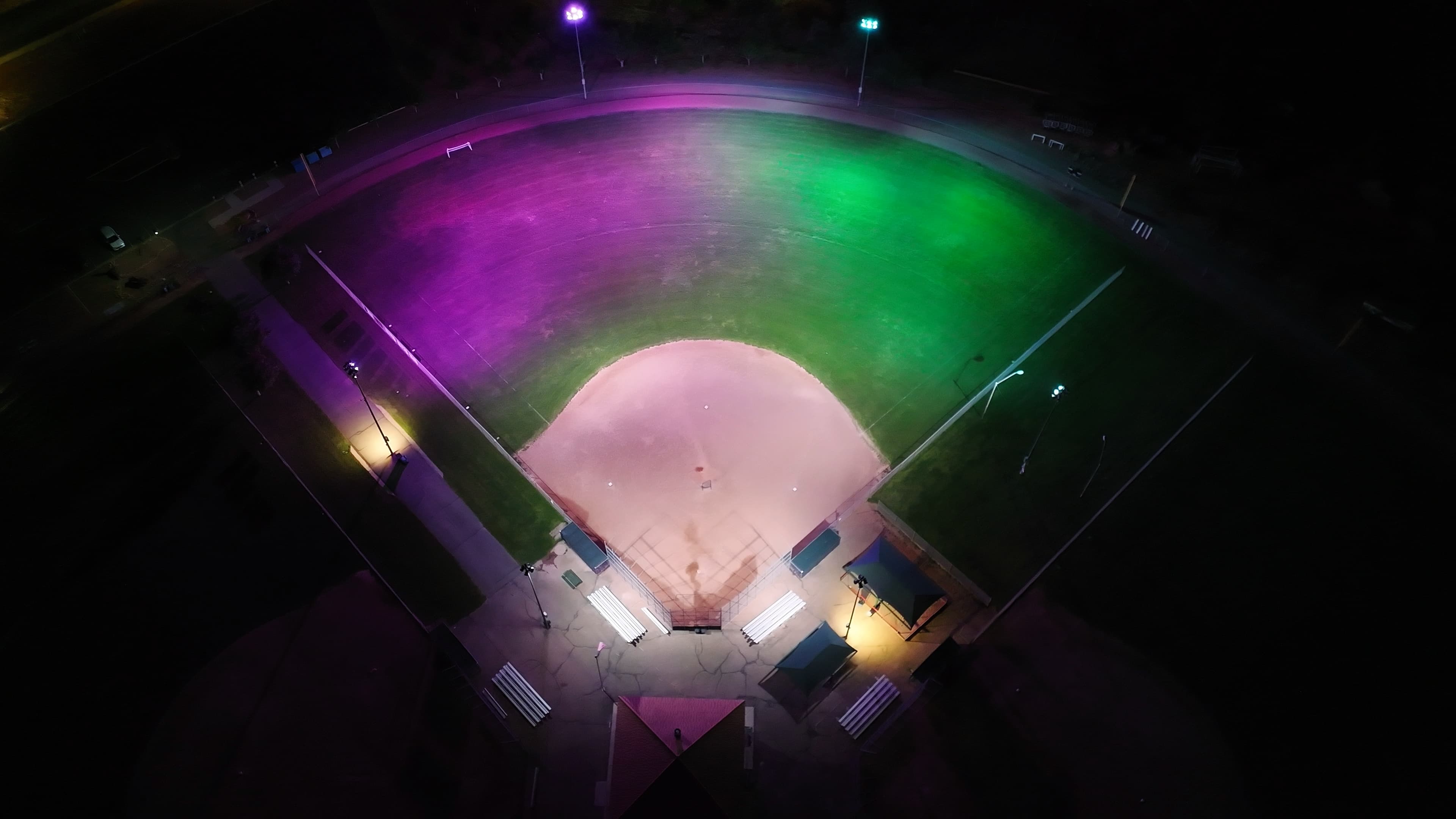
Why Baseball Lighting Deserves More Than a Generic Upgrade
Walk into any well-lit ballpark — whether it's a Little League complex in Moore or a collegiate stadium along the South Canadian River corridor — and you'll notice something immediately: the light just works. There are no shadowy gaps in the outfield, no blinding glare for the center fielder, no dead zones along the warning track. That quality of light doesn't happen by accident. It's the product of deliberate photometric design, sport-specific engineering, and lighting technology that has advanced dramatically over the past decade.
Norman, Oklahoma is a serious baseball and softball market. With a population exceeding 131,000 and the University of Oklahoma anchoring the city's identity, the region supports an exceptionally active athletic culture — from youth recreational leagues in Norman and Edmond to high school programs across the metro, collegiate competition at the Division I level, and semi-professional and amateur organizations that use public and private facilities year-round. As those facilities age and energy costs rise, operators and administrators are increasingly asking a practical question: Is it time to upgrade our lighting, and what does a modern LED system actually deliver?
This article explores what the transition to LED sports lighting really means for baseball and softball facilities in the Norman and Oklahoma City area — technically, financially, and operationally.
The State of Sports Lighting Technology: What's Changed
For decades, metal halide and high-pressure sodium (HPS) fixtures were the standard for outdoor sports fields. They were bright enough, relatively affordable to install, and familiar to contractors and facility managers. But they came with well-documented drawbacks: long warm-up and restrike times, significant energy waste, inconsistent color rendering, and maintenance cycles that required crews to swap out bulbs on poles 60 to 80 feet in the air.
Modern LED sports lighting systems represent a fundamental rethinking of how athletic fields are illuminated — not just a swap of one fixture type for another. Today's leading systems, including those engineered in partnership with manufacturers like Musco Sports Lighting, are designed from the ground up around the specific geometry of a baseball or softball diamond.
Key advances include:
- Precision optical engineering — LED fixtures can be aimed and arrayed to deliver specific foot-candle levels at the plate, in the infield, across the outfield grass, and along the warning track, minimizing spill light and eliminating the uneven "hot spots" and shadowed zones common in older installations
- Dramatically improved color rendering — Modern LEDs produce a Color Rendering Index (CRI) of 80 or above, often reaching 90+, which means players perceive the ball more accurately against the sky and field surface — a meaningful safety and performance benefit
- Instant-on performance — Unlike metal halide systems that require 15–20 minutes to reach full brightness, LEDs operate at full output the moment they're switched on, which matters enormously for rain-delay restarts, broadcast schedules, and late-start youth games
- Smart controls integration — Contemporary LED systems can be connected to automated controls platforms that allow scheduling, remote dimming, zone control, and even smartphone-based management — reducing both energy waste and the operational burden on facility staff
- Energy consumption reductions of 50–70% — Across comparable installations nationwide, LED upgrades routinely cut sports field energy use in half or more, a figure that compounds quickly when fields run 200+ nights per year
For facility managers juggling tight budgets and aging infrastructure, those last two points — controls integration and energy savings — often become the most compelling part of the conversation.
Lessons from the Field: What Real Projects Reveal
One of the most instructive things about LED sports lighting upgrades is how often the results exceed expectations — and how the benefits extend beyond the field itself.
VOSS has completed a range of LED projects across the Norman and Oklahoma City region that illustrate this dynamic clearly. At the University of Oklahoma's warehouse facility in Norman, VOSS replaced a failing high-pressure sodium and fluorescent lighting system in a large multi-room space where conditions had deteriorated to the point that temporary lights were required just to work safely. After removing the obsolete fixtures and upgrading the wiring and conduit to current electrical code, the project delivered remarkably even light distribution throughout the facility and approximately $6,000 per year in energy savings — a result that underscores how older HPS technology quietly bleeds operating budgets over time.
That same principle applies directly to sports lighting. An outdoor baseball complex running metal halide fixtures through a full season of night games carries energy costs that LED technology can cut dramatically — and those savings accumulate year after year, funding other capital improvements.
At The Triangle at Classen Curve in Oklahoma City, a parking lot LED retrofit managed by VOSS eliminated dangerous dark spots that had been generating safety complaints from tenants and shoppers. The redesigned system doubled light levels on the ground, produced immediate positive feedback from the property's users, and delivered an anticipated $14,000 in annual electrical savings with a project ROI of just over one year. The connection to sports facilities is direct: the same principles of photometric design, fixture selection, and results accountability that produced those outcomes apply to athletic field lighting projects.
These local examples reflect a broader national pattern — LED upgrades in high-use, high-visibility facilities consistently deliver measurable financial returns alongside improved user experience.
Baseball Field Lighting Standards: What Governing Bodies Require
One of the most important things to understand about baseball and softball lighting is that it isn't one-size-fits-all. Governing bodies at every level of play — from Little League International and USSSA to the NCAA and Major League Baseball — publish specific illumination standards that fields must meet to host sanctioned competition. Those standards vary significantly by level of play.
A youth recreational field hosting practice and intramural games may require 30–50 foot-candles of maintained horizontal illuminance. A high school varsity field hosting playoff games may need 50–75 foot-candles. A collegiate facility at the NCAA Division I level — like those serving the Norman and Oklahoma City area — will typically require 100 foot-candles or more, with specific uniformity ratios that ensure consistent light across the entire playing surface, not just the infield.
Broadcast facilities introduce additional requirements around vertical illuminance and color temperature to ensure cameras capture clean, true-to-life images under artificial light.
Designing to these standards isn't a matter of simply choosing the brightest fixture available. It requires a photometric study — a detailed computer model of how light will behave on a specific field layout, accounting for pole placement, mounting height, fixture aiming angles, field orientation, and surrounding structures. Getting that design right before the first shovel breaks ground is what separates a professional LED sports lighting installation from a costly mistake.
VOSS brings full-service design capabilities to every baseball and softball project — from initial photometric modeling through permitting, installation, commissioning, and post-installation verification.
The Norman and Oklahoma City Market: A Region Built Around Athletic Culture
Understanding the local market context matters when evaluating a sports lighting project. Norman sits at the heart of a metro area with extraordinary athletic infrastructure density. The greater Oklahoma City region — stretching from Edmond and Yukon in the north and west to Midwest City and Del City in the east, Moore and Mustang to the south — supports hundreds of youth sports leagues, dozens of high school programs, and multiple collegiate and semi-professional organizations, all competing for field time and operating against tight municipal and institutional budgets.
That budget pressure makes the energy efficiency case for LED sports lighting especially compelling here. Oklahoma's energy landscape, while historically favorable in cost terms, still rewards efficiency investment — and facilities that reduce their utility footprint often find additional support through utility rebate programs that can offset a meaningful portion of upfront project costs. For public-sector organizations — including Norman Public Schools, Cleveland County parks systems, and university athletic departments — cooperative purchasing programs can further simplify procurement and accelerate project timelines.
Oklahoma state agencies and eligible public organizations can access VOSS' products and services through an approved Oklahoma state contract, streamlining procurement while ensuring compliance with public purchasing requirements. Cooperative purchasing programs including Sourcewell, BuyBoard, TIPS, AEPA, and Omnia Partners are also available to qualifying school districts, municipalities, and public institutions — removing many of the procurement barriers that can delay important capital improvements.
For the region's parks and recreation departments, school districts, and higher education facilities evaluating sports lighting upgrades, these vehicles represent a practical path to moving forward without the time and administrative burden of a standalone bid process.
Connecting Baseball Lighting to the Broader Lighting Picture
Baseball and softball lighting doesn't exist in isolation. Many of the same facilities that operate baseball complexes also manage tennis courts, pickleball facilities, gymnasiums, parking lots, and interior spaces — all of which may be candidates for LED upgrades on similar timelines. VOSS brings a comprehensive perspective to athletic and recreational facility lighting, connecting field-level sports lighting work to related projects in gymnasium LED solutions, tennis court lighting, pickleball LED lighting, and outdoor area lighting for parking and pedestrian zones.
That integrated approach means facility managers and athletic directors in Norman and across the Oklahoma City metro can work with a single experienced partner across multiple project types — rather than managing separate contractors for each lighting challenge.
For facilities currently navigating aging fluorescent fixtures in interior spaces, it's also worth noting that fluorescent lamp phase-outs are reshaping procurement decisions in ways that make LED transitions more urgent. The LED Gymnasium Lighting Solutions and Fluorescent Tube Bans and LED Lighting Rebates resources in the VOSS Latest Lighting series provide additional context for facilities managing that transition alongside outdoor sports lighting needs.
Service Availability
While VOSS offers a comprehensive suite of national services, specific capabilities may vary by location. Please contact your local branch to confirm the current availability of specific services, technology solutions, or contracting capabilities in your immediate market.
Talk to a Local Expert About Your Baseball Facility
Whether you're managing a Little League complex in Norman, a high school varsity program in Edmond or Moore, a university athletic facility, or a multi-field recreational park serving communities across Cleveland or Oklahoma counties, the starting point for any successful lighting upgrade is a conversation about your specific facility, your operational goals, and what the numbers actually look like for your situation.
VOSS has served the Norman and greater Oklahoma City market for decades, completing projects ranging from industrial retrofits at the University of Oklahoma to outdoor commercial lighting at some of the metro's most visible properties. We bring that same depth of local experience to every baseball and softball lighting engagement.
VOSS — Oklahoma City Branch
Phone: (405) 949-1919 Toll-Free: (800) 735-8677
Reach out to discuss your field, your timeline, and what a professionally engineered LED lighting system could mean for your facility — and the players and fans who depend on it.