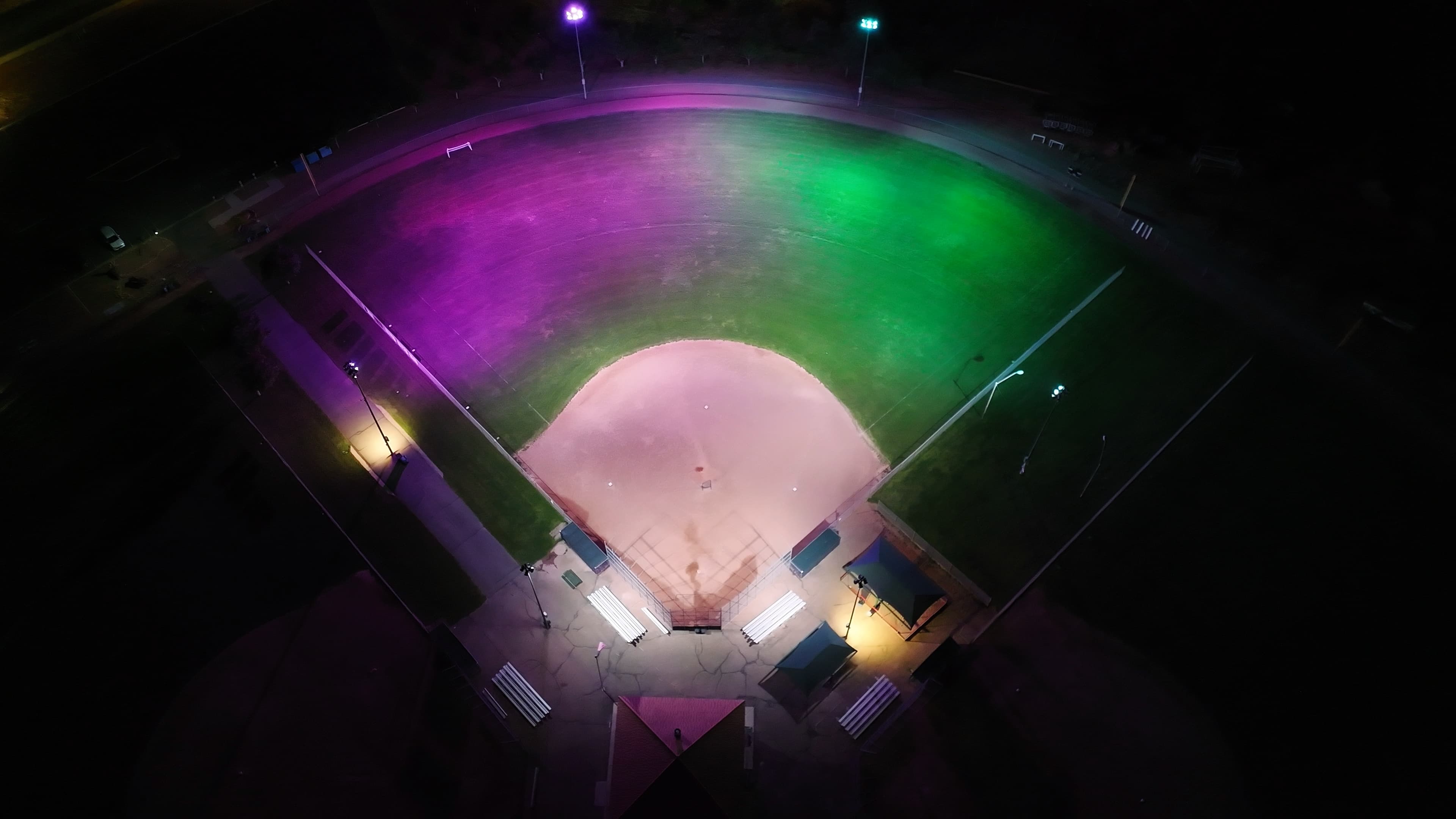
Why Baseball Lighting Matters More Than Most Facility Managers Realize
Baseball is a game of split-second visual judgments. A batter tracking a 90-mph fastball, an outfielder reading a fly ball off the bat, an umpire calling a pitch — all of it depends on lighting that is consistent, glare-free, and precisely distributed across every square foot of the playing surface. Yet across the Greater Oklahoma City area, many baseball and softball facilities — from community parks in Moore and Midwest City to competitive athletic complexes in Norman and Edmond — are still running on aging metal halide or high-pressure sodium systems that fall short of modern performance and efficiency standards.
The conversation around sports field lighting has shifted significantly in recent years. LED technology has matured to the point where it is now the clear standard for new construction and retrofits alike — not just because of energy savings, but because of the measurable improvements it delivers in light quality, controllability, and long-term operational reliability. Understanding what drives a well-executed baseball lighting project is the first step toward making a smart investment for your facility.
The Science Behind High-Performance Baseball Lighting
Unlike a warehouse or parking lot, a baseball field presents a uniquely complex lighting challenge. The playing surface spans a wide range of distances and elevations — from the tight geometry of the infield to the deep corners of the outfield. Pole placement, mounting heights, beam angles, and spill light control all interact with each other in ways that require precise photometric modeling before a single fixture is specified.
Professional lighting design for baseball and softball facilities typically addresses several interdependent variables:
- Uniformity ratios — The ratio of maximum to minimum light levels across the field must stay within tight bounds to prevent "hot spots" and shadowed zones that compromise depth perception
- Maintained foot-candles — League governing bodies, from Little League through NCAA and professional organizations, publish specific illuminance requirements based on competition level; a recreational field and a televised stadium have very different targets
- Vertical illuminance — Often overlooked, vertical light levels determine how well players and cameras can track a ball in flight against the sky, especially under broadcast conditions
- Glare control — Poorly aimed or improperly shielded fixtures create dangerous glare for batters and fielders; modern LED optics, combined with careful aiming strategies, dramatically reduce this risk
- Spill and obtrusive light — Especially important for fields in residential neighborhoods across Moore, Yukon, and Mustang, where minimizing light trespass onto adjacent properties is both a community courtesy and often a code requirement
Modern LED sports lighting systems address all of these variables with a level of precision that older technologies simply cannot match. Optical control in today's LED fixtures allows designers to target light exactly where it is needed — and keep it away from where it is not.
Energy and Operational Impact: What Oklahoma Facilities Are Discovering
For facility managers and parks administrators across the Greater Oklahoma City area, the business case for LED baseball lighting has become increasingly straightforward. Traditional metal halide systems — still common on fields across Moore, Del City, and Choctaw — are energy-intensive, slow to reach full brightness, and demand significant ongoing maintenance as lamps age, ballasts fail, and light output degrades over time.
LED systems change that calculus in several important ways:
- Dramatically lower energy consumption — LED fixtures use a fraction of the wattage of equivalent metal halide systems, translating directly to lower utility bills for every game night, practice session, and tournament weekend
- Instant-on performance — Unlike metal halide lamps that require a 15- to 20-minute warm-up period, LED systems reach full brightness immediately — a practical advantage for rain delays, late-starting games, and facilities that want to reduce pre-game startup windows
- Longer service life — Quality LED sports lighting systems are rated for tens of thousands of hours of operation, compared to the much shorter replacement cycles of conventional lamps — reducing maintenance labor and the safety risks associated with working at height on tall sports lighting poles
- Intelligent controls compatibility — LED systems integrate naturally with lighting controls platforms, enabling programmable scenes for practice versus game play, remote operation via smartphone or building management system, and dimming capability that can extend lamp life further
Our team has seen firsthand in the Oklahoma City market how the combination of energy savings and reduced maintenance overhead can meaningfully shift the financial picture for parks departments, school athletic programs, and private club facilities. The VOSS project at The Triangle at Classen Curve in Oklahoma City — a commercial parking lot retrofit — demonstrated what thoughtful LED design can accomplish: light levels were doubled, dark spots were eliminated, and the facility's general manager reported an anticipated annual electrical savings of $14,000 with a return on investment of just over one year. While a parking lot is a different application than a baseball field, the underlying principle is identical: right-sized LED technology, precisely designed, delivers results that older systems cannot.
From Little League to Competitive Play: Designing for Every Level
One of the most important points for facility decision-makers to understand is that not all baseball lighting projects — or all baseball lighting contractors — are the same. A recreational youth field in a Moore city park has different design requirements than a high school varsity stadium in Norman, which in turn is different from a collegiate or semi-professional facility. Getting this right requires both technical expertise and familiarity with the governing standards that apply at each level.
VOSS approaches every project with an engineered design process that begins with understanding how the facility will actually be used:
- Recreational and youth fields — Typically designed to Little League or local parks department standards, with an emphasis on adequate, uniform illumination at a cost structure that fits public recreation budgets
- High school and collegiate facilities — Must meet NFHS, NCAA, or conference-specific illuminance requirements; often involve more sophisticated pole configurations and may need to accommodate broadcast or streaming capabilities
- Tournament and showcase venues — Require the highest levels of uniformity and vertical illuminance, often with controls systems that allow rapid scene changes between field and broadcast modes
- Multi-sport or shared-use facilities — Common across the Greater Oklahoma City area, where a single field may serve baseball, softball, and other sports across different seasons
The communities of Moore, Tuttle, Blanchard, and Newcastle — along with the broader metro area stretching from Edmond in the north to Chickasha in the south — represent a diverse range of facility types and ownership structures, from municipal parks departments to school districts to private athletic organizations. VOSS has the depth of experience to serve all of them with appropriately scaled solutions.
A Proof Point from the Region: The Page, AZ Baseball Lighting Project
VOSS has applied its sports lighting expertise to baseball and softball projects at multiple scales. One example from our national project portfolio is the baseball lighting work completed for the City of Page, Arizona — a community-scale facility that required a ground-up approach to pole placement, photometric design, and fixture selection to meet recreational league standards while achieving meaningful energy efficiency targets. Projects like this reflect the kind of methodical, engineered approach that VOSS brings to every sports lighting engagement, regardless of facility size or market.
For Oklahoma-area clients, our team combines that national sports lighting experience with deep familiarity with the local market — including knowledge of how Oklahoma's climate, from summer heat to severe weather events, affects fixture selection, structural requirements, and long-term system reliability.
Public Sector and Institutional Buyers: Procurement Made Straightforward
For municipalities, school districts, and other public entities across the Greater Oklahoma City area — including the City of Moore, Moore Public Schools, and Oklahoma state agencies — VOSS holds an approved Oklahoma state contract, streamlining the procurement process and ensuring compliance with public purchasing requirements. Eligible organizations can also access VOSS products and services through a range of cooperative purchasing programs, including Sourcewell, BuyBoard, TIPS, Omnia Partners, and AEPA, among others. These vehicles allow public-sector buyers to move efficiently from project planning to award without the delays of a standalone bid process — an important practical advantage for parks departments and school athletic programs working within defined budget cycles.
Looking at the Broader Sports Lighting Picture
Baseball and softball lighting is one piece of a larger conversation about how athletic and recreational facilities across Moore and the Greater Oklahoma City region are modernizing their infrastructure. If your organization is also evaluating lighting for indoor gymnasiums, tennis courts, or pickleball facilities, VOSS has developed content specifically addressing those applications — including LED gymnasium lighting solutions and pickleball LED lighting considerations — as part of our broader Latest Lighting resource series. For outdoor facilities, our coverage of parking lot and outdoor LED lighting upgrades and commercial LED outdoor lighting provides additional context for comprehensive campus-level planning.
Service Availability
While VOSS offers a comprehensive suite of national services, specific capabilities may vary by location. Please contact your local branch to confirm the current availability of specific services, technology solutions, or contracting capabilities in your immediate market.
Talk to VOSS About Your Baseball Lighting Project
Whether you are managing a youth recreational complex, a high school varsity facility, or a multi-field tournament venue in Moore, Midwest City, Norman, Edmond, or anywhere across the Greater Oklahoma City area, VOSS is ready to help you think through your options — from initial photometric design to installation, controls integration, and long-term support. We invite you to start with a conversation about what your facility needs and what outcomes matter most to you.
VOSS — Oklahoma City Branch
Phone: (405) 949-1919 Toll-Free: (800) 735-8677