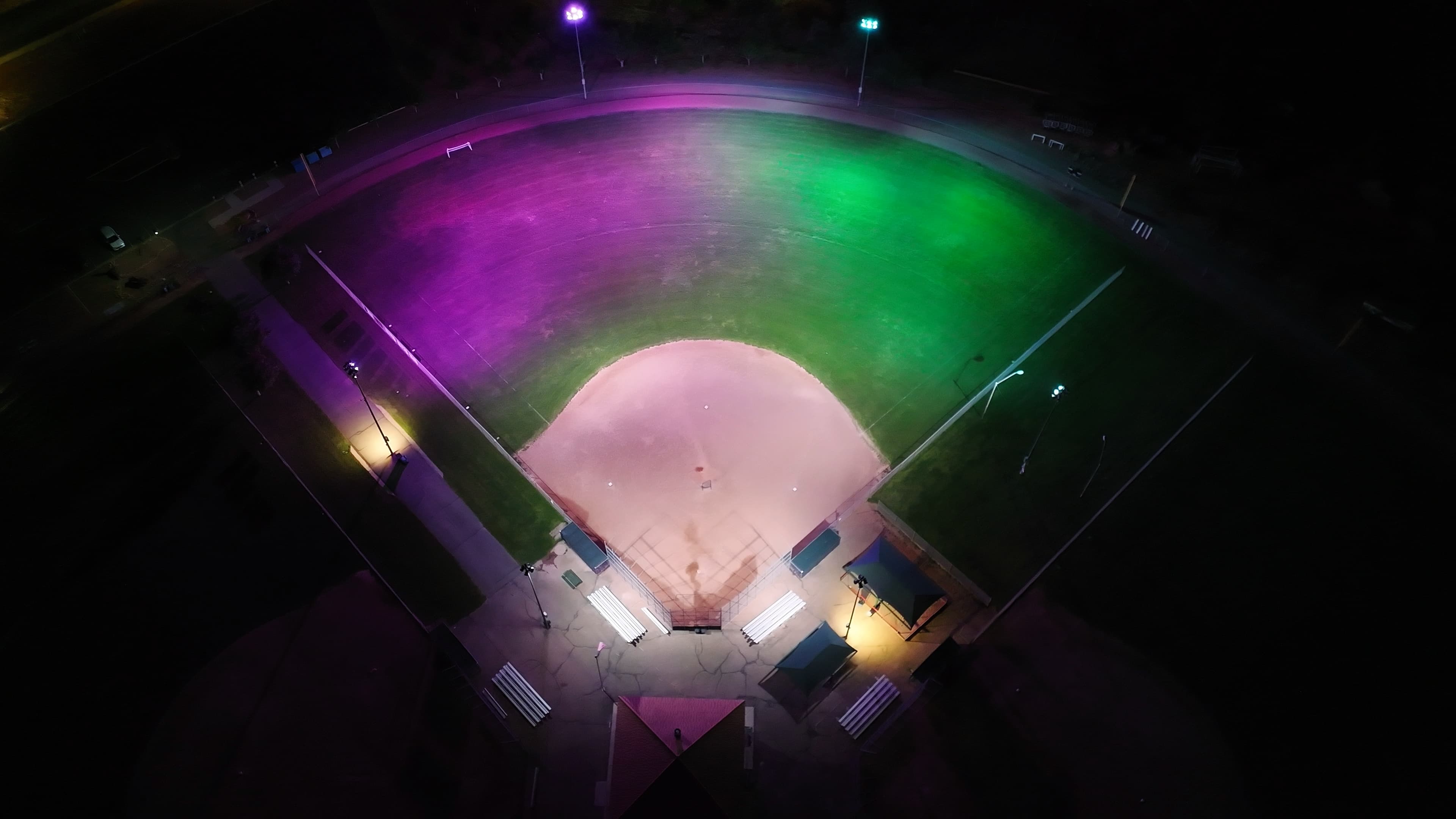
Why Baseball Lighting Is Having a Moment in Oklahoma City
Oklahoma City's sports culture runs deep. From the youth travel ball programs in Edmond, Yukon, and Moore to the competitive high school diamond programs in Mustang, Midwest City, and Norman, baseball and softball are woven into the fabric of life across the metro. And as the region continues to grow — OKC consistently ranks among the fastest-developing metros in the South-Central United States — the demand for well-lit, well-maintained athletic facilities has never been greater.
That growth is driving a quiet but significant transformation across Oklahoma's recreational and competitive sports infrastructure: the widespread shift from aging metal halide and high-pressure sodium field lighting to modern, purpose-built LED systems. For facility managers, parks and recreation directors, athletic directors, and venue operators, understanding why this shift is happening — and what it means for their specific facility — is becoming an increasingly important part of the job.
This article explores the trends, technology, and real-world considerations shaping baseball and softball LED lighting in the Greater Oklahoma City market today.
The Problem with Legacy Sports Lighting — and Why It Matters Now
Across the Oklahoma City metro, a large number of baseball and softball facilities are still running lighting systems that were installed 15 to 25 years ago. These systems — typically metal halide or high-pressure sodium (HPS) fixtures — were the industry standard for decades, and many are still technically functional. But "functional" and "optimal" are very different things.
Here's what facility operators and league administrators are increasingly grappling with:
- Uneven light distribution — Older pole configurations and fixture designs frequently produce inconsistent footcandle levels across the infield, outfield, and warning track. Batters deal with shadows and contrast issues; outfielders lose fly balls in poorly lit gaps.
- Significant warm-up and restrike delays — Metal halide fixtures can take five to ten minutes to reach full brightness, and if power is interrupted mid-game, they require a lengthy cool-down period before they can be restarted. For night games, rain delays, or broadcast events, this is a real operational liability.
- Rising energy and maintenance costs — Older fixtures are energy-intensive, and the lamps themselves degrade over time, requiring increasingly frequent replacement. Across a multi-field complex, this adds up to meaningful operating expense year after year.
- Compliance gaps — Governing bodies for youth leagues, high school athletics (OSSAA), collegiate programs (NCAA), and professional play have established specific illumination standards measured in footcandles and uniformity ratios. Aging systems that were once compliant may no longer meet current benchmarks.
For parks and recreation departments across communities like Del City, Bethany, Choctaw, and Tuttle, these challenges are compounded by tight municipal budgets and limited in-house technical resources. The good news is that modern LED technology addresses all of these pain points simultaneously — and often at a total cost of ownership that makes the business case compelling even before energy incentives are factored in.
What Modern Baseball LED Lighting Actually Looks Like
LED sports lighting has evolved dramatically over the past decade. Today's purpose-built systems for baseball and softball are a far cry from simply swapping out old bulbs for LED equivalents. A well-engineered sports lighting solution involves a holistic design process rooted in photometric science — the study of how light behaves across a three-dimensional playing surface.
Photometric Design and Pole Placement
Before a single fixture is specified, a qualified lighting designer models the entire playing field using specialized photometric software. This process accounts for pole height, pole placement, mounting angles, fixture aiming, beam spread, and the specific dimensions of the field. The goal is to achieve target footcandle levels at every point on the playing surface — infield, outfield, dugout areas, and warning track — while meeting required uniformity ratios that ensure no player is at a disadvantage based on where they're positioned on the field.
For a regulation youth field in a community like Edmond or Norman, this might mean fewer poles at optimized heights. For a collegiate or professional venue, it means a far more complex design with multiple mounting points, aiming configurations, and potential broadcast lighting requirements. The photometric model is the blueprint, and getting it right at the design stage is what separates a great result from a mediocre one.
Glare Control and Spill Management
One of the most underappreciated aspects of sports lighting design is controlling where light goes that you don't want illuminated. Poorly aimed or poorly shielded fixtures create glare for batters and fielders, wash light into neighboring residential areas, and produce sky glow that can draw community complaints. Modern LED optics and housing designs allow for precise beam control, dramatically reducing spill and glare compared to older broad-beam metal halide systems.
In a metro like Oklahoma City, where baseball complexes often sit near residential neighborhoods in communities like Nichols Hills, Warr Acres, or The Village, thoughtful spill management is both a courtesy to neighbors and a practical way to avoid future complaints or ordinance issues.
Lighting Controls and Smart Systems Integration
Modern LED sports lighting doesn't have to operate as a simple on/off system. Today's installations increasingly integrate with programmable controls platforms that allow facility managers to:
- Set scene-based lighting levels for practice versus game versus broadcast
- Schedule automatic on/off times to eliminate the cost of lights left running unnecessarily
- Monitor energy consumption and system performance remotely
- Dim fields progressively at the end of events to manage crowd flow
For multi-field complexes operated by municipalities or school districts, these controls capabilities can translate into meaningful operational savings and a measurably better experience for players, officials, and spectators.
Our related article on LED Football Stadium Lights & Sports Field Lighting Solutions explores controls integration in greater depth for multi-sport venues.
A Proof Point from the Region: Page, Arizona
VOSS has delivered baseball and softball LED lighting projects at multiple scales, and our work in Page, Arizona provides a relevant illustration of what a well-executed project looks like in practice. The Page project involved designing and installing a complete LED lighting system for a baseball facility — replacing the legacy system with a purpose-built LED solution engineered to meet sport-specific footcandle and uniformity standards.
The results reflected what well-executed LED sports lighting consistently delivers: dramatically improved light quality across the playing surface, reduced energy consumption compared to the prior system, and a facility that could host competitive play with confidence in the integrity of the lighting environment.
While Page is a smaller community in a very different geography from Oklahoma City, the design and engineering disciplines that drove that project's success are directly applicable to baseball facilities across the OKC metro — from a four-plex youth complex in Mustang to a high school varsity field in Piedmont.
Oklahoma City's Unique Market Context
Several factors make the Greater Oklahoma City market a particularly active one for sports lighting investment right now.
A Growing Youth Sports Economy
The OKC metro has seen sustained population growth, and with it, expanding youth sports participation. Communities like Edmond, Moore, Yukon, and Midwest City have invested significantly in recreational infrastructure to serve growing families. As those facilities age, lighting upgrades represent one of the highest-impact improvements an organization can make — both for safety and for the quality of the experience they're offering families.
University and Collegiate Demand
The University of Oklahoma in Norman, Oklahoma City University, and other collegiate programs in the metro have ongoing capital needs for athletic facilities. VOSS has an established track record working with OU — our University of Oklahoma Warehouse LED Retrofit in Norman demonstrated the energy savings and lighting quality improvements that LED technology delivers in demanding institutional environments. That same institutional knowledge applies directly to collegiate athletic facility projects.
Local Proof of LED Performance
Our work in Oklahoma City has consistently demonstrated that LED technology delivers on its promises in this market. At The Triangle at Classen Curve, a parking lot LED retrofit eliminated dangerous dark spots and delivered a projected annual electrical savings of approximately $14,000 with a ROI of just over one year — a result that General Manager Shane McWhorter called "nothing short of outstanding." While that project is commercial rather than athletic in nature, it illustrates how LED-engineered lighting design transforms real-world environments across the OKC metro.
Public Sector Opportunity
For parks and recreation departments, school districts, and public athletic facilities across Oklahoma, procurement doesn't have to be a barrier to upgrading. VOSS holds an approved state contract in Oklahoma, meaning eligible government agencies can access VOSS products and services through a streamlined procurement process. Additionally, VOSS participates in cooperative purchasing programs including Sourcewell, BuyBoard, TIPS, AEPA, Omnia Partners, and PACE, giving public-sector organizations efficient, compliant pathways to fund and execute lighting improvement projects.
Standards, Compliance, and Why Getting It Right Matters
Baseball and softball lighting is governed by a layered set of standards depending on the level of play and the governing body involved. Little League Baseball, OSSAA, the NCAA, and Major League Baseball each maintain illumination guidelines that specify minimum footcandle levels and uniformity ratios appropriate for the competitive level. Getting the design right isn't just about aesthetics — it's about compliance, player safety, and in some cases, the ability to host sanctioned events at all.
A youth recreation complex in Choctaw or Newcastle that wants to attract travel tournaments needs to meet the footcandle thresholds that tournament organizers require. A high school program in Guthrie or Yukon that's hoping to host playoff games needs to satisfy OSSAA standards. A collegiate program that wants to broadcast games — even at a regional streaming level — needs to address vertical illuminance requirements that affect how cameras see the field.
This is why photometric design expertise matters so much. A lighting contractor who simply installs fixtures without a rigorous design process may deliver a system that looks fine to the naked eye but fails to meet governing body standards when measured with a calibrated light meter.
For facility decision-makers, the practical takeaway is straightforward: insist on a photometric design that documents predicted footcandle levels and uniformity ratios before any equipment is ordered, and confirm that the contractor has experience meeting the specific standards applicable to your level of play.
Looking Ahead: The Future of Athletic Lighting in Oklahoma
The trajectory of sports lighting technology points toward continued convergence with broader smart building and smart campus systems. Wireless controls, IoT-enabled monitoring, integration with reservation and facility management software — these capabilities are becoming increasingly accessible even for community-level facilities, not just professional venues.
For Greater Oklahoma City, a market that has made meaningful public investment in parks, recreation, and athletic infrastructure, the next wave of sports lighting projects will likely emphasize not just energy savings, but operational intelligence: the ability to manage a complex with multiple fields, multiple user groups, and dynamic scheduling demands from a single platform.
VOSS is closely watching — and actively working within — these developments. Our related content on Pickleball LED Lighting Solutions and Tennis Court Lighting and Energy Solutions reflects our broader expertise across the sports lighting spectrum, and our work in LED Gymnasium Lighting Solutions demonstrates our experience with the controls and commissioning demands of competitive athletic environments.
Service Availability
While VOSS offers a comprehensive suite of national services, specific capabilities may vary by location. Please contact your local branch to confirm the current availability of specific services, technology solutions, or contracting capabilities in your immediate market.
Talk to VOSS About Your Baseball Facility in Greater Oklahoma City
Whether you're a parks director in Edmond evaluating options for a multi-field youth complex, an athletic director at a Midwest City high school planning a field upgrade, or a private venue operator in the metro looking to improve the quality of your facility, VOSS is ready to have an informed, no-pressure conversation about what modern LED sports lighting can do for your project.
Our Oklahoma City team brings local market knowledge, deep sports lighting design expertise, and the full resources of an 85-year-old national electrical contractor to every project — at any scale.
VOSS — Oklahoma City Branch Phone: (405) 949-1919 Toll-Free: (800) 735-8677
Reach out to schedule a consultation with our local lighting specialists. We'll start with your facility's current conditions and goals, and work toward a design approach that's right for your level of play, your budget, and your community.