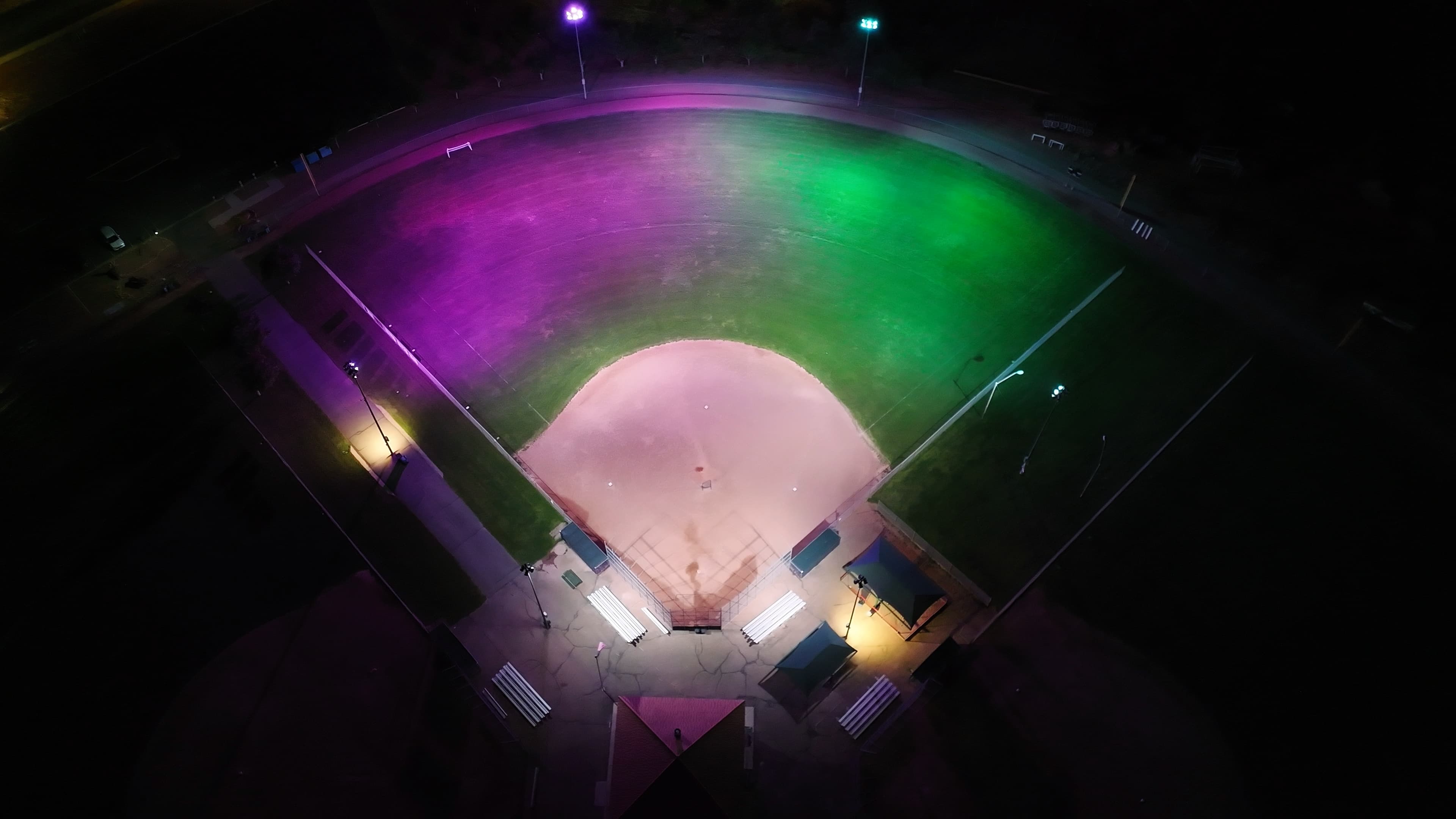
Why Baseball Lighting Deserves More Than a Generic Fixture Swap
When the sun sets over Edmond's athletic fields and the infield lights come on, what happens next matters more than most people realize. Lighting quality directly affects how well a batter picks up a curveball, how confidently an outfielder reads a fly ball off the track, and whether parents in the stands can comfortably follow the game. For the growing, sports-active community of Edmond — a city of nearly 99,000 people in the heart of the Greater Oklahoma City metro — baseball and softball facilities are a genuine community asset, and they deserve lighting that performs at the highest level.
Across the country, facility managers, parks and recreation directors, and athletic program administrators are accelerating the transition from aging metal halide and high-pressure sodium (HPS) systems to modern LED technology. The reasons go well beyond energy savings, though those are significant. This shift is fundamentally about performance — better visibility, smarter controls, lower long-term costs, and fields that work as hard as the athletes who use them. For Edmond and surrounding communities like Yukon, Mustang, Deer Creek, and Guthrie, understanding what drives a successful baseball lighting project is the first step toward making a sound, long-lasting investment.
The Science Behind Sport-Specific Baseball Lighting
Not every LED fixture belongs on a baseball field. Baseball and softball present lighting challenges that are unique among sports venues — and getting the design wrong can actually create worse playing conditions than the outdated system it replaced.
Vertical illuminance matters as much as horizontal illuminance. A baseball in flight travels through a three-dimensional space. Lighting systems must illuminate not just the ground plane, but the vertical plane — the arc of a pitch, the trajectory of a line drive, the height of a pop fly. Systems designed without proper attention to vertical illuminance can leave critical zones shadowed, creating visibility gaps that affect player safety and performance.
Glare control is non-negotiable. Batters, catchers, and outfielders all look upward as part of normal gameplay. Excessive glare from poorly aimed or unshielded fixtures can impair vision at precisely the wrong moment. Modern LED systems use precision optical engineering — specifically designed beam angles, full cutoff housings, and anti-glare lenses — to deliver the light where it's needed while protecting players' sight lines.
Uniformity ratios define consistency. The ratio between the brightest and darkest points on a playing surface (uniformity ratio) is a key metric for any sports lighting design. Industry standards set by governing bodies including the Illuminating Engineering Society (IES) and individual leagues define minimum uniformity requirements for different levels of play. A well-engineered LED system meets or exceeds these benchmarks consistently — something aging HPS and metal halide systems rarely do as they age and degrade.
Pole placement and mounting height are engineered decisions. The number of poles, their locations around the field, and the mounting height of fixtures all interact to determine light distribution. These variables must be modeled through photometric analysis before a single pole goes in the ground. Retrofitting fixtures onto existing poles without this analysis is a common — and costly — mistake.
For Edmond's parks system and private athletic facilities, partnering with a contractor who brings photometric design expertise to the table — not just installation muscle — is the difference between a field that performs and one that disappoints.
What LED Technology Delivers for Edmond Athletic Facilities
The practical benefits of a well-executed LED upgrade extend across every stakeholder group — from the parks director managing a budget to the Little Leaguer taking the field on a Tuesday night.
Dramatic energy efficiency. LED sports lighting systems typically consume 50–70% less energy than equivalent metal halide or HPS installations. For a facility running multiple fields several nights per week across a full spring and summer season, that reduction compounds into meaningful annual savings. Oklahoma's energy market and utility rate structures make this especially relevant for publicly operated parks facilities in Edmond and throughout Oklahoma County.
Instant-on performance and controls integration. Unlike metal halide systems that require 15–20 minutes to reach full brightness and cannot be restarted immediately after shutoff, LED fixtures reach full output the moment power is applied. This has real operational value — for rain delays, late-arriving teams, or broadcast schedules at higher-level facilities. When paired with intelligent lighting controls, fields can be programmed, dimmed, or shut down remotely, reducing both energy waste and after-hours operating costs.
Extended service life and reduced maintenance. Traditional metal halide lamps in sports applications may last 6,000–10,000 hours before requiring replacement — and they degrade significantly in output well before they burn out completely. Quality LED systems are rated for 50,000 to 100,000+ hours of service with minimal lumen depreciation. For a parks department managing dozens of facilities across Edmond and the broader metro area, the reduction in lamp replacement labor and equipment costs is a genuine operational benefit.
Improved broadcast and video quality. Even at the recreational and scholastic level, game video has become a standard part of player development. LED systems with high Color Rendering Index (CRI) ratings — typically 70+ for recreational fields and 90+ for competitive venues — produce colors that appear natural and vibrant on camera. Flicker-free LED technology, designed around high-frequency drivers, eliminates the stroboscopic effect that older lighting creates in slow-motion video.
VOSS' work across the Greater Oklahoma City region illustrates the real-world impact of thoughtful LED design. Our LED retrofit at The Triangle at Classen Curve in Oklahoma City, for example, demonstrated how proper photometric planning can double light levels, eliminate dark spots, and deliver a return on investment in just over one year — with measurable improvement in the experience of everyone using the space after dark. While that project was a commercial parking environment, the underlying principles — uniform coverage, elimination of underlit zones, and stakeholder confidence in the result — apply directly to athletic field environments where visibility and safety are equally critical.
Levels of Play, Levels of Design: From Youth Leagues to Competitive Venues
One of the most important things to understand about baseball and softball lighting is that standards vary meaningfully by level of play — and a design that meets recreational league requirements will not satisfy the standards of a high school varsity program or a collegiate facility. VOSS designs to the appropriate standard for each project.
Recreational and youth fields (Little League, municipal parks, youth travel ball) require lower minimum maintained illuminance levels but still demand good uniformity and glare control. These are often the fields where LED upgrades deliver the most dramatic visible improvement, because the existing systems tend to be oldest and most degraded.
High school and scholastic facilities in communities like Edmond, Deer Creek, and Yukon are governed by both state athletic association guidelines and individual school district standards. Many of these facilities are also used for community programs outside school hours, making energy efficiency and controls integration especially valuable for the facilities teams responsible for managing operating costs.
Collegiate and competitive travel facilities demand the highest illuminance levels and uniformity ratios, often with television-grade lighting requirements and the ability to integrate with broadcast infrastructure. These projects require the most rigorous photometric modeling and the most precise fixture selection and placement.
VOSS brings demonstrated experience across all of these levels. Our Page, AZ baseball case study — a project executed for a baseball facility requiring professional-grade precision — reflects our capability to deliver at the highest level of complexity and performance. That same engineering discipline informs every project we take on, regardless of scale.
For facility managers and athletics directors in Edmond considering an upgrade, the starting point is always a professional photometric design — a light study that models the existing conditions, identifies deficiencies, and establishes a recommended system that meets the appropriate standard for the level of play hosted at that venue.
A Practical Note for Public Facilities and Schools in Edmond
For parks departments, school districts, and other public-sector organizations in Edmond and across Oklahoma, procurement pathways matter. VOSS holds an approved state contract in Oklahoma, enabling eligible state agencies and public institutions to access our products and services through established channels — streamlining the procurement process and reducing administrative burden.
Additionally, VOSS participates in a number of cooperative purchasing programs available to qualifying public and nonprofit organizations, including Sourcewell, BuyBoard, TIPS, AEPA, Omnia Partners, PACE, and others. For school districts considering athletic field lighting upgrades — a significant capital investment — these cooperative contracts can significantly simplify the path from project concept to construction.
Parks and recreation departments evaluating multi-field upgrades across Edmond's growing residential base should also explore available utility incentive and rebate programs. Energy efficiency upgrades to sports lighting systems can qualify for meaningful rebate support, and VOSS has deep experience navigating those programs on behalf of our clients throughout Oklahoma. Our Latest Lighting section includes dedicated resources on LED lighting rebates and energy audits, incentives, and rebate navigation for businesses — useful background reading for any organization evaluating the financial case for an upgrade.
Related Topics in This Series
If your organization manages a broader portfolio of athletic and recreational facilities, you may find value in exploring other articles in this Latest Lighting series. We've covered LED lighting solutions for gymnasium environments, pickleball courts, tennis courts, and LED football stadium lights and sports field lighting solutions — each addressing the specific design standards and operational considerations unique to those venues. The considerations that make baseball lighting a specialized discipline apply across the entire spectrum of outdoor and indoor sports facilities.
Service Availability
While VOSS offers a comprehensive suite of national services, specific capabilities may vary by location. Please contact your local branch to confirm the current availability of specific services, technology solutions, or contracting capabilities in your immediate market.
Talk to Your Local VOSS Team in Oklahoma City
Edmond's growth as a community — and the expanding network of athletic facilities that growth has driven — makes this an ideal moment to evaluate whether your baseball and softball fields are equipped to meet the demands of today's players, programs, and fans. Whether you manage a single community park field or a multi-diamond athletic complex serving thousands of participants each season, VOSS has the expertise, the engineering discipline, and the local presence to help you make the right decisions.
We invite you to connect with our Oklahoma City branch team for a consultative conversation about your facility's specific needs — no obligation, just informed guidance from professionals who understand the region.
VOSS — Oklahoma City Branch
Phone: (405) 949-1919 Toll-Free: (800) 735-8677