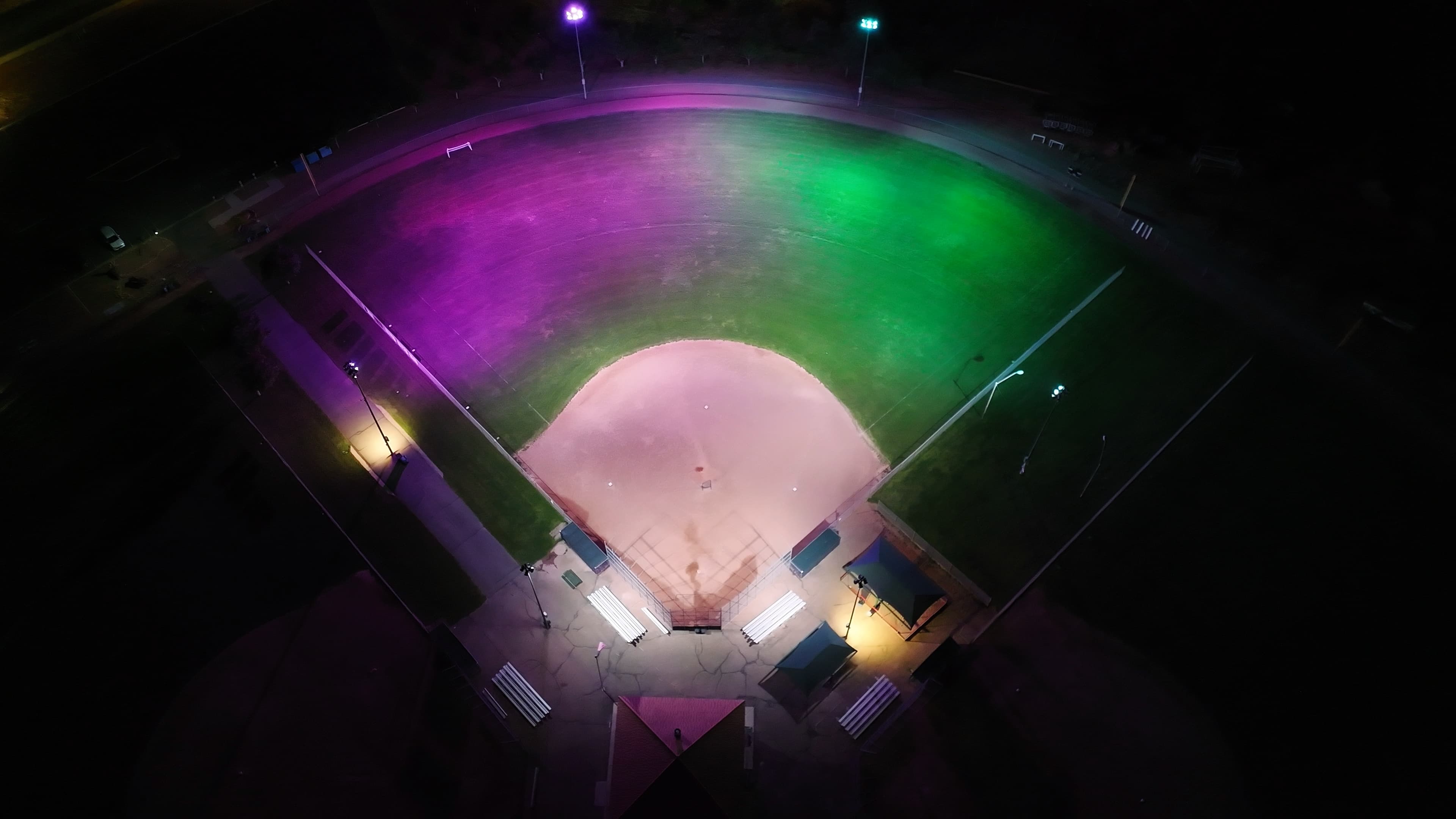
Why Broken Arrow's Baseball Facilities Are Rethinking Their Lighting
Broken Arrow is one of Oklahoma's fastest-growing cities — a community of more than 123,000 people with a robust parks system, active youth athletics programs, and a deep tradition of competitive baseball and softball. From the recreational leagues that fill Rose District-area parks on summer evenings to high school programs that draw regional scouts and prime-time crowds, field lighting has become a strategic priority for facility managers, parks directors, and athletic administrators across the area.
Across the broader Tulsa metropolitan region — including neighboring communities like Owasso, Bixby, Jenks, and Sand Springs — aging metal halide and high-pressure sodium (HPS) field lighting systems are reaching the end of their useful lives. Facility operators are discovering that the cost of maintaining these systems now rivals — or exceeds — the investment required to upgrade to modern LED technology. The question is no longer whether to make the switch; it's about making the switch correctly.
This article explores what today's best-in-class baseball LED lighting looks like, why the standards matter, and how organizations in Broken Arrow and across northeastern Oklahoma are approaching these projects strategically.
What Makes Baseball Lighting Uniquely Demanding
Not all sports lighting challenges are equal. Baseball and softball fields present one of the most technically complex lighting environments in athletics — and understanding why helps facility leaders make better decisions.
Unlike a rectangular court or a football field, a baseball diamond combines a precision infield with a wide, sweeping outfield that extends 300 to 400 feet in multiple directions. Players must track a 90-mph fastball against a backdrop of lights, stands, and sky — meaning glare control is not just a comfort issue, it's a safety and performance issue. Outfielders and infielders alike depend on consistent, shadow-free illumination to judge fly balls accurately.
Key design variables that define a quality baseball lighting project include:
- Maintained foot-candles (fc): Industry standards from organizations like the Illuminating Engineering Society (IES) and the NCAA define minimum horizontal and vertical illuminance levels for each class of play — from recreational leagues to televised collegiate or professional games
- Uniformity ratios: The ratio between the brightest and darkest areas of the field must stay within defined limits to prevent visual "hot spots" or dangerous shadow zones
- Glare control: Proper fixture selection, aiming angles, and shielding prevent light from entering batters' sight lines or blinding outfielders on pop-ups
- Spill and obtrusive light: Responsible design limits light trespass into neighboring residential areas — a growing concern in Broken Arrow's expanding suburban landscape
- Vertical illuminance: Television broadcasting and high-level competition require adequate vertical light on the ball in flight, not just on the ground plane
Traditional metal halide systems were designed with these concerns in mind, but modern LED technology addresses them far more precisely — and far more efficiently.
The LED Difference: Performance, Efficiency, and Control
The shift to LED in sports lighting has accelerated dramatically over the past decade. Today's LED fixtures for athletic fields are purpose-engineered products — not commercial area lights adapted for outdoor use — and the performance gap between legacy technology and modern LED systems is significant.
Energy efficiency is the headline benefit most facility operators recognize immediately. LED systems for baseball fields typically consume 40–60% less energy than equivalent metal halide installations, depending on the age and condition of the existing system. For a facility running night games across a full spring and summer season, the annual energy savings are material — and in Oklahoma, where utility rates and demand charges can fluctuate, right-sizing a system through photometric design protects against unnecessary operating costs.
Controllability is where modern LED systems truly separate themselves from older technology. Metal halide fixtures require 15–20 minutes to warm up to full output and cannot be dimmed without color-shifting or premature burnout. LED systems reach full brightness instantly — a critical feature for facilities managing rain delays, broadcast schedules, or youth game rescheduling. Advanced control systems can create programmable scenes for practice, game, and event modes; integrate with facility automation platforms; and even enable remote monitoring and adjustment from a smartphone or building management system.
Lamp life and maintenance represent a quieter but equally important advantage. Metal halide lamps typically require replacement every 5,000–10,000 hours. Premium LED fixtures are rated for 50,000–100,000+ hours of operation, dramatically reducing the frequency and cost of re-lamping — a meaningful benefit for parks departments and athletic programs managing constrained maintenance budgets.
VOSS has seen this lifecycle cost advantage play out in markets across Oklahoma and the broader region. Our LED retrofit work at the University of Oklahoma's Norman campus warehouse, for example, delivered approximately $6,000 per year in energy savings by replacing obsolete high-pressure sodium and fluorescent fixtures — and that's in an industrial interior environment. The savings potential on an open-air multi-field athletic complex with significant nighttime operating hours can be even more compelling.
Design Precision: The Foundation of Every Successful Project
The most important thing facility managers and parks directors should understand about a baseball lighting project is this: the quality of the design is what determines the quality of the outcome. Purchasing high-performance fixtures and installing them incorrectly produces poor results. Excellent design, by contrast, unlocks the full value of the investment.
A rigorous design process for a baseball or softball field includes:
- Field survey and existing system assessment — documenting pole locations, heights, fixture conditions, electrical infrastructure, and current light levels
- Photometric modeling — using specialized software to simulate foot-candle distribution, uniformity ratios, and glare indices across the entire playing surface before a single fixture is ordered
- Standard compliance review — confirming that the proposed design meets IES, NCAA, or governing body requirements for the intended class of play
- Electrical load analysis — ensuring the facility's existing electrical service can support the new system, or identifying necessary upgrades
- Controls integration planning — designing dimming, scheduling, and remote management capabilities that align with how the facility actually operates
This is the approach VOSS brings to every project — and it's the approach that has earned us a reputation as a trusted partner for organizations that can't afford to get it wrong. Our work on baseball facilities has informed how we approach every phase of design, from the photometric model through commissioning and staff training on control systems.
Broken Arrow parks and recreation administrators, Broken Arrow Public Schools athletic directors, and private club and tournament facility operators all benefit from this same rigorous process — regardless of the scale of the project.
A Proof Point: Engineered LED Solutions in Action Across Oklahoma
VOSS's experience in Oklahoma spans facility types, industries, and project scales — and that breadth of experience is directly relevant to athletic lighting projects.
Our retrofit work at The Triangle at Classen Curve in Oklahoma City illustrates what thoughtful lighting design delivers in practice. The parking lot project — while not an athletic facility — required the same discipline that governs field lighting design: eliminating dark spots, achieving even distribution, and ensuring the light levels on the ground met safety and usability standards. The result doubled light levels on the surface, earned outstanding feedback from tenants and patrons, and delivered a return on investment of just over one year. That same commitment to measurable outcomes applies directly to baseball field projects in Broken Arrow and across the Tulsa metro.
For athletic facility operators, the proof point extends further. The precision photometric design that eliminates shadows in a parking lot is the same methodology that eliminates shadow zones on a baseball infield. The control system that lets a property manager adjust outdoor lighting remotely is the same platform that lets a parks director set game-mode and practice-mode lighting scenes from a tablet.
VOSS also references baseball-specific project experience — including LED lighting work in Page, Arizona — as evidence of our capability across diverse markets and facility types. That project, like all VOSS athletic lighting work, was grounded in sport-specific photometric standards, proper pole placement engineering, and controls integration that serves the facility long after installation day.
Considerations for Public-Sector and Educational Facilities in Broken Arrow
For Broken Arrow Public Schools, the City of Broken Arrow Parks and Recreation Department, and other public-sector organizations, procurement efficiency matters as much as technical quality. Navigating the bidding and purchasing process for a capital lighting project can be time-consuming — but it doesn't have to be.
VOSS holds an approved state contract in Oklahoma, allowing state agencies and qualifying public entities to access VOSS products and services through a streamlined, competitively bid vehicle. This eliminates the need for a separate RFP process and accelerates project timelines — a meaningful advantage when a facility needs to be ready before opening day.
In addition, VOSS participates in several cooperative purchasing programs available to eligible public-sector organizations, including Sourcewell, BuyBoard, TIPS, AEPA, Omnia Partners, PACE, and others. School districts, municipal parks departments, and county recreation authorities across northeastern Oklahoma — from Broken Arrow to Claremore to Muskogee — can leverage these vehicles to move from planning to installation efficiently and with full procurement compliance.
Utility rebates represent another financial consideration worth exploring early in the planning process. Oklahoma utilities have periodically offered incentives for commercial and institutional LED upgrades. Our team actively monitors rebate availability and manages the application process on behalf of clients — a service detailed further in our related articles on energy audits, incentives, and rebate navigation for businesses.
Related Topics in This Series
Baseball lighting does not exist in isolation — it connects to a broader set of decisions facility owners and operators are navigating. Other articles in the Latest Lighting series address topics directly relevant to Broken Arrow and Oklahoma readers:
- Pickleball LED Lighting Solutions and Tennis Court Lighting and Energy Solutions explore sport-specific design requirements for other athletic surfaces commonly found in municipal and private recreation facilities
- LED Gymnasium Lighting Solutions addresses interior athletic spaces — relevant for school districts managing both indoor and outdoor athletic programs
- Energy Audits, Incentives, and Rebate Navigation for Businesses provides a deeper look at how to identify and capture available financial incentives for lighting upgrades
- Parking Lot and Outdoor LED Lighting Upgrades covers the broader campus lighting context that often accompanies a field lighting project
Reading across these topics gives facility managers and parks directors a more complete picture of how a coordinated lighting strategy — rather than individual point solutions — delivers the best long-term outcomes.
Service Availability
While VOSS offers a comprehensive suite of national services, specific capabilities may vary by location. Please contact your local branch to confirm the current availability of specific services, technology solutions, or contracting capabilities in your immediate market.
Talk to VOSS About Your Broken Arrow Baseball Lighting Project
Whether you're managing a youth recreation complex with two fields, a high school facility hosting regional tournaments, or a multi-diamond sports park serving the broader Tulsa metropolitan area, VOSS brings the design expertise, project management discipline, and local market knowledge to deliver results you can count on.
Our Oklahoma City branch serves Broken Arrow, Tulsa, and communities throughout northeastern and central Oklahoma — including Owasso, Bixby, Jenks, Sand Springs, Claremore, and beyond. We'd welcome the opportunity to learn about your facility, review your current system, and share what a properly designed LED upgrade could mean for your players, your fans, and your operating budget.
VOSS — Oklahoma City Branch Phone: (405) 949-1919 Toll-Free: (800) 735-8677
Reach out to start a conversation with our team. There's no better time to plan ahead for next season.