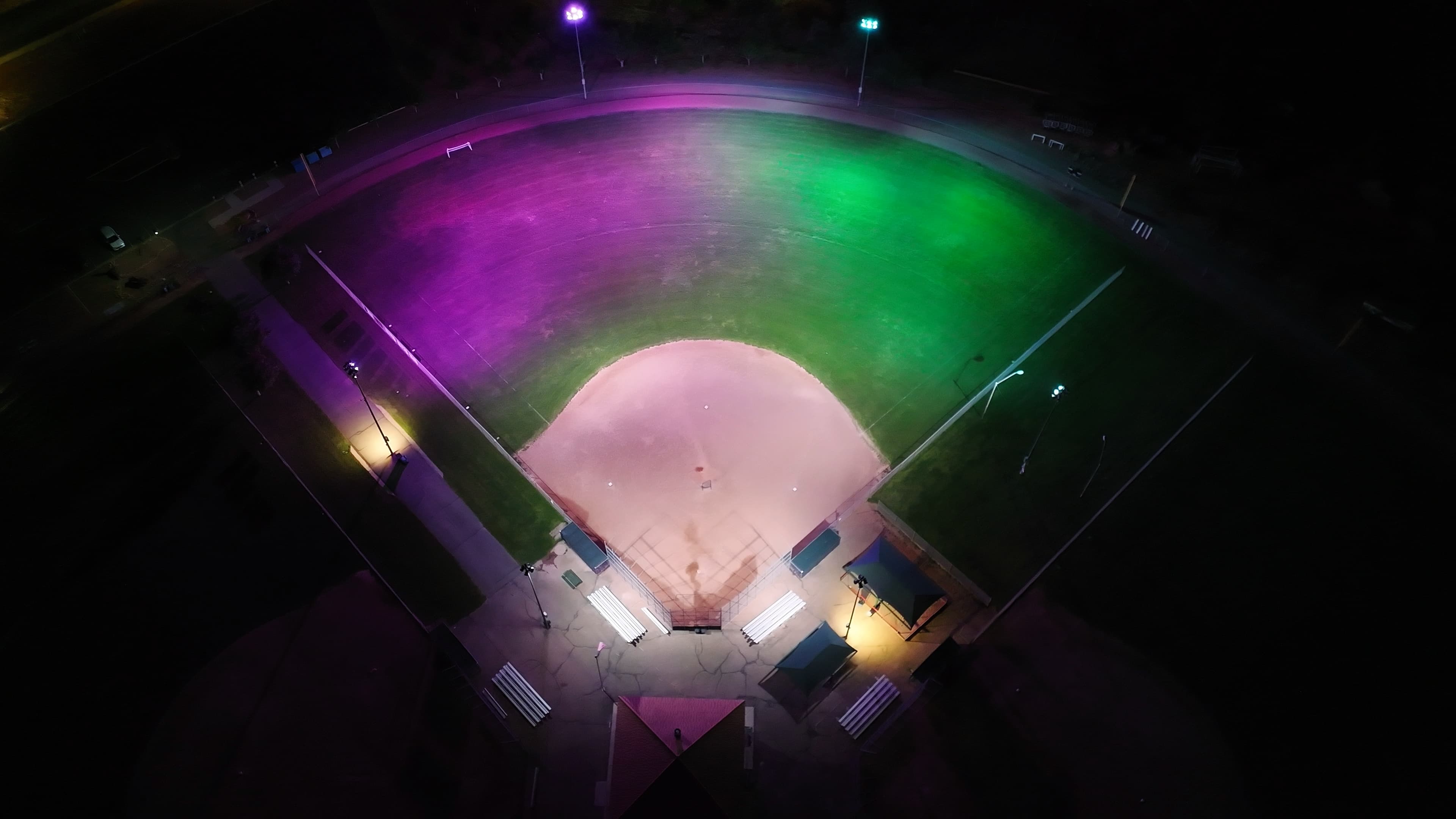
Why Baseball Lighting Deserves More Than a One-Size-Fits-All Approach
Baseball is a game of fractions — a fraction of a second to track a fastball, a fraction of a degree in a fielder's line of sight, a fraction of a foot separating a safe call from an out. Lighting influences all of it. Yet across Oklahoma, many baseball and softball facilities — from youth park complexes in Bixby and Jenks to competitive high school programs in Broken Arrow and Owasso — are still relying on aging metal halide or high-pressure sodium (HPS) systems that were engineered decades ago for a different era of play.
As LED technology has matured and sport-specific photometric standards have grown more sophisticated, the question for facility managers, parks and recreation directors, and athletic administrators is no longer whether to upgrade — it's how to do it right. That distinction matters enormously on a baseball diamond, where the geometry of light, glare, and shadow is more complex than almost any other athletic environment.
This article explores what makes baseball and softball LED lighting a uniquely demanding discipline, why the Greater Oklahoma City market is well-positioned for these upgrades right now, and what facility leaders should know before starting a project.
The Science Behind Great Baseball Lighting
Most people think of sports lighting as simply "making it bright enough." In reality, baseball field illumination is one of the most technically challenging applications in the commercial lighting industry. Consider the geometry: a batter standing at home plate must track a pitched ball traveling at speeds between 50 and 90-plus miles per hour from a release point roughly 60 feet away, with luminaires positioned on poles that are typically 60 to 100 feet tall around the field perimeter. If those fixtures are improperly aimed, angled, or spaced, the result isn't just poor aesthetics — it's a genuine safety risk.
Key technical considerations for baseball and softball lighting include:
- Uniformity ratios — The ratio between the brightest and darkest points on the field must stay within defined limits set by governing bodies like the Illuminating Engineering Society (IES) and leagues ranging from Little League to the NCAA. Uneven light creates visual "dead zones" that affect depth perception for batters and outfielders alike.
- Glare control — Luminaires positioned in a batter's or fielder's sightline can cause temporary blindness at critical moments. Proper fixture selection and aiming angles are essential to eliminate direct or indirect glare.
- Vertical illuminance — Unlike a warehouse or parking lot, a baseball field requires strong vertical light to illuminate the ball as it travels through the air, not just horizontal light on the playing surface. This is why standard commercial area lights are never appropriate for athletic field applications.
- Color rendering (CRI) — High-CRI LED systems render color accurately and help players distinguish the white ball against a variety of background conditions — from a sunny infield to a twilight sky or crowd backdrop.
- Pole placement and layout — Pole height, spacing, and count are interdependent variables that must be modeled through photometric simulation before any equipment is specified or purchased.
These are not considerations that can be resolved with an online fixture calculator or a manufacturer's generic layout template. They require the kind of experienced engineering judgment that separates a true sports lighting specialist from a general electrical contractor.
What's Driving LED Adoption on Oklahoma Athletic Fields
Across the Greater Oklahoma City metro — from Bixby and Glenpool in the south to Edmond and Yukon in the north — municipal parks departments, school districts, and private athletic clubs are accelerating their transitions to LED sports lighting. Several converging factors are driving this trend locally.
Energy costs and operational budgets. Oklahoma's parks and recreation departments and public school districts face persistent pressure to reduce operational expenditures. LED systems for athletic fields typically consume 50–70% less energy than equivalent metal halide installations, and because LED fixtures have dramatically longer rated lifespans, the cost and disruption of lamp replacements are nearly eliminated. For a facility running night games or practices four to five evenings per week across a full spring and fall season, those savings accumulate quickly.
Aging infrastructure. Many of the ball fields installed across the Oklahoma City metro in the 1990s and early 2000s are now approaching or exceeding the end of their useful life. Ballasts are failing, poles are showing corrosion, and replacement parts for older metal halide fixtures are becoming increasingly difficult to source. Rather than invest in diminishing-returns repairs on obsolete systems, forward-thinking facilities managers are using these natural replacement cycles as an opportunity to upgrade to modern LED.
Competitive programming expectations. Bixby is one of the fastest-growing communities in Oklahoma, with a population that has expanded dramatically over the past decade. As the city and surrounding communities like Jenks, Sand Springs, and Sapulpa continue to grow, athletic programming demand grows with them. Families and athletic organizations expect facilities that meet modern standards — and well-lit, safe, visually comfortable fields are a baseline expectation for competitive leagues, travel ball tournaments, and high school programs.
State procurement pathways. For public entities in Oklahoma — school districts, municipalities, parks authorities — VOSS holds an approved state contract, making procurement straightforward and compliant. Eligible organizations can also access cooperative purchasing programs including Sourcewell, BuyBoard, TIPS, AEPA, and Omnia Partners, among others, which streamline the process further and help avoid lengthy competitive bid timelines.
One of the most important things to understand about baseball LED lighting is that the engineering discipline is consistent regardless of project scale — but the specific design parameters, fixture specifications, and controls capabilities vary significantly between a four-field youth recreational complex and a high school varsity stadium.
Recreational and community park fields — typically serving ages 6 through 14 in Little League, Cal Ripken, or similar formats — require carefully balanced illumination that prioritizes player safety and visibility at relatively modest footcandle targets. These projects often benefit from simpler pole configurations and may be ideal candidates for utility rebate programs that can meaningfully offset capital costs.
High school and travel ball facilities — operating under NFHS standards and often hosting evening games broadcast on local streaming platforms — require more sophisticated designs that address both player performance and broadcast quality. Controls systems that allow precise dimming, scene recall, and remote management are increasingly standard at this level.
Collegiate and semi-professional venues — such as those affiliated with universities across the Oklahoma City metro and Tulsa corridor — must meet IES and governing body standards for both game play and live broadcast. At this scale, photometric modeling becomes especially rigorous, and integration with stadium control systems, scoreboards, and broadcast infrastructure adds engineering complexity.
VOSS has delivered sports lighting projects across this full spectrum, and our team understands how to right-size a design for each environment without over-specifying or cutting corners.
Proof in the Region: What LED Upgrades Deliver in Oklahoma
While baseball-specific case studies represent their own category of project complexity, VOSS's track record across the Greater Oklahoma City market demonstrates the consistent outcomes that thoughtful LED upgrades produce — outcomes that translate directly to athletic facilities.
At The Triangle at Classen Curve in Oklahoma City, a commercial parking lot retrofit that VOSS designed and installed effectively doubled light levels across the property, eliminating the dark spots that had made tenants and patrons feel unsafe. The project generated approximately $14,000 in annual energy savings, with a full return on investment achieved in just over one year. For parks departments and athletic complex managers evaluating field lighting upgrades, that kind of ROI timeline is a compelling data point — athletic field systems, which run on defined seasonal schedules, can produce similarly strong financial outcomes.
At the University of Oklahoma Warehouse in Norman, VOSS replaced failed high-pressure sodium and fluorescent fixtures with a modern LED system, achieving remarkably even light distribution and approximately $6,000 per year in verified energy savings. That project also required updating obsolete wiring and conduit — a reminder that aging infrastructure beneath the fixtures is often part of the conversation in any long-overdue upgrade.
These regional projects reflect what VOSS brings to every engagement: engineered design, code-compliant installation, and demonstrated results.
Controls and Smart Systems: The Next Layer of Value
Modern LED baseball field lighting is not just about the fixtures — it's about how those fixtures are managed. Controls integration is increasingly a differentiating factor in how facilities operate their lighting investments.
Wireless and app-based controls allow operations staff to schedule lights for practice windows, game times, and seasonal shutdowns remotely — eliminating wasted energy from lights left on after events. Systems can be programmed to dim automatically during pre-game warmups and ramp to full brightness for first pitch, or to hold at reduced power during breaks in play.
Instant-on performance is a feature that metal halide systems simply cannot match. Traditional systems require 15–20 minutes to reach full brightness after a restart, making rain delay situations — common in Oklahoma's spring baseball season — operationally complicated. LED systems reach full output immediately, giving facility managers and game officials maximum flexibility.
Occupancy and photocell integration can further reduce energy consumption by ensuring lights respond to ambient conditions and actual field use rather than running on fixed timer schedules.
For facilities interested in exploring the broader landscape of LED controls and smart systems, VOSS's related content on sports lighting controls and energy-efficient field lighting provides additional context on how these technologies integrate at the facility level. The sibling articles in this series — including our coverage of LED gymnasium lighting solutions, pickleball LED lighting, tennis court lighting, and LED football stadium lights — offer parallel insights for organizations managing multi-sport complexes.
Service Availability
While VOSS offers a comprehensive suite of national services, specific capabilities may vary by location. Please contact your local branch to confirm the current availability of specific services, technology solutions, or contracting capabilities in your immediate market.
Talk to VOSS About Your Bixby or Greater Oklahoma City Baseball Facility
Whether you're managing a four-field recreational complex in Bixby, a high school varsity diamond in Broken Arrow or Jenks, or a multi-purpose athletic park serving communities across the Tulsa and Oklahoma City corridors, VOSS is ready to help you think through your lighting project from concept to commissioning.
Our Oklahoma City branch serves the full Greater Oklahoma City and surrounding region, and our team brings both local market knowledge and national sports lighting expertise to every engagement. We welcome the opportunity to review your current system, discuss your programming needs and budget parameters, and walk you through what a modern LED solution could look like for your facility.
VOSS — Oklahoma City Branch
Phone: (405) 949-1919 Toll-Free: (800) 735-8677
Reach out today to schedule a consultation — and let's talk about how to bring your baseball facility up to the standard your players, coaches, and community deserve.