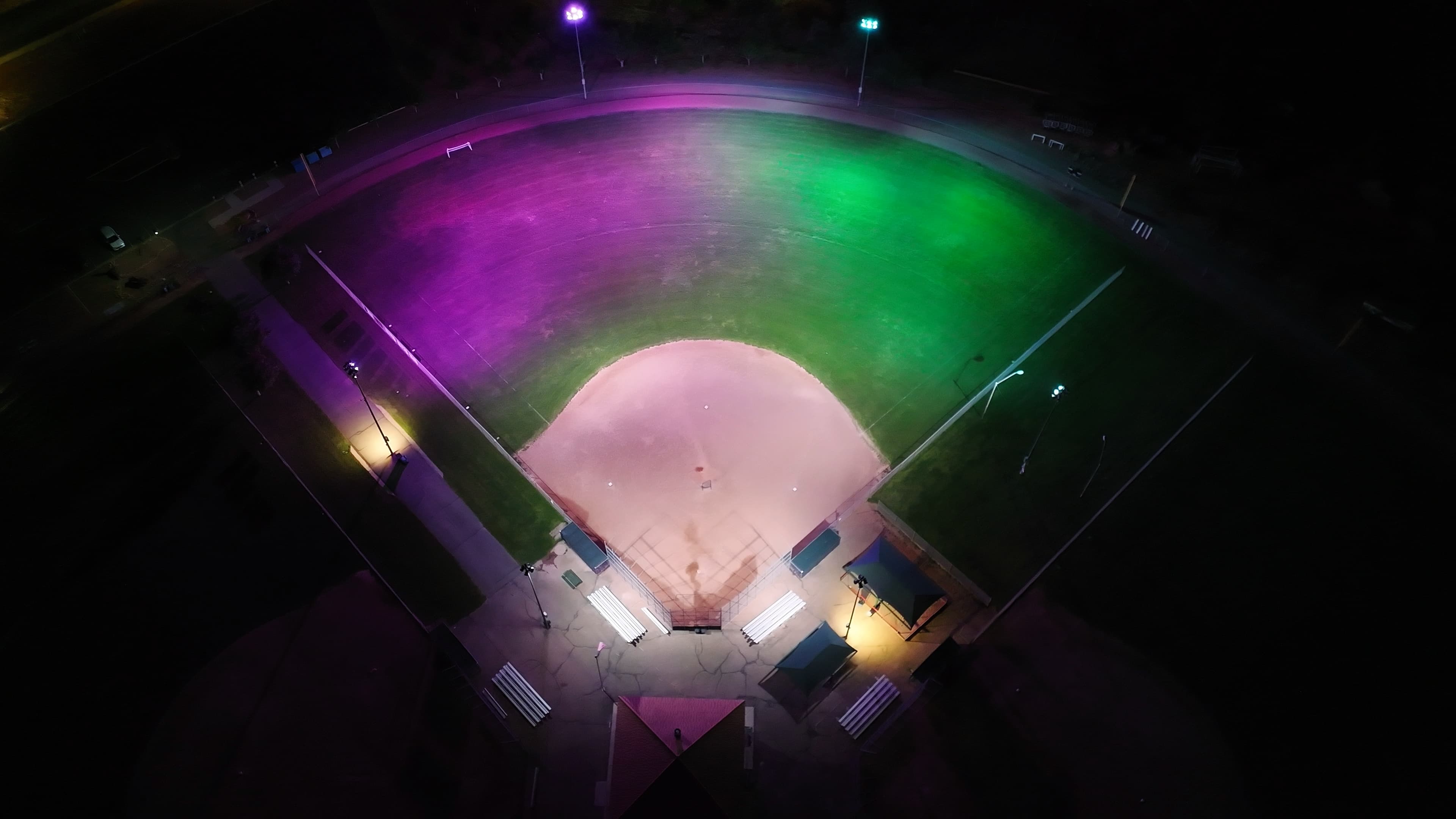
Why Baseball Field Lighting Is a Bigger Decision Than It Looks
When a youth league in Woodbury schedules evening games or a community athletic complex in the eastern Twin Cities suburbs extends its season into late fall, the quality of field lighting determines whether those moments happen safely and effectively — or not at all. Yet lighting decisions at baseball and softball facilities are often made reactively: a fixture fails, a utility bill spikes, or a field inspection flags outdated equipment. By that point, the facility is already behind.
For facility managers, parks and recreation directors, and athletic administrators across Washington County and the broader Greater Minneapolis market, LED lighting upgrades represent one of the most impactful infrastructure investments available today. The technology has matured significantly, the economics are compelling, and the standards governing sports lighting have become increasingly precise. Understanding what makes a great baseball lighting system — and what separates a properly engineered solution from a commodity product swap — is the first step toward making a decision you won't need to revisit for decades.
What Makes Baseball Lighting Uniquely Demanding
Baseball is one of the most technically challenging sports to light well. Unlike a basketball court or tennis surface, a baseball field is asymmetrical, multi-dimensional, and asks players to track a small, fast-moving object against a variety of backgrounds — sky, crowd, outfield wall, and artificial turf or natural grass — often under rapidly changing conditions.
A few factors that set baseball and softball lighting apart from other athletic applications:
- Field geometry requires pole placement precision. The arc of a baseball diamond, combined with foul territory, dugouts, and outfield dimensions that vary by facility, means that pole height, spacing, and aiming angles must be calculated through rigorous photometric modeling — not approximated.
- Glare control is critical for player safety. Batters, outfielders tracking fly balls, and infielders reading line drives are all vulnerable to poorly aimed or insufficiently shielded fixtures. Glare-induced visibility loss is not just a performance issue — it's a safety concern.
- Uniformity ratios matter more than raw lumen output. A field can be technically "bright enough" by average foot-candle measurement and still have dangerous shadow zones in the warning track or low spots in the infield. Governing bodies including Little League International, NFHS, NCAA, and MLB all publish specific uniformity standards that engineered designs must meet.
- Broadcast and streaming add new requirements. As youth leagues and amateur organizations increasingly stream games online, camera-ready lighting — with appropriate color rendering indexes (CRI) and minimal flicker at high frame rates — has become relevant even at the community park level.
For communities like Woodbury, Cottage Grove, Stillwater, and Oakdale, where active parks systems support robust youth and adult athletic programs, these technical nuances have real consequences for how fields are used and how long they remain competitive.
The LED Advantage for Baseball Facilities in the Twin Cities Climate
Minnesota's climate creates a distinct operating context for outdoor sports lighting that facility operators throughout the Greater Minneapolis area know well. Metal halide and high-pressure sodium (HPS) systems — still common on many regional fields — struggle in cold temperatures. These legacy technologies require extended warm-up and restrike times, meaning a rain delay or power interruption can leave a field dark for ten minutes or more before play can safely resume. In late-season October games, where temperatures in the eastern suburbs regularly drop into the 30s, traditional systems also lose efficiency and light output.
LED technology addresses these challenges directly:
- Instant-on performance means full brightness is available the moment the switch is thrown — no warm-up cycle, no restrike delay after an interruption.
- Cold-weather rated LED fixtures maintain consistent lumen output even in sub-freezing temperatures, an important consideration for Minnesota facilities that push their seasons into spring and fall.
- Dramatically lower energy consumption translates to meaningful operating cost reductions. LED systems typically consume 50–70% less energy than equivalent metal halide systems, and that savings compounds over a long Minnesota winter when facilities may run lights for extended indoor training sessions or off-season use.
- Longer service life reduces maintenance burden. LED fixtures routinely offer 100,000+ hour lifespans, which means fewer bucket truck deployments, fewer lamp replacement cycles, and lower total cost of ownership over time — a significant advantage for parks departments and school districts managing tight maintenance budgets.
For public agencies in Washington County and across the region, Minnesota's utility rebate landscape can further improve project economics. VOSS works closely with facility operators to identify and navigate available incentive programs that may be applicable to sports lighting upgrades.
Proven Results: The Page, AZ Baseball Case Study
One of the most instructive proof points in VOSS's sports lighting portfolio comes from Page, Arizona, where the team delivered a complete LED lighting retrofit for a baseball facility that demonstrates what a well-executed project looks like in practice. The Page project involved engineered photometric design, precise pole and fixture positioning to meet governing body standards, and full installation and commissioning — delivering improved visibility for players and coaches, measurable energy savings for the facility operator, and a dramatically upgraded experience for fans attending night games.
The lesson from Page — and from similar projects across VOSS's national portfolio — is that the quality of the outcome depends heavily on the quality of the design process. Selecting the right fixture for the right application, modeling the photometrics before a single pole goes in the ground, and commissioning the system to verify performance against the design spec are the steps that separate a great result from an expensive disappointment.
For baseball and softball facilities in Woodbury and across the Greater Minneapolis metro, this kind of engineered approach is exactly what distinguishes a long-term infrastructure investment from a reactive repair.
Controls, Connectivity, and the Smart Field
Modern LED sports lighting doesn't end at the fixture. Controls integration is increasingly central to how athletic facilities manage their lighting — and the capabilities available today are genuinely transformative for facility operators.
Wireless lighting controls allow field managers to adjust light levels, schedule on/off times, and monitor system performance remotely — from a phone, tablet, or facility management system. For a parks department managing multiple fields across a community like Woodbury or across Washington County, centralized controls can reduce staff time spent on manual switching, catch maintenance issues before they become failures, and enforce energy-saving schedules automatically.
Dimming and scene control add flexibility for multi-use facilities. A field configured for a televised high school championship can be set to broadcast-grade illumination; the same field can run at a reduced level for a casual adult recreational league game later the same evening. This kind of operational flexibility wasn't practical with legacy technology.
Integration with smart building and campus systems is also increasingly relevant for colleges, universities, and large athletic complexes. VOSS's broader expertise in controls and smart systems — explored in more depth in related resources on LED gymnasium lighting solutions and LED football stadium lights — positions us to design sports lighting that works within a cohesive facilities management ecosystem rather than as an isolated system.
A Note for Parks Departments, School Districts, and Public Agencies
Public-sector organizations in Minnesota — including school districts, municipal parks departments, and county facilities teams — have procurement pathways available that simplify the process of engaging VOSS for sports lighting projects. VOSS holds an approved state contract in Minnesota, giving eligible agencies a compliant, streamlined route to access our services without the need for a separate competitive bid process.
In addition, cooperative purchasing programs including Sourcewell, TIPS, BuyBoard, AEPA, Omnia Partners, PACE, and others are available to qualifying organizations. These vehicles are widely used by Minnesota public agencies to accelerate project timelines while maintaining full procurement compliance.
For athletic directors, facilities directors, and parks administrators in Woodbury, Cottage Grove, Mahtomedi, Lake Elmo, and surrounding communities, these programs can meaningfully reduce the administrative burden of getting a lighting upgrade project off the ground.
Thinking About a Baseball Lighting Project? Start with a Conversation
The best sports lighting projects begin well before a design is drawn or a fixture is specified. They start with a clear-eyed assessment of what the facility needs — current light levels, field dimensions, governing body requirements, energy cost baseline, available incentives, and long-term operational goals. That conversation is where VOSS adds the most value: not just as a contractor, but as a knowledgeable partner who has worked through these decisions at facilities of every scale, from community youth parks to collegiate stadiums.
Whether you're managing a single Little League complex in Woodbury or overseeing an athletic portfolio across the eastern Twin Cities suburbs, we'd welcome the opportunity to discuss what a well-engineered LED lighting upgrade could mean for your facility.
For readers exploring related topics, VOSS's content on pickleball LED lighting solutions, tennis court lighting, and LED gymnasium lighting solutions offers additional perspective on how similar principles apply across different athletic environments.
Service Availability
While VOSS offers a comprehensive suite of national services, specific capabilities may vary by location. Please contact your local branch to confirm the current availability of specific services, technology solutions, or contracting capabilities in your immediate market.
Connect with VOSS in the Greater Minneapolis Area
The VOSS Minneapolis branch serves Woodbury, the broader Washington County area, and communities throughout the Greater Minneapolis metro — including Cottage Grove, Stillwater, Oakdale, Mahtomedi, Lake Elmo, Maplewood, and beyond.
VOSS Minneapolis Branch
Phone: (651) 697-1599 Toll-Free: (800) 776-8677
Reach out to start a conversation about your baseball or softball lighting project — no obligation, just an informed discussion about what's possible for your facility.