Why Baseball Lighting Is a Bigger Deal Than Most Facility Managers Expect
At first glance, lighting a baseball field sounds straightforward — get the lights bright enough, point them at the field, done. In practice, it's one of the most technically demanding applications in commercial and athletic lighting. Baseball is a sport defined by split-second visual decisions: a batter reading a 90-mph fastball, an outfielder tracking a fly ball against a night sky, an infielder picking up a hard-hit grounder in the gap. Poor lighting doesn't just create an unpleasant experience — it directly affects player safety, game quality, and the long-term viability of a facility.
Across Lakeville and the broader South Metro region — including Apple Valley, Burnsville, Farmington, Prior Lake, and Savage — this issue is particularly timely. Lakeville is one of the fastest-growing communities in Minnesota, with a population approaching 70,000 and a robust parks and recreation infrastructure that supports youth athletic leagues, school programs, and community sports organizations. As those programs grow and compete for field time, the quality and reliability of athletic lighting becomes a genuine operational concern for parks administrators, school district facilities directors, and athletic directors alike.
The good news: LED technology has matured to a point where upgrading an aging metal halide or high-pressure sodium (HPS) system is no longer a capital-intensive leap of faith. It's a well-proven investment with predictable outcomes — and one that VOSS has been helping Minnesota organizations navigate for years.
The State of Baseball Lighting Technology in 2024 and Beyond
The shift from conventional sports lighting to LED in baseball and softball applications has accelerated dramatically over the past decade, driven by three converging forces: dramatic reductions in LED fixture costs, the introduction of sophisticated controls platforms, and increasing pressure from energy utilities and municipalities to reduce consumption.
What's changed in LED sports lighting:
- Optical precision — Modern LED sports fixtures are engineered with sport-specific beam distributions. Unlike legacy floodlights that scatter light broadly, today's LED systems use arrayed optics to direct light exactly where it's needed — across the infield, outfield, and warning track — while minimizing spill and glare into adjacent neighborhoods and roadways.
- Uniformity ratios — Lighting engineers now design to strict uniformity ratios (the relationship between maximum and minimum foot-candles across a surface), reducing shadows and "hot spots" that create visual inconsistency for players and fans.
- Controls integration — Smart lighting controls allow facility operators to dim fields for practice versus game play, schedule lights remotely, and even integrate with broadcast systems. This capability is no longer reserved for professional venues — it's increasingly standard on college and municipal fields.
- Broadcast-ready performance — LED systems designed for HD and 4K broadcast eliminate the flicker that plagued earlier-generation LEDs. For facilities that host recorded games, live streams, or televised events, this is a critical specification.
For Lakeville parks staff and Independent School District 194 athletic facilities managers, understanding these developments matters because it changes the calculus on deferred maintenance. A metal halide system installed in the 1990s or early 2000s isn't just aging — it's functionally obsolete relative to what LED can deliver today.
From Page, AZ to the Twin Cities: Proof That Scale Doesn't Limit Results
One of the most common questions facility managers ask when evaluating a lighting upgrade is simple: Has this actually worked somewhere like us?
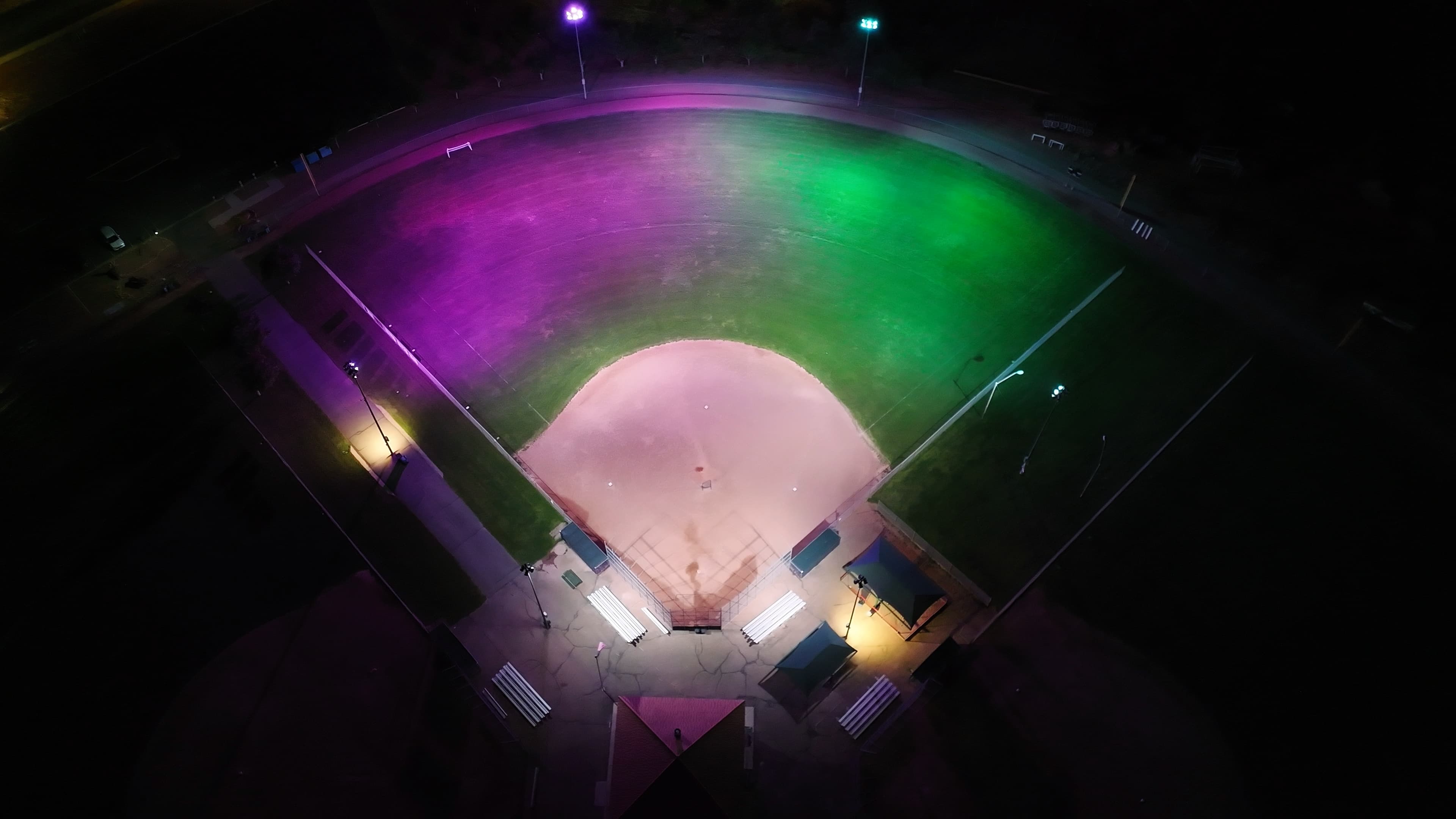
VOSS has direct, documented experience delivering professional-grade baseball LED lighting solutions in real-world municipal and athletic contexts. In Page, Arizona, VOSS executed a baseball field LED lighting project that demonstrates exactly what a well-engineered upgrade delivers — improved light quality, energy efficiency, and a facility that better serves its community. While Page and Lakeville are different markets, the fundamentals of the project translate directly: photometric design tailored to the specific field dimensions and use cases, pole placement engineered for optimal coverage without glare, and a finished product that meets the standards expected of a modern athletic facility.
That kind of project experience matters when you're evaluating contractors. Baseball lighting isn't a commodity installation — it requires an electrical contractor who understands sport-specific photometric design, local permitting and utility interconnection requirements, and the project management discipline to deliver on schedule for a facility with a live game calendar.
Those looking to explore other sports applications will also find relevant context in VOSS's related articles on pickleball LED lighting, tennis court lighting and energy solutions, LED gymnasium lighting, and LED football stadium lights — all part of the broader Latest Lighting resource library.
What Minnesota Facility Owners and Administrators Should Know Before Specifying a Project
If you're managing a baseball or softball facility in Lakeville, Apple Valley, Eagan, Rosemount, or elsewhere in Dakota County, here are the practical considerations that should shape your planning:
Governing body lighting standards vary by level of play. Little League, USSSA, high school (MSHSL), NCAA, and professional leagues each publish lighting level recommendations. A well-designed system should meet or exceed the standard for your highest intended use — because upgrading later is significantly more expensive than designing right the first time.
Pole placement and height are as important as fixture selection. The geometry of a baseball field — particularly the asymmetry of outfield dimensions and the sightlines from the batter's box — creates unique pole placement challenges. Poorly positioned poles can create shadow zones, glare angles that blind batters, or spill light into adjacent residential areas. This is where photometric design software and engineering expertise become non-negotiable.
Energy savings are real — and they're fundable. Minnesota utilities and government programs support energy-efficient lighting upgrades in athletic facilities. Minnesota's energy efficiency programs have historically provided incentives for commercial and institutional LED retrofits, and projects completed under state contract or cooperative purchasing agreements can streamline procurement significantly.
For public agencies in Minnesota, procurement is simpler than you think. VOSS holds an approved state contract in Minnesota, which means school districts, city parks departments, and other public entities can procure lighting services and products through a compliant, pre-vetted contract vehicle — eliminating the need for a standalone competitive bid on every project. Eligible organizations may also access VOSS through Sourcewell, TIPS, BuyBoard, AEPA, Omnia Partners, PACE, and other cooperative purchasing programs.
Maintenance and lifecycle costs matter as much as upfront price. LED fixtures at a reputable specification level carry rated lifespans of 100,000+ hours. For a field that operates 1,000 hours per year, that's a century of operation — in theory. In practice, you should evaluate warranty terms, lumen depreciation curves, and contractor support commitments alongside the fixture price.
The VOSS Approach: Engineered for the Field, Managed from Start to Finish
VOSS is not a lighting distributor that subcontracts installation. We are a full-service commercial electrical contractor — with 85+ years of experience — that manages every phase of a lighting project in-house: photometric design, engineering, permitting, installation, commissioning, and ongoing service. That matters for baseball and softball projects because the work is inherently complex: structural engineering for pole foundations, coordination with local utilities, trenching for underground electrical runs, and precise fixture aiming that can only be validated on-site after dark.
Our Minneapolis branch team serves Lakeville and the surrounding South Metro — including communities from Shakopee and Prior Lake in the west to Hastings and Cottage Grove in the east, and from the Minneapolis-Saint Paul urban core south through Dakota and Scott counties. We understand the local permitting environment, the utility landscape, and the specific needs of Minnesota athletic facilities.
Our baseball and softball lighting services include:
- Sport-specific photometric design and layout planning
- Pole selection, placement, and structural engineering coordination
- LED fixture specification and procurement
- Full electrical installation and underground work
- Lighting controls and dimming system integration
- Commissioning, aiming, and post-installation verification
- Ongoing maintenance and support programs
Service Availability
While VOSS offers a comprehensive suite of national services, specific capabilities may vary by location. Please contact your local branch to confirm the current availability of specific services, technology solutions, or contracting capabilities in your immediate market.
Talk to VOSS About Your Lakeville or Twin Cities Baseball Facility
Whether you're managing a city park complex with four fields, a high school athletic campus, or a competitive travel ball facility in the South Metro, VOSS can help you think through the lighting strategy that fits your use case, your budget, and your timeline. The conversation starts with understanding your facility — not a product pitch.
Reach our Minneapolis branch team to schedule a consultation:
VOSS — Minneapolis Branch Phone: (651) 697-1599 Toll-Free: (800) 776-8677
We serve Lakeville, Apple Valley, Burnsville, Eagan, Farmington, Rosemount, Prior Lake, Savage, Shakopee, and communities throughout the Greater Minneapolis metro area.