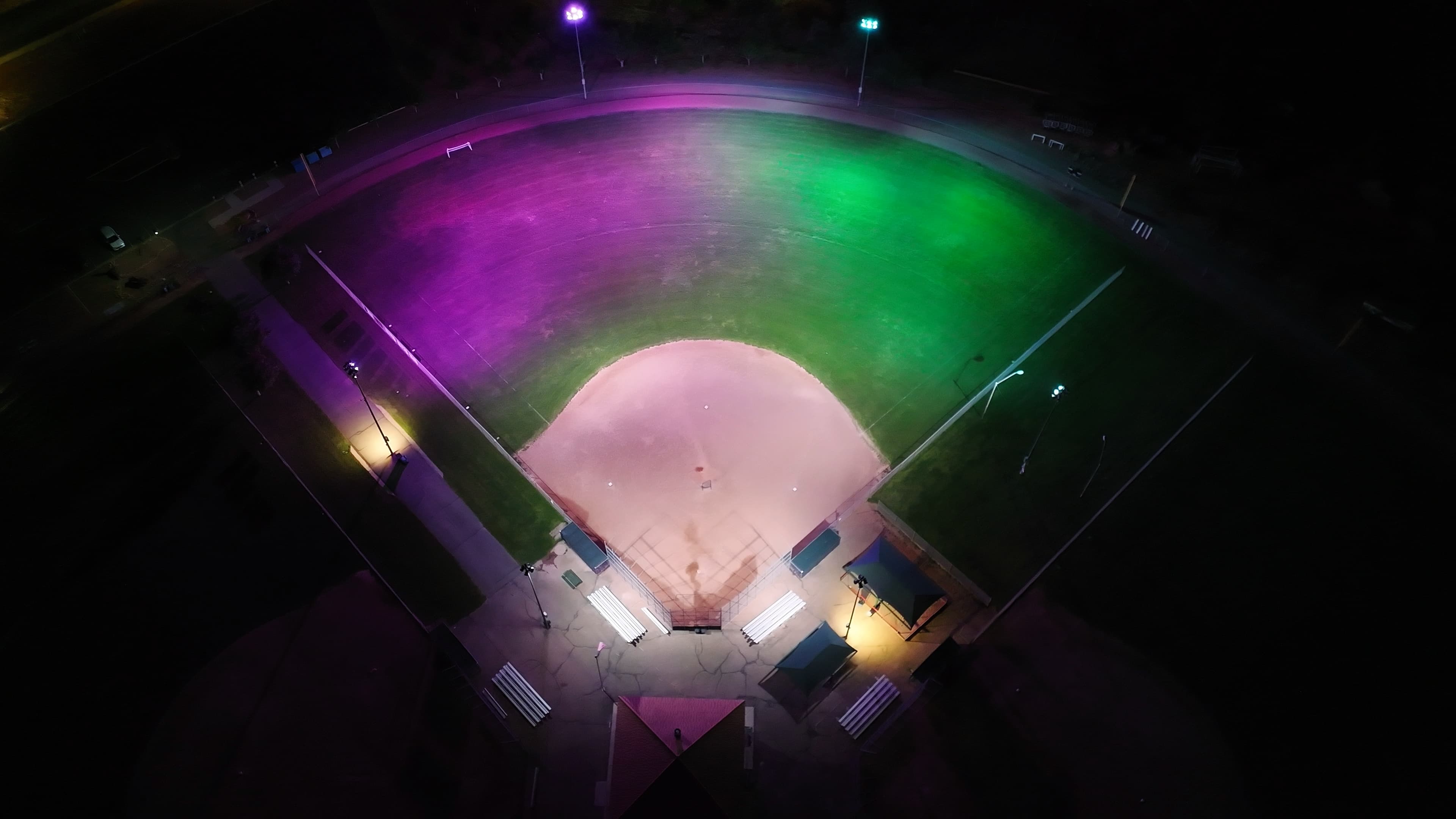
Why Baseball Field Lighting Is a Bigger Decision Than It Looks
For most facility managers and parks directors, a baseball field lighting project looks straightforward on the surface — replace old fixtures, improve brightness, and move on. In practice, it's one of the more technically demanding projects in the commercial lighting world. The geometry of a baseball diamond, the need to eliminate glare for batters and outfielders tracking fly balls, and the challenge of lighting a field that stretches more than 300 feet in every direction all require a level of photometric precision that general lighting work simply doesn't deliver.
Across the greater Minneapolis metro — in communities like Eagan, Burnsville, Apple Valley, Lakeville, Inver Grove Heights, and Rosemount — there are hundreds of baseball and softball fields serving youth leagues, high school programs, amateur adult leagues, and collegiate clubs. Many of those fields were built or last re-lit with metal halide or high-pressure sodium (HPS) fixtures that are now aging out of their useful life. The opportunity — and the pressure — to upgrade is growing.
This article explores what makes a great baseball LED lighting project, what the transition looks like for facilities in this region, and how organizations can make the most of available resources, incentives, and technology to get it right the first time.
The Case for LED: What's Changed and Why It Matters Now
LED technology has matured significantly over the past decade, and today's sports-grade LED fixtures are purpose-built for the demands of athletic facilities. This isn't the same category of product used to retrofit a warehouse or a parking garage — high-performance LED sports luminaires are engineered for precise beam control, high color rendering, and consistent output across long throw distances.
For baseball and softball facilities in Eagan and the surrounding Dakota County communities, the practical benefits are substantial:
- Energy Reduction — Modern LED systems typically consume dramatically less energy than the metal halide systems they replace, which is a meaningful consideration given Minnesota's year-round utility costs and the extended hours many competitive fields operate during summer tournament season
- Improved Uniformity — A well-designed LED system delivers consistent foot-candle levels across the infield, outfield, and warning track, eliminating the hot spots and dark zones that plague aging HPS systems and that affect player safety and performance
- Instant-On Performance — LED fixtures reach full brightness immediately, with no warm-up period — a practical advantage for fields that need to respond quickly to weather delays, reschedule starts, or support broadcast requirements
- Reduced Maintenance — LED fixtures carry significantly longer rated lifespans than traditional sources, reducing the frequency and cost of re-lamping on tall poles — a real operational benefit for parks departments managing multiple facilities with limited crews
- Controls Compatibility — Today's LED sports lighting systems integrate naturally with digital controls platforms, enabling scheduling, dimming, zone management, and remote operation that traditional systems simply cannot support
For public agencies and school districts in Eagan, Burnsville, Savage, and Farmington managing aging field infrastructure, the energy savings case is often compelling enough on its own. When paired with available utility rebates and state-level incentive programs, the financial picture becomes even stronger.
What a Professional Baseball Lighting Design Actually Involves
The difference between a professionally engineered baseball lighting project and a generic field lighting job comes down to the design process. A proper photometric study models the exact pole layout, mounting heights, fixture aim points, and beam angles needed to achieve target foot-candle levels — typically defined by governing bodies like Little League Baseball, NFHS (for high school play), or the Illuminating Engineering Society (IES) — across the entire playing surface.
For baseball and softball specifically, the design must address several challenges that don't apply to other sports:
- Glare Control for Batters and Outfielders — Light sources positioned too aggressively can blind batters tracking pitches or outfielders pursuing pop-ups. Proper fixture selection and aim point engineering minimizes spill into the batter's line of sight and outfield sky view
- Pole Placement and Setbacks — Poles must be positioned to avoid interfering with play, satisfy local zoning setback requirements, and provide adequate structural support for the fixture loads and wind exposure common to open athletic fields in the upper Midwest
- Spill Light and Light Trespass — In residential communities like Eagan where fields often sit near neighborhoods, managing off-site spill light is both a neighbor relations issue and a regulatory one; modern LED optics make tight spill control far more achievable than older technologies allowed
- Multi-Use Capability — Many fields in the metro area serve both baseball and softball, or support recreational soccer and other uses in the off-season; a well-designed system can accommodate these variations with dimming and zone controls
VOSS approaches every baseball and softball lighting project with a full photometric design process, working from the governing body standards applicable to the specific facility and use case — whether that's a Little League park in Eagan, a high school varsity diamond in Prior Lake, or a tournament complex in Shakopee.
Proof in the Field: Lessons from Page, AZ
While the climate in Page, Arizona is a long way from Minnesota, a project VOSS completed there illustrates exactly the kind of precision and outcomes that translate directly to facilities here in the greater Minneapolis area.
VOSS delivered a full LED lighting upgrade for a baseball facility in Page, AZ — a project that required navigating the sport-specific design demands described above while delivering measurable energy savings and improved playability. The result was a field that met the lighting standards required for competitive play, with a system designed for long-term performance and dramatically reduced operating costs compared to the legacy technology it replaced.
For facility managers and parks directors in Eagan and the surrounding communities, that project is a practical reference point: the same methodology, the same fixture-level precision, and the same controls integration approach that worked in Arizona is exactly what VOSS brings to fields in Dakota County and across the Twin Cities metro.
The Minnesota Advantage: Rebates, State Contracts, and Cooperative Purchasing
One of the most practical aspects of a baseball LED lighting project in Minnesota is the availability of financial tools that can meaningfully reduce net project cost. Facility owners and public agencies in Eagan and the greater Minneapolis region have access to a range of programs worth understanding before committing to a project budget.
Utility Rebates — Minnesota utilities offer rebate programs for qualifying LED upgrades that can offset a portion of equipment and installation costs. The specific rebate structure and eligibility requirements vary by utility and program year; working with a contractor who understands the current rebate landscape is essential to capturing available incentives.
Minnesota State Contract — VOSS holds an approved state contract in Minnesota, which means public agencies — including city parks departments, school districts, and county facilities teams — can procure lighting and electrical services through a compliant, pre-negotiated vehicle without the burden of a standalone bid process. For organizations managing tight procurement timelines or limited administrative capacity, this is a meaningful practical advantage.
Cooperative Purchasing Programs — Eligible organizations in Eagan and across Minnesota can also access VOSS through a range of cooperative purchasing programs, including Sourcewell, TIPS, BuyBoard, Omnia Partners, AEPA, PACE, and others. These programs are available to government agencies, school districts, nonprofits, and other qualifying organizations and provide a streamlined path to project initiation without sacrificing competitive pricing or compliance.
For parks and recreation departments serving the youth leagues and community athletic programs that are the backbone of baseball culture in communities like Eagan, Burnsville, and Apple Valley, these procurement tools can make the difference between a project that moves forward and one that stalls in the planning phase.
Connected Topics Worth Exploring
Baseball and softball lighting is one part of a broader conversation about how modern LED technology and controls integration are transforming athletic and recreational facilities. If this topic is relevant to your work, you may also find value in our articles on LED gymnasium lighting solutions, pickleball LED lighting solutions, and tennis court lighting and energy solutions — all part of our Latest Lighting content series. For organizations thinking about outdoor infrastructure more broadly, our coverage of parking lot and outdoor LED lighting upgrades and energy audits, incentives, and rebate navigation for businesses provides useful context on the financial and operational dimensions of larger-scale upgrades.
Service Availability
While VOSS offers a comprehensive suite of national services, specific capabilities may vary by location. Please contact your local branch to confirm the current availability of specific services, technology solutions, or contracting capabilities in your immediate market.
Talk to VOSS About Your Eagan or Twin Cities Baseball Facility
Whether you're managing a single community field in Eagan or overseeing a multi-diamond complex serving leagues across Dakota County and the southern metro, VOSS has the design experience, installation expertise, and local knowledge to deliver a baseball or softball lighting project that performs — for decades.
We welcome the conversation. Reach out to our Minneapolis branch team to discuss your facility's current situation, your timeline, and the options available to you — including applicable rebates, cooperative purchasing vehicles, and the state contract available to Minnesota public agencies.
VOSS Minneapolis Branch
Phone: (651) 697-1599 Toll-Free: (800) 776-8677
Serving Eagan, Burnsville, Apple Valley, Lakeville, Inver Grove Heights, Rosemount, Prior Lake, Shakopee, Savage, Farmington, and communities throughout the greater Minneapolis–Saint Paul metro area.