Why Baseball Lighting Is a Bigger Deal Than You Might Think in Blaine, MN
Blaine isn't just a suburb north of Minneapolis — it's one of the most sports-active communities in the entire state of Minnesota. Home to the National Sports Center, one of the largest amateur sports facilities in the world, and surrounded by a dense network of community parks, recreational leagues, and school athletic programs, Blaine and its neighboring communities — Coon Rapids, Andover, Ham Lake, Lino Lakes, and Fridley — represent some of the highest concentrations of organized youth and adult athletics in the Upper Midwest.
That level of athletic activity puts real pressure on the infrastructure supporting it. Baseball and softball fields throughout the area face a common challenge: aging metal halide or high-pressure sodium (HPS) lighting systems that were designed for a different era. These systems are energy-intensive, slow to warm up, uneven in their light distribution, and increasingly expensive to maintain. For parks and recreation departments, school athletic programs, and privately operated complexes across the Greater Minneapolis market, the question is no longer whether to upgrade — it's how to do it right.
This article explores what facility managers, athletic directors, and parks administrators in the Blaine area should know about modern LED sports lighting — the technology, the planning process, the financial case, and what separates a great installation from a merely adequate one.
What Makes Baseball Lighting Uniquely Demanding
Not all sports lighting is created equal, and baseball presents some of the most technically demanding requirements in the field. Unlike a basketball court or a tennis facility with a defined, compact footprint, a baseball diamond radiates outward in multiple directions — the infield geometry, the variable outfield depth, the foul territory, the warning track, and the stands all require different lighting approaches simultaneously.
Several factors make baseball and softball lighting especially complex:
- Pole placement precision — Poles must be positioned to minimize obstructions to play (fly balls, line drives) while maximizing uniform coverage. Poor pole placement can create dangerous shadowing in the outfield or glare in the batter's line of sight.
- Vertical illuminance — Batters and fielders need to track a moving ball against varying backgrounds. This requires strong vertical light — not just horizontal foot-candles on the turf — so that the ball is visible at all heights and angles.
- Glare control — Glare directed at batters, infielders reading a high popup, or outfielders tracking a fly ball is a safety issue, not just a comfort one. Modern LED optics allow for precise beam control that traditional HID fixtures simply cannot match.
- League and governing body standards — From Little League International and NFHS (National Federation of State High School Associations) to NCAA and professional standards, each competitive level has specific footcandle and uniformity ratio requirements. Designs must be engineered to meet — not merely approximate — those benchmarks.
For facilities in Blaine and across Anoka County, where fields host everything from 8-year-old T-ball to competitive adult leagues and high school varsity play, this range of standards often means a single complex may need different lighting designs across multiple fields. Getting that right requires photometric engineering expertise, not just equipment procurement.
The LED Advantage: What the Numbers Actually Mean for Your Facility
LED technology has matured dramatically over the past decade, and the performance gap between modern LED sports fixtures and legacy HID systems is now substantial. Here's what that means in practical terms for facility operators in the Greater Minneapolis area:
Energy efficiency that changes the operating math. LED systems typically consume 50–70% less energy than the metal halide systems they replace. For a multi-field complex running lights several evenings per week through a full spring and summer season — plus fall league play — that reduction represents meaningful budget relief, particularly as Xcel Energy and other regional utility providers continue to adjust commercial rate structures. Facilities may also qualify for utility rebates that offset a significant portion of upfront project costs.
Instant-on performance that fits real schedules. Metal halide fixtures require a warm-up period of several minutes before reaching full brightness — and if power is interrupted during a rain delay, they can take 15–20 minutes to restrike. LED fixtures reach full output instantly. For parks departments managing tight scheduling windows and coaches working around Minnesota's notoriously compressed spring season, that operational flexibility matters.
Dramatically reduced maintenance burden. LED fixtures carry rated lifespans that can exceed 100,000 hours — far outpacing the 10,000–15,000-hour lifespan of typical metal halide lamps. For parks and recreation staff in communities like Blaine, Coon Rapids, and Andover who are often managing large portfolios of facilities with lean maintenance crews, eliminating frequent lamp replacements is a tangible operational benefit.
Controls integration for modern facility management. Contemporary LED sports lighting systems can be integrated with lighting controls platforms that allow scheduling, dimming, remote monitoring, and even mobile app operation. A parks director managing multiple fields across a municipality no longer needs someone on-site to manually operate lights — schedules can be set, overridden, and monitored from a central interface. This capability connects naturally to the broader conversation about smart facility infrastructure that VOSS covers in its resources on commercial LED outdoor lighting and controls and smart systems.
A Proven Approach: Lessons from the Field
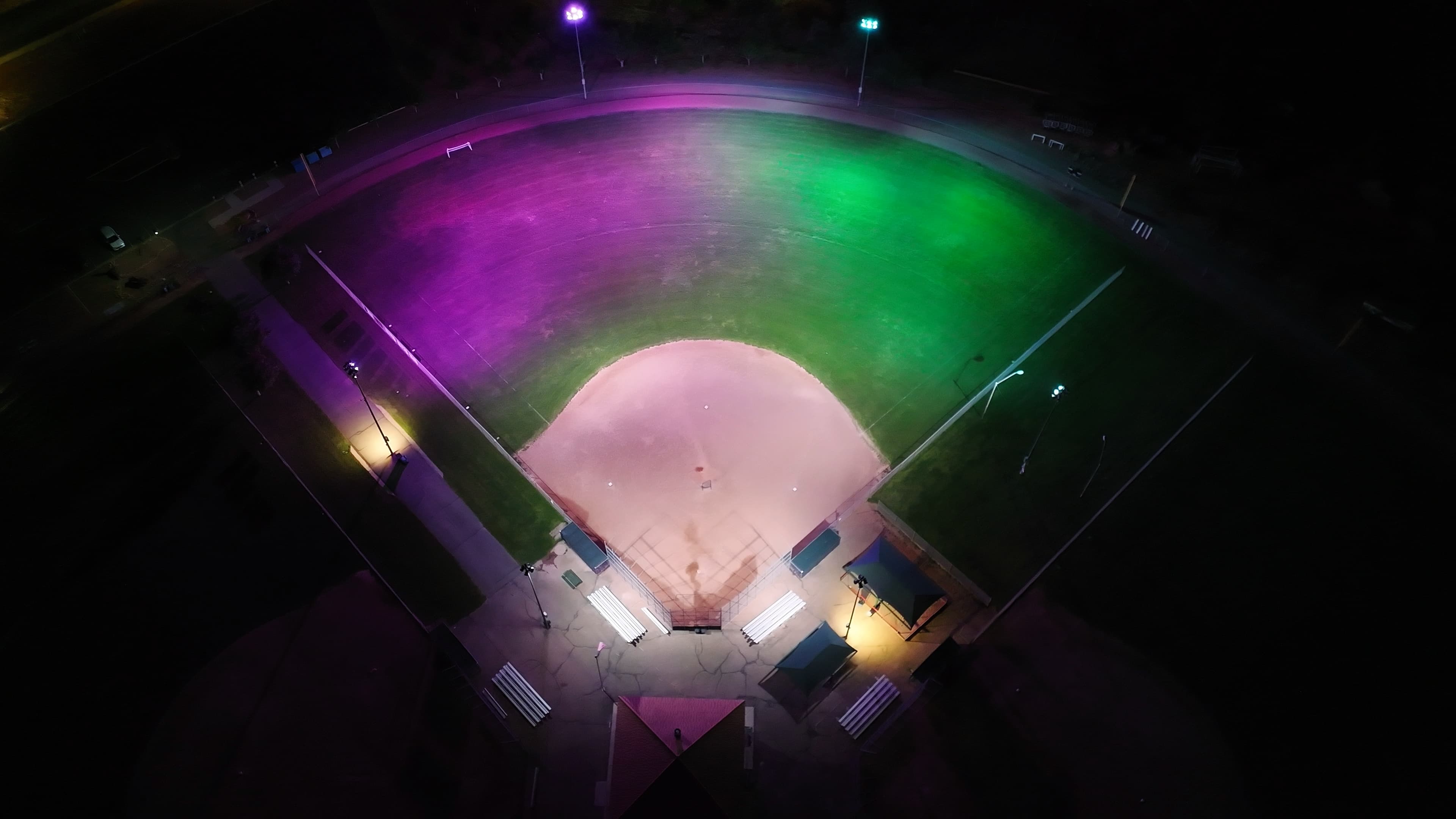
VOSS has completed LED lighting projects across baseball and softball facilities at multiple competitive levels. One instructive example is a project in Page, Arizona, where VOSS delivered a professional-grade LED lighting installation for a baseball facility that demonstrates the kind of engineered precision that separates a well-executed sports lighting project from a cut-rate lamp swap.
That project required careful photometric design to meet competitive standards, precise pole placement to serve the field's geometry, and integration with controls systems that gave operators flexible management capability. The result was a facility that met the illuminance and uniformity standards required for competitive play while delivering the energy efficiency and long-term reliability that justified the investment.
The takeaway for facilities in Blaine and the surrounding region is straightforward: sports lighting projects succeed or fail at the design phase. The equipment matters, but the engineering behind pole placement, aiming angles, fixture selection, and controls integration is what determines whether the finished product performs the way it should — night after night, season after season.
Planning a Baseball Lighting Project in Greater Minneapolis: Key Considerations
For facility managers, athletic directors, and parks administrators in Blaine, Coon Rapids, Spring Lake Park, Mounds View, and surrounding communities who are evaluating a lighting upgrade, here are the planning factors that most often determine project outcomes:
Start with a photometric study. Before any equipment is specified or budgeted, a qualified lighting designer should conduct a photometric analysis of your field — mapping pole locations, calculating required footcandle levels by zone, and modeling uniformity ratios. This isn't an optional step; it's the foundation of a compliant, high-performing design.
Understand your league's standards. If your facility hosts NFHS-sanctioned high school play, NCAA competition, or organized amateur leagues with specific governing body requirements, those standards must be built into the design from the outset. Retrofitting a non-compliant installation is far more expensive than engineering for compliance the first time.
Evaluate controls as part of the system, not an afterthought. Lighting controls — scheduling, dimming, remote operation, occupancy integration — are increasingly standard in professional-grade sports lighting systems. For public facilities managing shared-use fields across multiple user groups, controls are often the feature that delivers the most day-to-day operational value.
Identify available incentives early. Utility rebate programs, state energy efficiency incentives, and cooperative purchasing vehicles can meaningfully reduce net project costs. Minnesota facilities — particularly public agencies and school districts — have access to procurement pathways that streamline the process. VOSS holds an approved state contract in Minnesota, which allows government agencies and public institutions to procure lighting and electrical services through a compliant, pre-vetted contract vehicle. Eligible organizations may also access cooperative purchasing programs including Sourcewell, TIPS, BuyBoard, AEPA, Omnia Partners, and others — simplifying procurement while ensuring competitive pricing.
Think beyond the single field. Many facilities in the Greater Minneapolis area are multi-field complexes where a phased upgrade approach may be appropriate. Planning at the complex level — rather than field by field — allows for coordinated pole infrastructure, shared controls systems, and more efficient use of incentive dollars.
Related Topics Worth Exploring
Baseball field lighting sits within a broader conversation about sports and recreational facility infrastructure. If you're also evaluating other athletic facilities or energy initiatives, VOSS has published resources on LED lighting for gymnasiums, pickleball courts, tennis courts, and football stadiums — all part of the Latest Lighting content series. For organizations with broader energy goals, resources on energy audits, utility rebates, and commercial outdoor LED lighting provide useful context for building a facility-wide efficiency strategy.
Service Availability
While VOSS offers a comprehensive suite of national services, specific capabilities may vary by location. Please contact your local branch to confirm the current availability of specific services, technology solutions, or contracting capabilities in your immediate market.
Talk with VOSS About Your Baseball Facility in Blaine or the Greater Minneapolis Area
If you're managing a baseball or softball facility anywhere in the Greater Minneapolis region — from Blaine and Anoka County south through the Twin Cities metro — and you're evaluating a lighting upgrade, we'd welcome a conversation. VOSS brings 85+ years of commercial electrical expertise, in-house photometric design capability, and deep experience with sports lighting projects across competitive levels.
Our Minneapolis branch team works with parks and recreation departments, school districts, athletic associations, and private facility operators throughout Minnesota. We can help you understand what a well-engineered LED upgrade would look like for your specific facility, what incentives and procurement pathways are available to you, and what the realistic timeline and investment picture looks like.
VOSS — Minneapolis Branch
Phone: (651) 697-1599 Toll-Free: (800) 776-8677
Reach out to start a conversation — no obligation, just expertise.