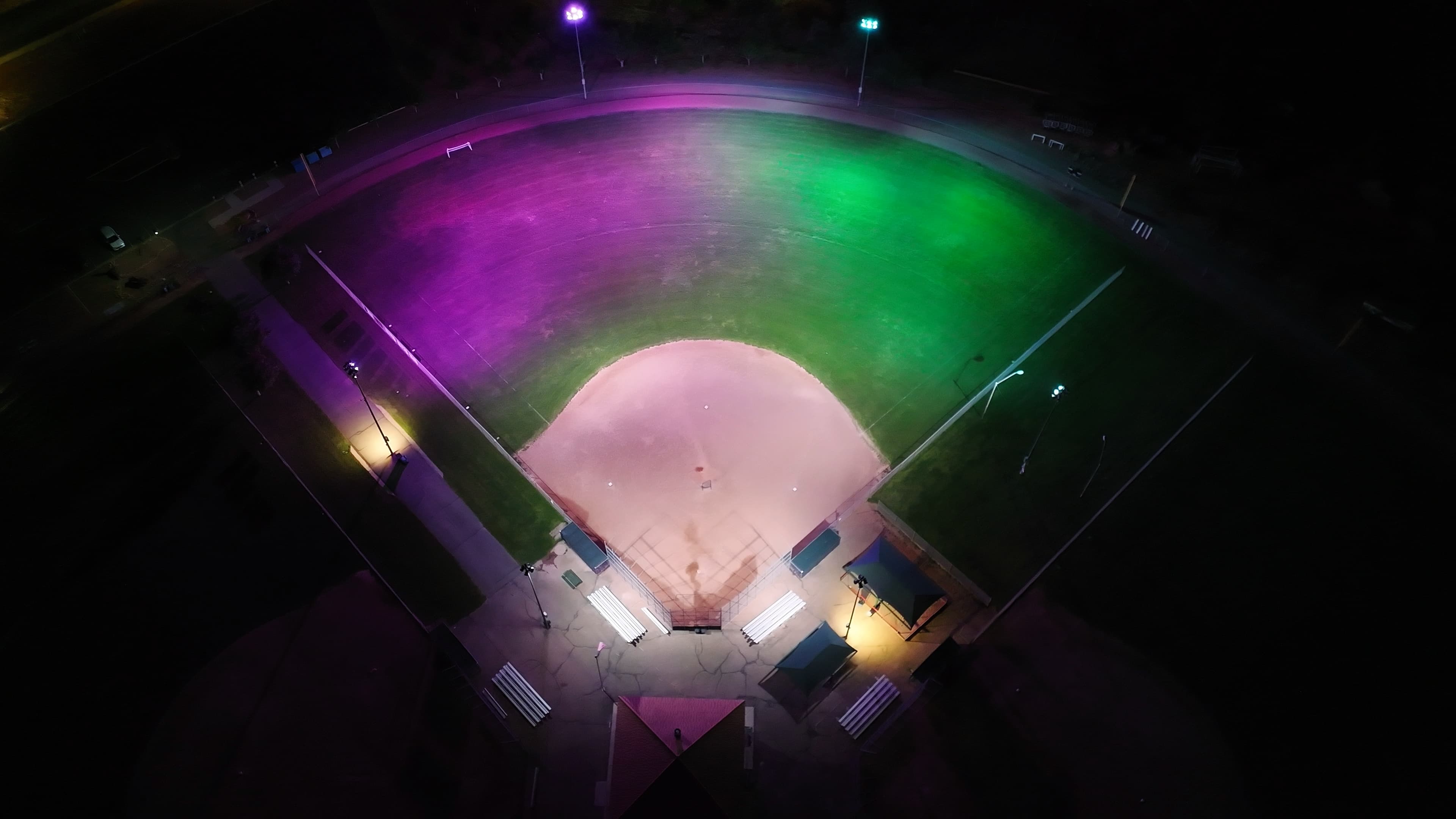
Why Baseball Lighting Deserves More Attention in Northeast Nebraska
For communities across Northeast Nebraska — from Norfolk and Madison County to the surrounding towns of Wayne, Columbus, and O'Neill — baseball and softball are woven into the culture. High school programs, American Legion leagues, recreational parks, and municipal athletic complexes all depend on well-lit fields to keep games running safely and competitively after sundown.
Yet many of these facilities are still operating with aging metal halide or high-pressure sodium (HPS) lighting systems that were installed decades ago. These legacy systems weren't designed with today's performance expectations in mind: they consume significantly more energy, require frequent lamp replacements, take 15–20 minutes to warm up, and often produce uneven light that creates hazardous shadows in the outfield or warning track. In a region where municipal budgets are carefully managed and energy costs matter, the case for upgrading to modern LED sports lighting has never been stronger.
At VOSS, we believe great lighting is more than a utility — it's infrastructure that supports athletic development, community pride, and long-term operational efficiency. This article explores what's driving the shift to LED baseball lighting, what facility managers and parks departments in the Norfolk area should know before beginning a project, and how to approach an upgrade thoughtfully and strategically.
The Science Behind High-Performance Baseball Lighting
Baseball is one of the most lighting-demanding sports in existence. A batter tracking a 90-mph fastball, a center fielder reading a fly ball off the bat, or an umpire calling a pitch on the outside corner — all of these moments depend on precise, consistent illumination that legacy systems simply cannot deliver reliably.
Modern LED sports lighting systems are engineered with sport-specific photometric design at their core. Here's what separates professional-grade baseball lighting from a generic outdoor LED installation:
- Pole placement and aiming angles — Strategic pole positioning minimizes glare in batters' lines of sight while maximizing coverage from foul line to foul line. Poor pole placement is one of the most common — and costly — mistakes in field lighting design.
- Uniformity ratios — Governing bodies such as the NCAA, National Federation of State High School Associations (NFHS), and USA Baseball publish minimum uniformity standards. A well-designed system ensures the ratio between the brightest and darkest points on the field stays within acceptable limits, eliminating the "patchwork" effect common in aging installations.
- Glare control — Shields, optics, and precise beam angles are used to keep direct glare out of players' peripheral vision and eliminate spill light into neighboring residential areas — an important consideration for urban and semi-urban fields in communities like Norfolk.
- Vertical illuminance — Unlike parking lots or warehouses, baseball fields require strong vertical light to illuminate a ball in flight. Properly engineered systems account for this dimension in ways that general-purpose outdoor lighting does not.
- Instant-on capability — LED systems reach full brightness immediately, with no warm-up delay. This is critical for managing rain delays, late-start games, and broadcast schedules at any level of play.
Understanding these technical factors is the first step toward making an informed decision — whether you're a parks director evaluating a capital improvement project, a school athletic director advocating for a field upgrade, or a booster club raising funds for a new facility.
Energy and Cost Trends Reshaping Sports Lighting Decisions
The financial calculus for LED sports lighting has shifted dramatically over the past decade. What was once a premium technology reserved for professional venues is now accessible — and economically compelling — for community parks and small municipal programs.
Here's what facility owners and operations leaders in the Norfolk area should understand about the economics:
Energy consumption reductions are the headline benefit. LED systems typically consume 50–70% less energy than the metal halide systems they replace. For a field that operates several nights per week across a full spring and summer season, that reduction translates into meaningful savings on utility bills year after year.
Maintenance costs drop significantly. Traditional HPS and metal halide lamps require replacement every 2,000–5,000 hours and begin losing lumen output well before they fail entirely. Quality LED fixtures are rated for 50,000–100,000 hours of operation, dramatically reducing the frequency of expensive bucket truck rentals and lamp replacement labor — costs that are easy to overlook in a total cost of ownership analysis.
Rebate programs can offset upfront investment. Nebraska utility providers and state-level energy efficiency programs may offer incentive rebates for qualifying LED upgrades. VOSS has extensive experience navigating rebate applications on behalf of clients — our team handled the full rebate management process for the Blue Cross Blue Shield of Nebraska parking lot lighting upgrade, helping that project reduce energy usage by over 56% while offsetting installation costs through available incentives. The same expertise applies to sports lighting projects.
Nebraska state contract eligibility simplifies procurement. VOSS holds an approved state contract in Nebraska, meaning government entities — including municipalities, school districts, and county parks departments in the Norfolk and Madison County area — can procure lighting and electrical services through a compliant, pre-approved vehicle. Cooperative purchasing programs including Sourcewell, BuyBoard, TIPS, AEPA, Omnia Partners, PACE, and the Nebraska ESU Co-Op are also available to eligible public-sector organizations, streamlining the path from project approval to installation.
Lessons from the Field: What Real Projects Reveal
VOSS brings hands-on sports and recreation lighting experience from across Nebraska and the broader region. Our work at the Salvation Army Kroc Center gymnasium in Omaha offers a relevant illustration of the kind of transformation that's possible when lighting design is approached with precision.
At the Kroc Center, the facility was running 99 fluorescent high bay fixtures in a gymnasium used year-round for athletic events and community programming. The energy burden was high, and maintenance demands — sometimes weekly lamp replacements — were consuming staff time and budget. VOSS redesigned the lighting layout from the ground up, specifying long-life LED high bay fixtures and reducing the total fixture count from 99 to 47 without sacrificing light quality. The result: energy usage cut in half, projected annual savings of $4,257, and a facility that Carl Larson, Head of Facilities, called "truly remarkable" in its transformation.
While a gymnasium and a baseball field present different engineering challenges, the underlying discipline is the same: understand the space, model the photometrics carefully, right-size the system, and don't treat lighting as an afterthought. That approach is what VOSS brings to every sports facility project.
For baseball-specific work, VOSS references the Page, AZ baseball lighting project as a proof point for our capability to deliver engineered field lighting solutions that meet sport-specific standards at real facilities. Our Lincoln branch team works with clients across Northeast Nebraska — including communities along the Highway 275 corridor, the Elkhorn River valley, and the broader area stretching toward Pierce, Stanton, and Antelope counties — to assess existing conditions, model upgrade scenarios, and manage projects from photometric design through commissioning.
Choosing the Right Partner for Your Baseball Lighting Project
Not every electrical contractor has the specialized experience that baseball and softball lighting demands. When evaluating partners for a field lighting project in the Norfolk area, facility managers and athletic directors should ask the right questions:
- Do they perform photometric modeling? A credible sports lighting contractor will provide a detailed light layout simulation — often called an AGi32 or DIALux model — showing predicted footcandle levels and uniformity ratios across the entire field before a single fixture is ordered.
- Are they familiar with governing body standards? NFHS, NCAA, USA Baseball, and local league associations all publish lighting level requirements. Your contractor should be able to specify a design that meets or exceeds the appropriate standard for your level of play.
- Can they manage the full project scope? From pole foundations and electrical service upgrades to fixture installation, controls integration, and utility rebate applications, a full-service contractor eliminates the coordination gaps that cause delays and cost overruns.
- Do they offer controls integration? Modern LED sports lighting pairs naturally with smart controls — dimming systems, scheduling automation, and remote monitoring — that further reduce energy consumption and simplify operations. This is especially valuable for multi-use athletic complexes managing fields across different sports seasons.
- What is their track record in Nebraska? Local experience matters. Understanding utility rate structures, rebate program timelines, and the procurement landscape in Nebraska is knowledge that comes from working in the market — not just reading about it.
VOSS has operated in Nebraska for decades, with a Lincoln branch serving the greater region including Norfolk and the communities of Northeast Nebraska. Our team includes lighting designers, project managers, and licensed electricians who understand both the technical and logistical demands of field lighting at every scale.
Further Reading in This Series
If baseball and softball lighting is one piece of a larger facility modernization conversation, VOSS has developed related resources that may be useful to facilities professionals in the Norfolk area. Our articles on LED Gymnasium Lighting Solutions, Pickleball LED Lighting Solutions, and Tennis Court Lighting and Energy Solutions explore similar themes for adjacent sports environments. For organizations evaluating their full energy profile, our coverage of Energy Audits, Incentives, and Rebate Navigation for Businesses and Commercial LED Outdoor Lighting provides broader context. These resources are available through the Latest Lighting section of the VOSS website.
Service Availability
While VOSS offers a comprehensive suite of national services, specific capabilities may vary by location. Please contact your local branch to confirm the current availability of specific services, technology solutions, or contracting capabilities in your immediate market.
Talk to Our Lincoln Branch About Your Facility
Whether you're planning a full field lighting replacement, evaluating a retrofit for an existing system, or simply trying to understand what a modern LED upgrade would cost and deliver for your baseball or softball complex in Norfolk or the surrounding Northeast Nebraska region, VOSS is ready to have that conversation.
Our Lincoln branch team serves communities across the greater area — including Wayne, Pierce, Madison, Columbus, O'Neill, and beyond — and can provide a no-pressure consultation to help you think through the scope, timeline, and financial case for your project.
VOSS — Lincoln Branch Phone: (402) 328-2283 Toll-Free: (800) 733-8677
Reach out today to schedule a consultation and learn how the right lighting design can transform your baseball or softball facility into a safer, more efficient, and more enjoyable place to play.