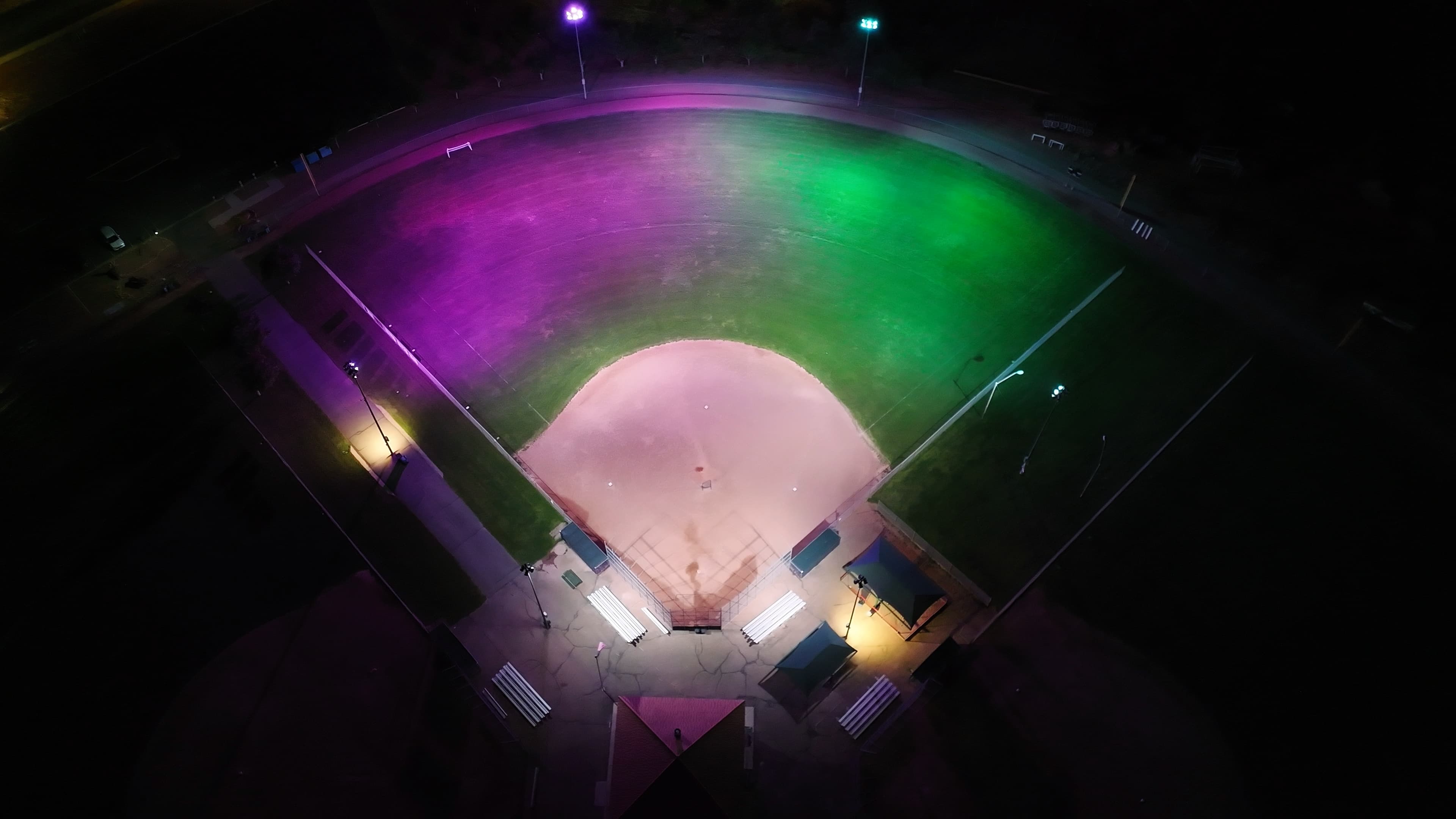
Why Baseball Lighting Is More Than Just Turning on the Lights
Across south-central Nebraska, baseball and softball are more than recreational pastimes — they're community anchors. From youth leagues playing on city park fields in Hastings to collegiate and semi-pro programs drawing regional crowds, the quality of a facility's lighting has a direct and measurable impact on player safety, game quality, and community engagement.
Yet many fields throughout the Greater Lincoln region — including those serving Adams County and surrounding communities like Kearney, Grand Island, and York — still rely on aging metal halide or high-pressure sodium (HPS) lighting systems that are increasingly difficult to justify. These technologies waste energy, require extended warm-up periods, demand frequent maintenance, and struggle to deliver the uniform illumination that modern play and broadcast standards require.
LED sports lighting technology has fundamentally changed what facility owners, parks and recreation departments, and athletic directors can expect from their fields. Understanding those changes — and what drives successful projects — is what separates a well-executed upgrade from a costly misstep.
The Science Behind Sports-Specific LED Lighting Design
Not all LED lighting is created equal, and nowhere is that more apparent than on a baseball diamond. The geometry of the sport creates unique photometric challenges: a batter tracking a pitch at 70+ mph needs consistent light levels from home plate through the pitcher's mound; an outfielder reading a fly ball needs shadow-free illumination across deep center field; and an umpire needs enough vertical illumination to make accurate calls at every base.
Designing for these demands requires more than selecting a bright fixture. Effective baseball LED lighting systems are engineered around several key principles:
- Pole Placement and Mounting Heights — Proper pole positioning minimizes glare into batters' eyes and ensures light reaches the warning track and foul lines without creating unlit zones or excessive spill onto neighboring properties
- Uniformity Ratios — Governing bodies including Little League International, the NFHS, and the NCAA each publish specific uniformity standards. A well-designed system ensures the ratio between the brightest and darkest points on the field stays within acceptable ranges — a metric that directly affects how players track the ball
- Foot-Candle Targets by Level of Play — A youth recreational field has different illumination requirements than a high school varsity diamond or a collegiate facility. Photometric modeling during the design phase ensures the right light levels are achieved at the right investment level
- Glare Control — LED systems can be engineered with precision optics that direct light onto the field rather than into the sky or surrounding areas, reducing light trespass and supporting good-neighbor relations in community settings
- Vertical Illuminance — Often overlooked, vertical illuminance determines how well players can see a ball in flight. High-quality sports LED systems are modeled in three dimensions to account for this critical factor
When VOSS designs a baseball lighting system, our team begins with a thorough photometric analysis of the site — accounting for field orientation, pole locations, desired foot-candle targets, and applicable league standards. This upfront engineering investment is what ensures the finished installation performs as expected on opening night and for decades to come.
LED Upgrades in the Heartland: What the Data Is Telling Facility Operators
The energy economics of LED conversion are compelling across any industry, but sports lighting offers some of the most dramatic return-on-investment profiles available in commercial electrical work. Traditional metal halide fixtures used in sports applications commonly consume 1,000 to 1,500 watts per fixture. Modern LED equivalents can deliver equal or superior performance at a fraction of that draw.
VOSS has documented this impact firsthand across Nebraska. When we completed a gymnasium lighting retrofit for the Salvation Army Kroc Center in Omaha, the project reduced the total fixture count from 99 units down to 47 — cutting energy consumption in half and projecting $4,257 in annual savings. While a gymnasium is a different environment than an outdoor ballpark, the underlying principle is identical: smart LED design delivers more light with fewer fixtures and far less energy.
For outdoor athletic facilities, those savings compound further. Fields that operate 30 to 50 nights per season for games and practices — along with extended use for tournaments and special events — accumulate substantial lighting hours. Every kilowatt-hour saved translates directly to operating budget relief for parks departments, school districts, and private facility operators across Adams County and the surrounding region.
Nebraska utility providers, including those serving the Hastings area, offer energy efficiency incentives that can meaningfully offset the upfront cost of LED conversions. VOSS has extensive experience navigating rebate programs on behalf of clients — a process we managed successfully for Blue Cross Blue Shield of Nebraska's parking lot lighting upgrade, helping offset project costs through rebate coordination. The same expertise applies to outdoor sports lighting projects.
Controls and Smart Systems: Taking Baseball Lighting Further
Modern LED sports lighting systems aren't just more efficient — they're significantly more capable. Controls integration is increasingly becoming a standard expectation for new and retrofitted baseball facilities, and for good reason.
Wireless Lighting Controls allow facility managers and parks staff to operate fields remotely — scheduling lights to turn on before a game and off after the last inning without requiring on-site personnel. This is particularly valuable for smaller communities like Hastings, where parks and recreation staff often manage multiple facilities simultaneously.
Dimming and Scene Control enable facilities to run at reduced output during practice sessions, reducing energy consumption during the hours that don't require full game-level illumination. This alone can dramatically improve the economics of operating a lighted field.
Programmable Scheduling eliminates the risk of lights being left on overnight — a common and costly issue with older systems that lack remote management capability.
Broadcast and Event Modes are increasingly relevant as tournament play and streaming events expand. LED systems designed for broadcast can be configured to eliminate the flicker that older HPS and metal halide systems produce on camera, delivering clean, professional-quality footage for any level of production.
For public-sector facility operators in Hastings and across Greater Lincoln, controls integration can also support compliance with municipal dark-sky ordinances and community standards around light pollution — an area of growing concern in Nebraska's rural and suburban communities.
A Proof Point from the Region: The Page, AZ Baseball Case Study
VOSS has delivered LED lighting solutions for baseball and softball facilities at multiple scales, and our work in Page, Arizona stands as a strong example of what a well-engineered sports lighting project can accomplish. The Page project demonstrates our team's capability to manage site-specific photometric design, pole and fixture specification, installation, and commissioning — delivering results that meet league standards and improve the experience for players and fans alike.
This kind of end-to-end project management is central to how VOSS approaches every sports lighting engagement. From the initial photometric layout to the final commissioning walk-through, our Lincoln branch team brings the same rigor and accountability to a community field in Hastings as we bring to larger regional venues.
Who This Matters For in the Hastings Market
The conversation around baseball LED lighting in south-central Nebraska touches a wide range of decision-makers:
- Parks and Recreation Directors managing aging municipal fields in Hastings and Adams County are balancing community expectations for quality facilities against the realities of constrained public budgets. LED upgrades — especially when paired with available rebates and cooperative purchasing programs — can make full field renovations achievable within existing capital plans
- School Athletic Directors at Hastings High School and other Adams County programs understand that quality lighting supports longer practice windows, extended evening game schedules, and the ability to host regional and state-qualifying events that bring economic activity into the community
- Booster Organizations and Youth League Administrators looking to improve facilities for players and attract tournament revenue benefit from the same technology improvements — and may find that a phased LED upgrade pays for itself over time through reduced utility and maintenance costs
- Private Facility Operators and sports complex developers serving the Greater Lincoln corridor, including communities like Aurora, Clay Center, and Minden, can leverage VOSS's design and procurement capabilities to build facilities that compete for regional and statewide events
Procurement Options for Public-Sector Organizations in Nebraska
For government entities, school districts, and other public-sector organizations in Hastings and across Nebraska, VOSS holds an approved state contract in Nebraska — enabling eligible organizations to procure lighting and electrical services through a compliant, pre-vetted pathway without the time and administrative burden of a standalone bidding process.
VOSS is also an approved vendor through multiple cooperative purchasing programs, including Sourcewell, BuyBoard, TIPS, AEPA, Omnia Partners, PACE, and the Nebraska ESU Co-Op. These programs provide additional flexibility for public-sector clients to move projects forward efficiently while meeting procurement requirements.
If your organization is evaluating a baseball or softball lighting project and wondering how to structure the procurement process, our Lincoln team can walk you through the options that apply to your specific situation.
Explore Related Topics from VOSS
Baseball lighting is one part of a broader conversation about sports and recreational facility upgrades. If you're also managing court-based athletic facilities, our content on LED Gymnasium Lighting Solutions and Pickleball LED Lighting Solutions covers similar design and energy considerations for indoor and outdoor court environments. For those evaluating outdoor site lighting more broadly, our Parking Lot and Outdoor LED Lighting Upgrades and Commercial LED Outdoor Lighting pages offer additional context. And for facilities in Nebraska navigating changing lamp regulations, our coverage of Fluorescent Tube Bans and LED Lighting Rebates may be directly relevant to your operations.
Service Availability
While VOSS offers a comprehensive suite of national services, specific capabilities may vary by location. Please contact your local branch to confirm the current availability of specific services, technology solutions, or contracting capabilities in your immediate market.
Talk to VOSS About Your Baseball Lighting Project
If you're responsible for a baseball or softball facility in Hastings, Adams County, or anywhere across the Greater Lincoln region, VOSS is ready to have a substantive conversation about what a lighting upgrade could mean for your players, your fans, and your operating budget. Our Lincoln branch team brings local market knowledge and 85+ years of national experience to every engagement — whether you're planning a full-scale renovation or just beginning to explore your options.
VOSS — Lincoln Branch Phone: (402) 328-2283 Toll-Free: (800) 733-8677
Reach out to schedule a consultation. We'll start with your facility's specific needs and help you understand exactly what's possible.