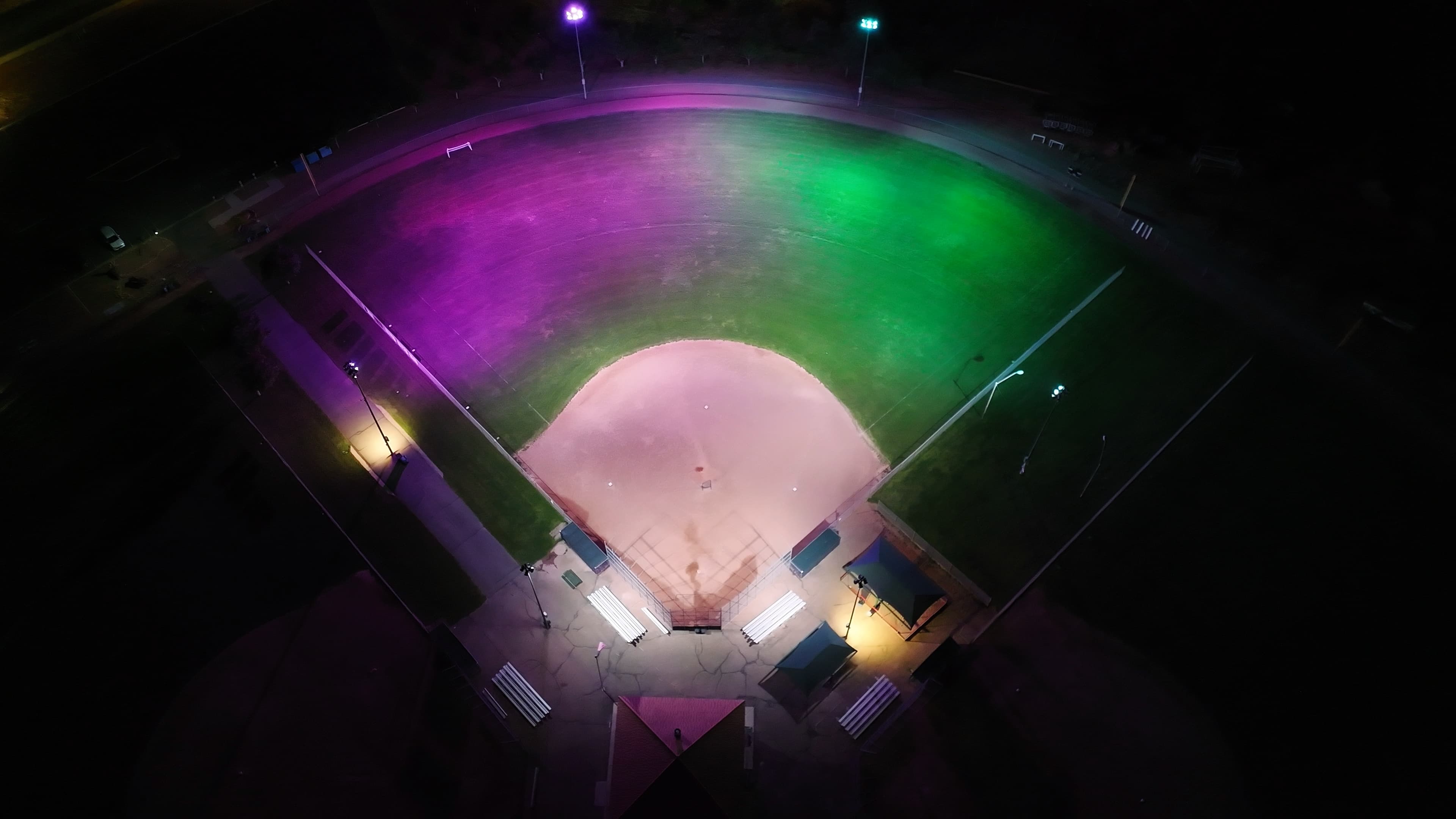
Why Baseball Lighting Deserves More Than an Afterthought in Grand Island
Grand Island, Nebraska has a strong sporting culture — from youth recreational leagues drawing families on warm summer evenings to high school programs competing under the lights at some of the region's most well-attended athletic events. With a population of over 53,000 and a community that takes pride in its parks, schools, and athletic facilities, Grand Island is exactly the kind of market where the quality of a ball field's lighting system matters — not just to facility managers, but to players, parents, and the broader community.
Yet many baseball and softball facilities across Hall County and the surrounding area are still running on aging metal halide or high-pressure sodium (HPS) systems that were installed decades ago. These systems bring real costs: high energy bills, frequent lamp replacements, uneven light distribution, and slow warm-up times that frustrate coaches and broadcasters alike. As lighting technology continues to evolve, the gap between what's possible and what's in place at many local fields is widening — and that gap has meaningful consequences for the people who use those facilities every day.
This article explores what modern LED sports lighting looks like for baseball and softball facilities, why the transition is happening faster than many operators expect, and what facility owners and managers in the Grand Island and Greater Lincoln region should know before planning their next project.
The Science Behind Sport-Specific Baseball Lighting
Not all LED lighting is created equal — and baseball fields present some of the most technically demanding lighting challenges in the sports world. A football field is a rectangle. A basketball court is a fixed, enclosed space. A baseball diamond, by contrast, is a complex geometry: a 90-foot infield diamond, a sprawling outfield that extends several hundred feet, a warning track, dugouts, bullpens, and spectator areas — all requiring precisely coordinated light distribution from a carefully engineered arrangement of poles and fixtures.
The stakes are high because the game demands it. A batter needs to see a pitch leaving the pitcher's hand at 80-plus miles per hour. An outfielder needs to track a fly ball against a dark sky. An umpire needs to make split-second calls on the base paths. All of this depends on lighting that is:
- Uniform and consistent — eliminating hot spots and dark zones across the entire playing surface
- Glare-controlled — positioned and shielded to prevent blinding players, coaches, and umpires at critical moments
- Color-accurate — delivering a high Color Rendering Index (CRI) so the ball and field markings are clearly distinguishable under artificial light
- Vertically effective — not just illuminating the ground plane, but providing adequate vertical illuminance so players can track a ball in flight
Modern LED systems, when properly designed by experienced engineers, address all of these factors simultaneously. Photometric modeling software allows lighting designers to simulate exactly how light will fall across a specific field's dimensions before a single fixture is installed — reducing guesswork and ensuring compliance with standards set by organizations such as the Illuminating Engineering Society (IES) and governing bodies for Little League, NFHS, NCAA, and professional play.
For facilities in the Grand Island area — whether a municipal park complex off Fonner Park Road, a high school field at Grand Island Senior High, or a recreational complex serving communities like Hastings, Kearney, or Central City — this level of design precision is what separates a lighting upgrade that performs from one that disappoints.
What's Driving the LED Transition at Baseball Facilities Across Nebraska
The shift toward LED sports lighting has accelerated significantly over the past several years, and it's being driven by a convergence of factors that are particularly relevant to facilities in Nebraska.
Energy costs and operational budgets are the most immediate motivator. LED systems consume dramatically less energy than metal halide equivalents — often reducing lighting-related electricity consumption by 50% or more. For a facility running lights four or five nights a week through a full spring and summer season, that translates into real, recurring savings on the utility bill. Our work with Blue Cross Blue Shield of Nebraska on a parking lot lighting upgrade in Nebraska achieved an energy reduction of over 56%, demonstrating the kind of efficiency gains that are achievable with a well-executed LED transition — even outside of a sports-specific context. The same principles apply on the field.
Maintenance burdens are another major driver. Metal halide lamps degrade over time — often losing 30-40% of their output before they fail entirely — and they require periodic relamping that pulls maintenance staff away from other priorities. LED fixtures are rated for tens of thousands of hours of operation with minimal lumen depreciation, meaning fewer interruptions, fewer emergency service calls, and more predictable capital planning. Our team's work at the Salvation Army Kroc Center gymnasium in Omaha illustrates this dynamic clearly: by replacing 99 aging fluorescent fixtures with 47 LED high bays, the facility cut its fixture count nearly in half, eliminated near-constant maintenance headaches, and achieved projected annual savings of $4,257. While a gymnasium and a baseball field are different environments, the operational logic is identical — fewer fixtures, better technology, and lower ongoing costs.
Broadcast and event readiness is increasingly important as well. LED systems reach full brightness instantaneously — no warm-up period, no cool-down before a re-strike. For facilities that host televised games, tournament events, or evening competitions that may be delayed by rain, this responsiveness is operationally significant. Paired with modern lighting controls, LED systems can also be dimmed for pre-game warm-ups, adjusted for different competition levels, or programmed for automated on/off scheduling — capabilities that older systems simply cannot replicate.
Cooperative Purchasing and State Contract Procurement for Nebraska Organizations
For public-sector organizations in Grand Island and across Nebraska — including municipalities, school districts, parks and recreation departments, and county governments — procurement compliance is a real constraint on any capital project. VOSS holds an approved state contract in Nebraska, making it straightforward for eligible government entities to procure lighting and electrical products and services through a compliant, cost-effective channel without the time and administrative burden of a standalone bid process.
In addition, VOSS participates in a wide range of cooperative purchasing programs that may be available to schools, municipalities, and other public institutions in the region, including AEPA, BuyBoard, TIPS, Sourcewell, Omnia Partners, PACE, and the Nebraska ESU Co-Op. For parks and recreation departments in Hall County, or school athletic directors at facilities across the Greater Lincoln region from York to Lexington, these programs can significantly simplify the path from project concept to construction start.
Private facility operators — including privately managed baseball complexes, sports training facilities, and tournament venues — may also benefit from utility rebate programs that can offset a meaningful portion of upfront project costs. Our team navigates these incentive programs as a standard part of project planning, ensuring that clients in Grand Island and the surrounding area capture every available dollar.
Lighting Controls: The Feature Facility Managers Are Discovering Late
One of the most underappreciated elements of a modern LED sports lighting project is the controls system. Many facility managers focus their attention on the fixtures themselves — understandably so — but the controls layer is what transforms a lighting upgrade from a simple swap of technology into a genuinely smarter facility.
For baseball and softball venues, advanced lighting controls offer capabilities that were either unavailable or prohibitively expensive with older systems:
- Automated scheduling — lights come on and go off based on a programmable calendar, eliminating the risk of leaving fields lit all night after an event ends
- Dimming and zoning — fields can be divided into zones that are independently controlled, allowing managers to illuminate only the areas in active use
- Remote monitoring and management — facility staff can check system status, adjust settings, or respond to issues from a smartphone or tablet, without having to be physically present at the facility
- Emergency and event modes — pre-programmed scenes for specific situations, from tournament lighting levels to post-game dimming for player exit
This integration of lighting and controls is a thread that runs through much of VOSS's work in Nebraska. Our project with Trinity Lutheran Church in Omaha, for example, involved not just a retrofit of existing fixtures to LED but the commissioning of a full lighting control system that gave the congregation a user-friendly app to manage lighting scenes from a phone or wall-mounted tablet. The principle scales directly to athletic facilities: a parks and recreation director in Grand Island shouldn't have to drive to a ball field to manage a lighting situation — and with the right controls infrastructure, they won't have to.
Choosing the Right Partner for Your Baseball Lighting Project
A baseball LED lighting project is not a commodity purchase. It involves photometric engineering, structural considerations for pole placement and foundation design, electrical infrastructure assessment, and coordination across multiple trades and inspection processes. The quality of the outcome depends heavily on the expertise of the team executing it.
VOSS brings 85+ years of experience as a full-service commercial electrical contractor to every project — including sports lighting for facilities of every size and competitive level. Our team manages every phase of the process: photometric design, equipment specification, permitting coordination, installation, commissioning, and post-project support. We work with industry-leading fixture manufacturers and design to the specific standards required by each facility's governing body, whether that's a local parks and recreation commission, a state athletic association, or a national governing body.
For facilities across the Grand Island area — and communities throughout Greater Lincoln including Hastings, Kearney, Columbus, York, and beyond — our Lincoln branch provides local project management backed by VOSS's national resources and experience.
Service Availability
While VOSS offers a comprehensive suite of national services, specific capabilities may vary by location. Please contact your local branch to confirm the current availability of specific services, technology solutions, or contracting capabilities in your immediate market.
Talk to a Sports Lighting Expert at Your Local VOSS Branch
If you manage a baseball or softball facility in Grand Island, Hall County, or anywhere across the Greater Lincoln region, now is the right time to understand what a modern LED lighting upgrade could mean for your operation — your energy costs, your maintenance workload, your players' experience, and your community's investment in athletic infrastructure.
Our Lincoln team is available to discuss your facility's specific needs, walk through what a photometric design process looks like, and help you identify financing, rebate, and procurement options that fit your organization's situation.
VOSS — Lincoln Branch Phone: (402) 328-2283 Toll-Free: (800) 733-8677
We also encourage you to explore related topics in our Latest Lighting series, including our articles on LED Gymnasium Lighting Solutions, Pickleball LED Lighting Solutions, LED Football Stadium Lights and Sports Field Lighting Solutions, and our broader resource on Energy Audits, Incentives, and Rebate Navigation for Businesses — all of which offer additional context for facilities leaders navigating lighting and energy decisions across their portfolios.