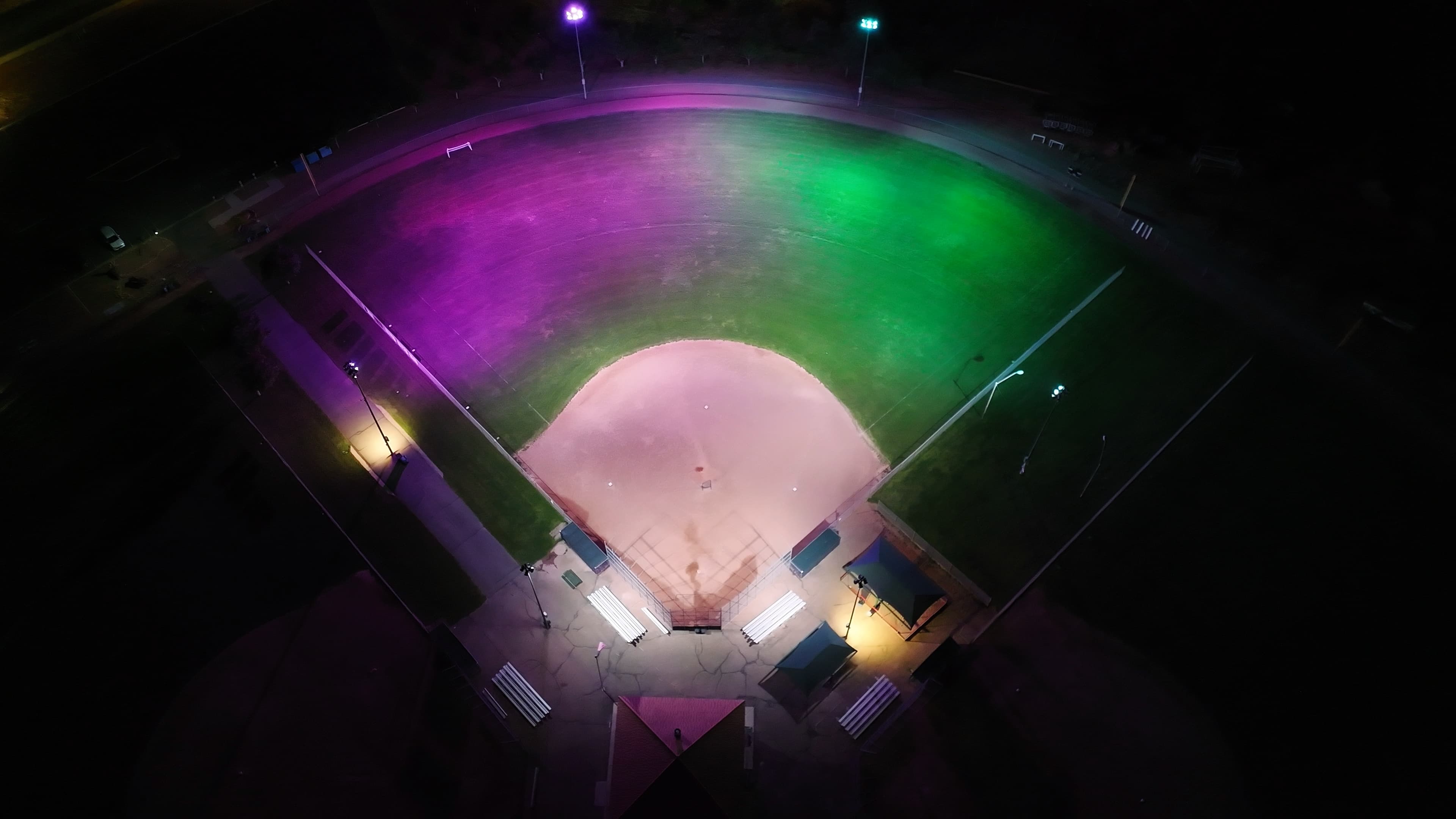
Why Baseball Lighting Is Having Its LED Moment in Greater Kansas City
Across Independence, Missouri and the surrounding Greater Kansas City metro — from Lee's Summit and Blue Springs to Raytown, Grandview, and Lenexa — a quiet but meaningful transformation is underway on baseball and softball diamonds. Aging metal halide and high-pressure sodium (HPS) systems that have served community parks, school athletic complexes, and recreation leagues for decades are reaching the end of their useful lives. And when facility managers and parks administrators begin exploring their options, they're discovering that LED technology isn't just a like-for-like replacement — it's a generational upgrade.
The conversation around LED sports lighting has accelerated nationally as fixture costs have declined, photometric design tools have matured, and utility rebate programs have made the economics increasingly compelling. For the Kansas City region specifically, where youth athletic participation is strong and municipal budgets are under constant pressure, the case for LED retrofits on baseball and softball fields has rarely been stronger. Understanding what makes a great baseball lighting project — and what separates a well-engineered system from a disappointing one — is where that conversation needs to start.
What Makes Baseball Lighting Uniquely Challenging
Not all sports lighting projects are created equal. A well-lit basketball gymnasium or pickleball court (topics explored elsewhere in VOSS' Latest Lighting content series) presents a very different engineering challenge than a baseball or softball field. The geometry of the game itself creates complexity: a batter tracking an incoming pitch at 90 mph needs consistent, shadow-free illumination across the entire plate. Outfielders reading a fly ball against a dark sky need uniform vertical illuminance without blinding glare. Infielders, base coaches, umpires, and catchers all have distinct sightline demands happening simultaneously.
Key design considerations for baseball and softball field lighting include:
- Pole placement and mounting height — Optimizing pole locations around the field to minimize shadows on the infield skin, warning track, and outfield grass requires careful photometric modeling before a single fixture is specified
- Uniformity ratios — Governing bodies including Little League International, NFHS (National Federation of State High School Associations), NCAA, and MLB each publish minimum uniformity standards; a properly engineered system doesn't just meet minimums — it exceeds them for player safety
- Glare control — Spill light onto adjacent residential areas and roadways is a real concern at parks throughout Independence and surrounding communities; modern LED optics can dramatically reduce glare and light trespass compared to legacy HID systems
- Vertical vs. horizontal illuminance — Batters and fielders interact with a ball moving through three-dimensional space; lighting designs that only optimize horizontal foot-candles while neglecting vertical illuminance create real visibility gaps
- Broadcast and multi-use readiness — Even community parks increasingly host streamed and recorded games; LED systems with high Color Rendering Index (CRI) ratings and flicker-free output perform significantly better on camera than older technology
These aren't abstract engineering concerns. They directly affect player safety, game quality, and — for parks departments and recreation commissions in Jackson County and the wider metro — the satisfaction of the families and athletes who use these facilities every night of the season.
Proof That LED Field Lighting Delivers: Lessons from Page, AZ
One of the most instructive real-world examples of what a well-executed baseball LED lighting project can deliver comes from Page, Arizona — a project in VOSS' portfolio that illustrates the gap between what LED technology promises and what it actually delivers when properly designed and installed.
The Page project involved upgrading a baseball facility to a full LED system, addressing the dual objectives that drive most field lighting decisions: improving the quality of the playing environment and reducing the long-term cost of operating the facility. The results demonstrated both. Players and officials experienced measurably better visibility across all zones of the field — the kind of improvement that shows up not just in photometric reports, but in the comments of athletes and coaches who practice and compete under the new system. Simultaneously, energy consumption dropped substantially compared to the legacy HID system it replaced, translating into meaningful operational savings for the facility over time.
What the Page project reinforces is a point that VOSS emphasizes consistently: the quality of the outcome depends heavily on the quality of the design process. Lighting a baseball field to professional standards isn't a product purchase — it's an engineered solution. The fixture specifications, pole layout, aiming angles, and controls integration all have to work together to produce a field that performs the way players and facility owners expect.
The Energy and Financial Case for Independence and Jackson County Facilities
For parks and recreation administrators, school district facility directors, and municipal officials across Independence and Jackson County, the financial calculus of LED field lighting has become increasingly favorable — and understanding the full picture matters when building a business case for capital investment.
Energy savings are real and substantial. LED systems for baseball fields typically consume significantly less energy than the metal halide systems they replace. For a field running lights multiple evenings per week through a full season, that reduction in kilowatt-hour consumption adds up quickly on the utility bill.
Maintenance costs drop dramatically. Metal halide lamps require periodic relamping — a cost that involves not just the fixtures themselves but the labor and equipment (often lift trucks) required to reach poles that may be 50, 60, or 70 feet tall. LED systems have dramatically longer rated lifespans, reducing the frequency and cost of maintenance interventions. For a parks department managing multiple facilities across Independence, Grain Valley, Oak Grove, and surrounding communities, that maintenance burden reduction is operationally significant.
Utility rebate programs can offset initial costs. Missouri utilities have offered rebate programs for energy-efficient lighting upgrades, and understanding what incentives may be available for your specific project can meaningfully improve the return on investment timeline. VOSS' team helps clients identify, apply for, and document utility rebates — a process covered in depth in the Energy Audits, Incentives, and Rebate Navigation resource within VOSS' Latest Lighting content series.
Controls integration multiplies the savings. Modern LED field lighting systems can be paired with smart controls — scheduling, dimming, occupancy-based automation, and remote management — that ensure lights aren't running at full output when fields are empty or partially occupied. For facilities that host a mix of youth practice sessions, adult league games, and occasional tournaments, intelligent controls deliver energy savings that go well beyond the baseline efficiency of the fixtures themselves.
Serving Independence, MO and the Greater Kansas City Region
VOSS' Kansas City branch serves the full Greater Kansas City metro area, including Independence and its surrounding communities. Whether the project is a single youth recreational field in a neighborhood park, a multi-field complex serving a competitive travel ball organization, a high school varsity facility in the Independence School District or nearby districts across Jackson, Clay, Platte, and Johnson counties, or a larger collegiate or professional venue, VOSS has the project experience and local presence to manage the work from photometric design through final commissioning.
For public-sector clients — parks departments, school districts, municipalities, and other government entities — procurement flexibility matters. VOSS holds an approved state contract in Missouri, which allows Missouri public agencies to access VOSS' solutions while meeting procurement requirements efficiently. Additionally, eligible organizations may utilize cooperative purchasing programs including Sourcewell, TIPS, BuyBoard, AEPA, Omnia Partners, PACE, and others, simplifying the contracting process and ensuring competitive pricing without the administrative burden of a standalone bid.
For athletic directors and facility managers at schools and parks across the Independence area, these procurement pathways are worth exploring early in the project planning process — they can meaningfully accelerate timelines and reduce administrative friction.
VOSS' expertise in baseball and softball lighting connects naturally to a broader range of sports and outdoor facility lighting work. The Latest Lighting content series includes related resources on LED Football Stadium Lights and Sports Field Lighting Solutions, Pickleball LED Lighting Solutions, Tennis Court Lighting and Energy Solutions, and LED Gymnasium Lighting Solutions — all relevant to organizations managing multi-sport athletic campuses across the Kansas City region.
Service Availability
While VOSS offers a comprehensive suite of national services, specific capabilities may vary by location. Please contact your local branch to confirm the current availability of specific services, technology solutions, or contracting capabilities in your immediate market.
Talk to VOSS About Your Baseball Facility in Independence or Greater Kansas City
If you're evaluating a LED lighting upgrade for a baseball or softball facility — whether you're in the early stages of scoping a project or ready to move forward — VOSS' Kansas City team is ready to have a practical, no-pressure conversation about what the right solution looks like for your field and your budget.
VOSS — Kansas City Branch Phone: (816) 471-8677
Reach out to discuss your facility's lighting goals, explore available utility incentives, and learn how VOSS can bring the same engineering precision and project expertise to your field in Independence, Lee's Summit, Blue Springs, Raytown, Grandview, or anywhere across the Greater Kansas City metro.