Why Baseball Lighting Deserves a Closer Look in Sugar Land
Sugar Land has long been more than a suburb of Houston — it's a city that takes baseball seriously. With a population of over 110,000 residents spread across thriving neighborhoods like First Colony, Telfair, and New Territory, and home to Constellation Field — one of the premier minor league venues in the state — this community has built a deep identity around the game. From Fort Bend County recreational leagues and high school programs across Clements, Austin, and Elkins High to adult amateur leagues at local parks, organized baseball is woven into the fabric of life here.
Yet despite this rich athletic culture, many of the region's baseball and softball facilities are still operating under aging metal halide or high-pressure sodium (HPS) lighting systems — technology that was standard 20 years ago but is increasingly inadequate by today's standards. In an era when players, parents, and fans expect a better experience, and when facility operators are under pressure to control operating costs, the conversation around LED lighting for athletic fields is no longer optional — it's essential.
This article explores what modern LED sports lighting means for baseball and softball facilities across Sugar Land and the Greater Houston area, and why getting the design right matters as much as the technology itself.
The Technical Reality: Why Baseball Lighting Is Uniquely Demanding
Not all sports lighting challenges are the same. Baseball and softball fields present a combination of factors that make lighting design genuinely complex — and getting it wrong has real consequences for player safety, game quality, and facility reputation.
Field geometry creates optical challenges. Unlike rectangular courts or rectangular football fields, a baseball diamond's asymmetrical layout — with an infield, outfield, foul territory, and warning track radiating outward from a single point — requires carefully engineered pole placement and aiming strategies to deliver uniform illumination across every zone. A batter facing a poorly aimed fixture bank doesn't just struggle to see the ball — they face a real safety risk.
Glare control is a non-negotiable priority. Poles positioned incorrectly, or fixtures with inadequate shielding, can create glare directly in the line of sight for batters, outfielders tracking fly balls, or catchers tracking pop-ups. Modern LED optics, designed specifically for sports applications, allow engineers to precisely aim light where it's needed while minimizing spill into players' eyes — a capability that older HID technology simply cannot match at the same level of precision.
League and governing body standards vary by level of play. Little League, NFHS (high school), NCAA, and professional organizations each publish specific illuminance requirements — measured in foot-candles — for infield and outfield zones. A well-designed LED system doesn't just meet these standards at installation; it's engineered to maintain performance over the life of the fixture, accounting for lumen depreciation.
Broadcast and media considerations are growing. Even at the high school and collegiate level, live-streaming of games has become standard practice. Cameras require higher, more consistent lighting levels than the human eye alone — a factor that smart LED designs account for from the beginning.
Understanding these technical realities is the foundation for any serious conversation about sports lighting upgrades in the Sugar Land and Greater Houston region.
LED vs. Traditional Sports Lighting: What Facility Operators Need to Know
For facility directors, parks and recreation administrators, and school district operations leaders across Fort Bend County and Harris County, the comparison between LED and traditional lighting systems comes down to several practical dimensions.
Energy consumption and operating costs. Traditional metal halide systems used in most older baseball facilities are energy-intensive and expensive to operate. LED systems typically consume significantly less electricity to deliver equivalent or superior illumination levels. For a municipality like Sugar Land — where CenterPoint Energy serves as the local utility and where city and school district budgets are always under scrutiny — lower kilowatt-hour consumption translates directly into recurring budget savings, year after year.
Maintenance burden and lamp life. Metal halide lamps degrade quickly, losing significant output within two to three years, and require regular group relamping to maintain consistent field conditions. LED fixtures, by contrast, are engineered for dramatically longer service lives — often 100,000 hours or more — with far slower lumen depreciation. For parks and recreation departments managing multiple facilities across Sugar Land, Missouri City, Stafford, and Richmond, reduced maintenance frequency has real operational value.
Instant-on performance. Metal halide systems require a warm-up period — often 15 to 20 minutes — before reaching full brightness, and if power is interrupted (as happens during storms common to the Houston area), they require an additional cool-down period before restarting. LED systems reach full brightness immediately. For night games, weather delays, and broadcast schedules, this is a meaningful operational advantage.
Controls integration and smart lighting. Modern LED sports lighting systems are designed to integrate with sophisticated controls platforms — enabling wireless dimming, scheduling, zone-by-zone management, and remote monitoring. A facility manager in Sugar Land can adjust field lighting levels from a smartphone, schedule automatic shutoffs, or integrate controls with a broader building management system. For organizations exploring smart campus or smart park infrastructure, this capability fits naturally into a larger technology vision.
For readers interested in the broader landscape of outdoor LED technology, our Commercial LED Outdoor Lighting and Parking Lot and Outdoor LED Lighting Upgrades articles in the Latest Lighting section explore complementary topics that apply to full-facility planning.
Proof in Practice: A Case Study from Page, AZ
Conceptual benefits are valuable — but real-world results tell the most compelling story. VOSS has directly delivered on baseball LED lighting projects, and one proof point worth examining is a project completed in Page, Arizona.
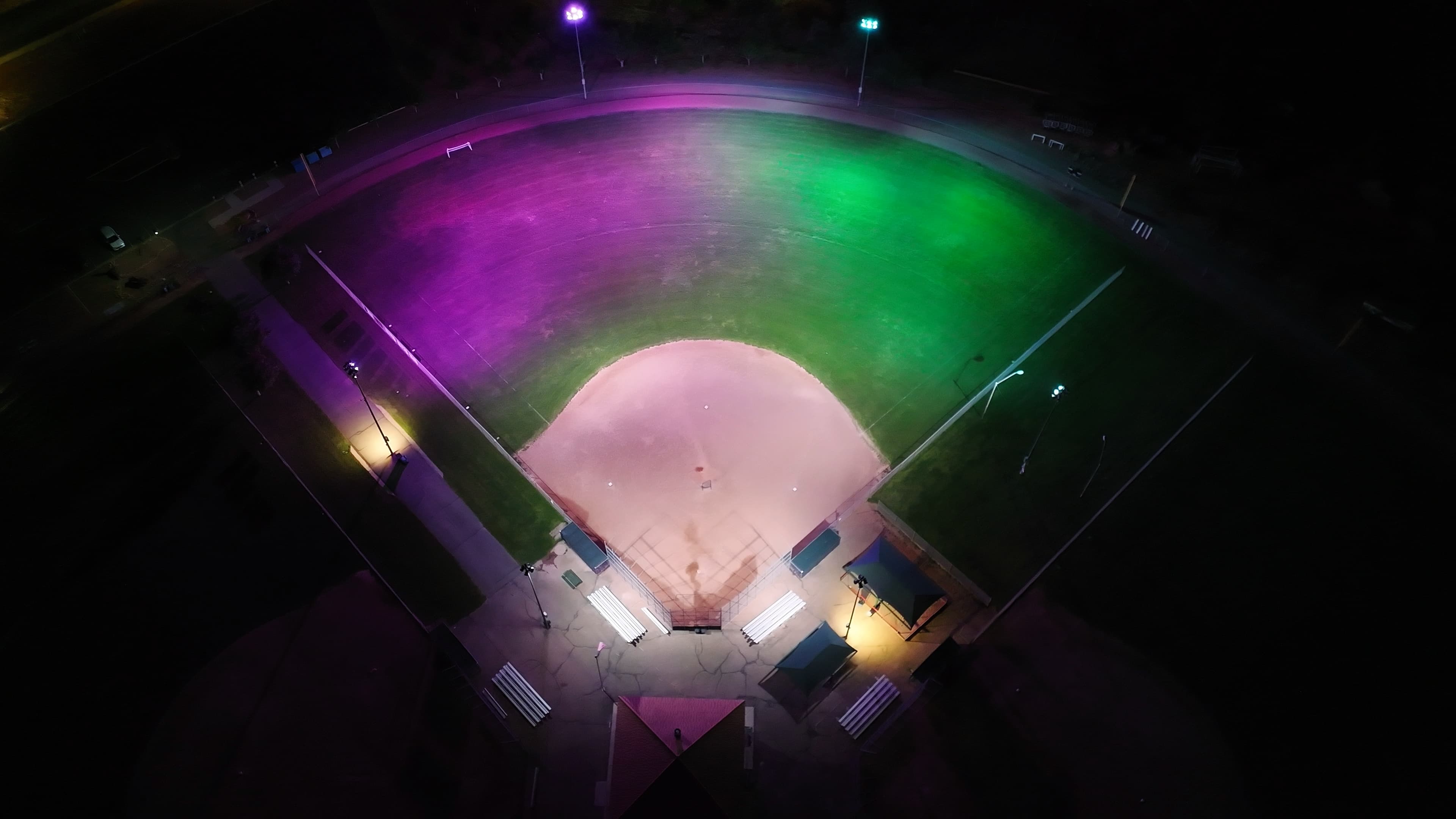
The Page, AZ baseball facility project gave VOSS the opportunity to engineer a complete LED lighting solution for a baseball field in a community where quality athletic facilities matter deeply to local residents. The project involved designing the photometric layout — the precise science of how light distributes across the field surface — selecting appropriate pole heights and fixture aiming angles, and managing the full installation process through commissioning.
The result was a field that met sport-specific illuminance standards, delivered noticeably improved visibility for players and spectators, and positioned the facility to benefit from dramatically lower energy operating costs compared to the prior lighting infrastructure.
This kind of project — a community field that serves youth athletes, adult leagues, and the broader public — is exactly the type of work VOSS has built its reputation on across more than 85 years of commercial electrical contracting. It isn't about delivering a product; it's about delivering a system that performs as promised, night after night, season after season.
For Greater Houston area communities like Sugar Land, Pearland, Katy, and Rosenberg, where recreational infrastructure investment is a reflection of community values, that track record matters.
What a Modern Baseball Lighting Project Looks Like
For facility administrators, school district capital planners, and parks directors considering a baseball lighting upgrade, understanding the project lifecycle helps set realistic expectations.
A well-managed LED sports lighting project typically moves through several phases:
- Photometric Design & Engineering — Before any hardware is specified or purchased, a lighting designer develops a photometric model of the field, simulating how light from proposed fixtures and pole locations will distribute across every zone. This phase ensures compliance with applicable league standards and identifies any potential glare or uniformity issues before they become field problems.
- Utility Incentive Assessment — In many cases, LED sports lighting upgrades qualify for rebates or incentive programs through local utilities. CenterPoint Energy serves the Greater Houston area and administers energy efficiency programs that may apply to qualifying projects. Identifying these opportunities early can meaningfully affect project economics.
- Procurement & Contracting — For public agencies, school districts, and municipalities in Fort Bend County and Harris County, procurement requirements can add complexity to project planning. Cooperative purchasing programs — including BuyBoard, TIPS, Sourcewell, Omnia Partners, and AEPA — provide pre-competed contract vehicles that simplify the procurement process for eligible organizations, helping public-sector buyers move forward with confidence and compliance.
- Installation & Commissioning — Physical installation of poles, fixtures, and wiring requires coordination with the facility's operational schedule — minimizing disruption to league play and community use. Commissioning ensures that every fixture is aimed and performing as the photometric design intended.
- Ongoing Support — A quality LED sports lighting project doesn't end at commissioning. Ongoing support — including controls management, performance monitoring, and warranty coordination — is part of what separates a true partner from a one-time vendor.
For organizations planning multi-sport facility upgrades, the Pickleball LED Lighting Solutions, Tennis Court Lighting and Energy Solutions, and LED Football Stadium Lights & Sports Field Lighting Solutions articles in our Latest Lighting section offer parallel guidance for other athletic environments. The LED Gymnasium Lighting Solutions article is also relevant for indoor athletic facilities connected to the same school or parks campus.
The Broader Opportunity: Baseball Lighting as Part of a Smarter Facility Strategy
Sugar Land's growth trajectory — and the broader expansion of Fort Bend County, one of the fastest-growing counties in Texas — means that investment in public and private athletic infrastructure will continue for the foreseeable future. New residential developments in communities like Sienna, Cross Creek Ranch, and Harvest Green bring families who expect high-quality recreational facilities close to home. Existing fields serving established neighborhoods need to keep pace.
For school districts like Fort Bend ISD, which serves a large and growing student population across Sugar Land and surrounding communities, athletic facility infrastructure is a meaningful part of capital planning. For the City of Sugar Land's parks and recreation department, field lighting quality directly affects programming capability — facilities that can be used safely after dark extend the usable hours for leagues, tournaments, and community events.
There is also a revenue dimension worth considering. Well-lit, high-quality baseball fields attract tournament play — a significant economic driver for municipalities. Regional and state-level tournaments bring visiting teams, families, and spectators who support local hotels, restaurants, and businesses. Field lighting quality is often a direct factor in tournament site selection.
This is the broader context in which baseball LED lighting decisions are made in Sugar Land — not simply a facilities maintenance question, but a community and economic investment with measurable returns.
Service Availability
While VOSS offers a comprehensive suite of national services, specific capabilities may vary by location. Please contact your local branch to confirm the current availability of specific services, technology solutions, or contracting capabilities in your immediate market.
Talk to a Sports Lighting Expert at VOSS Houston
Whether you're evaluating a first-time LED upgrade for a community park field, planning a multi-field complex renovation, or navigating a school district capital project, VOSS's Houston team is ready to help you think through the design, procurement, and implementation questions that matter most.
We bring more than 85 years of commercial electrical contracting experience to every project — along with the engineering depth, utility incentive knowledge, and project management capability to deliver results that hold up season after season.
VOSS — Houston Branch
(713) 996-8060
Reach out to start a conversation about your Sugar Land or Greater Houston area baseball or softball lighting project. We'll bring the expertise — you bring the vision for what your facility can become.