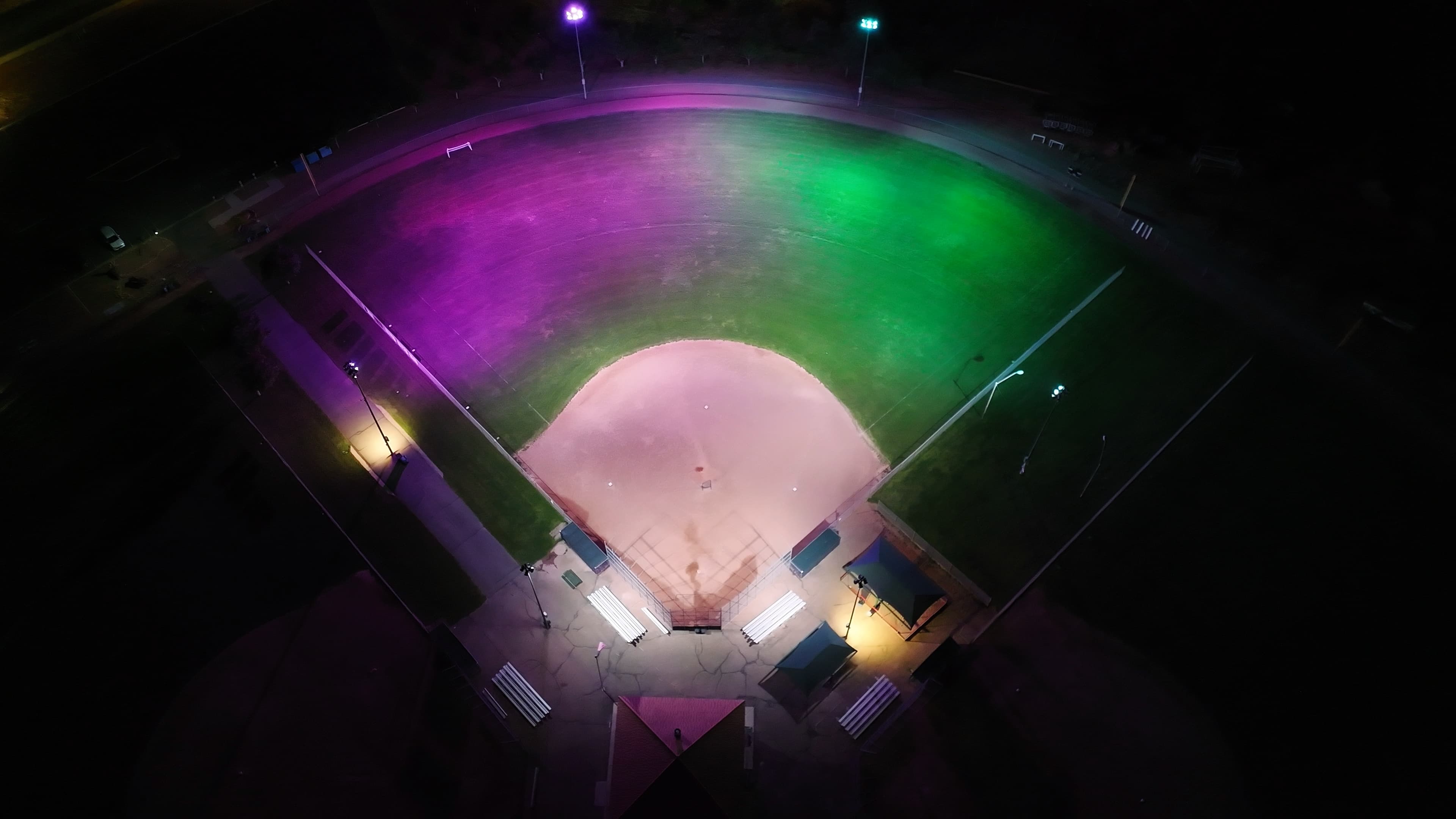
League City has grown into one of the most vibrant sports communities on the Texas Gulf Coast. With a population exceeding 115,000 and a steady influx of families drawn by proximity to the Johnson Space Center corridor, Clear Lake, and the broader Friendswood, Pearland, and Webster communities, demand for quality recreational infrastructure — including well-lit athletic fields — has never been higher. From community parks to travel ball complexes and high school stadiums, baseball and softball are woven into the fabric of daily life here.
Yet many facilities across the Greater Houston area continue to operate under aging metal halide or high-pressure sodium (HPS) lighting systems that were engineered decades ago. These legacy systems carry real costs: high energy consumption, long warm-up times, inconsistent light distribution, and increasingly expensive maintenance as replacement parts become harder to source. As the South Texas heat and Gulf Coast humidity accelerate fixture wear, facility operators are finding that the status quo is no longer sustainable — financially or operationally.
This article explores why the shift to LED sports lighting is accelerating across the region, what facility owners and administrators should understand before planning an upgrade, and how thoughtful design and controls integration can transform a baseball or softball facility into a truly high-performance venue.
The Science Behind Sport-Specific LED Lighting Design
Not all LED upgrades are created equal. A warehouse retrofit and a baseball field lighting project share very little in common beyond the technology type. Baseball lighting is among the most technically demanding applications in the commercial lighting world — and understanding why matters for any facility owner or parks administrator considering a project.
The core challenge is geometry. A baseball diamond presents a unique spatial problem: the infield, outfield, warning track, and foul zones all require different lighting intensities and angles, and the placement of light poles must account for sightlines from the batter's box, outfield positions, and the stands. Poor pole placement or inadequate photometric modeling can create glare zones that impair a batter's vision or leave pockets of shadow in the outfield that compromise player safety.
Professional-grade LED sports lighting addresses these challenges through:
- Precise Photometric Design — Advanced modeling software calculates light distribution across every square foot of the playing surface before a single fixture is ordered, ensuring the final installation meets uniformity standards required by leagues ranging from Little League to NCAA and professional organizations
- Glare Control Engineering — Modern LED systems use precision optics and shielding to direct light onto the field, not into the eyes of players, fans, or neighbors — a growing concern in League City and surrounding communities where residential development continues to expand near athletic facilities
- Color Rendering Excellence — LED systems deliver high Color Rendering Index (CRI) scores, meaning the field appears in natural, true-to-life color — a meaningful improvement for players tracking fly balls and for broadcast and photography applications
- Instant-On Performance — Unlike metal halide systems that require 15–20 minutes of warm-up time, LED fixtures reach full output immediately. This matters enormously for facilities managing rain delays, scheduling flexibility, and late-arriving youth leagues in the busy spring and fall seasons
For facilities serving competitive travel programs, high school athletics, or adult leagues in communities like Dickinson, El Lago, Kemah, and Nassau Bay, these performance characteristics aren't amenities — they're expectations.
Energy Savings and the Financial Case for Upgrading
One of the most compelling arguments for LED sports lighting is the operating cost reduction — and it's an argument that resonates equally with parks and recreation directors, school district administrators, and private facility owners.
Traditional metal halide systems used at baseball facilities are energy-intensive. A six-pole, 1,500-watt-per-fixture configuration common on competitive fields can draw enormous amounts of power during evening game schedules. LED systems can reduce energy consumption by 50–70% compared to legacy technology, and that reduction compounds quickly across a full season of games, practices, and tournaments.
Beyond direct energy savings, consider the maintenance picture. Metal halide lamps degrade significantly in light output before they actually burn out — a phenomenon called lumen depreciation — meaning facility operators are often paying full energy costs for a fraction of the original light output. LED systems maintain consistent output over a dramatically longer rated lifespan, reducing both re-lamping labor and the facility disruptions that come with emergency maintenance during the season.
In Page, Arizona, VOSS completed a baseball field LED lighting upgrade that demonstrated exactly this kind of impact in a real-world setting. The Page project involved the full-scale replacement of an aging sports lighting system with a professionally designed and installed LED solution, delivering measurable improvements in field illumination quality and long-term energy performance. That project reflects the same methodology VOSS brings to facilities across Texas and the Gulf Coast region.
For public agencies and school districts in League City, Galveston County, and Harris County, utility incentive programs and cooperative purchasing vehicles can further improve the financial case for an upgrade. Eligible organizations may be able to access projects through cooperative purchasing programs including BuyBoard, TIPS, Sourcewell, Omnia Partners, AEPA, PACE, and Omnia Partners — streamlining the procurement process and potentially reducing both project cost and administrative burden.
Controls Integration: Running Smarter Facilities
A modern LED sports lighting upgrade isn't just about new fixtures — it's an opportunity to fundamentally improve how a facility is operated. Lighting controls technology has advanced dramatically, and today's systems offer capabilities that make a real difference in day-to-day management.
Wireless and App-Based Controls allow facility managers to schedule, dim, and operate field lighting remotely — eliminating the all-too-common problem of fields left lit overnight, which wastes energy and shortens fixture life. For a parks department managing multiple facilities across League City and neighboring communities, centralized controls can mean managing an entire portfolio of fields from a single interface.
Dimming and Scene Settings enable operators to pre-program lighting levels for different use cases — full competition brightness for varsity games, reduced output for practice sessions, minimal lighting for field maintenance or early-morning groundskeeping. This kind of granular control reduces energy consumption without any sacrifice in the appropriate experience for each use case.
Integrated Broadcast and Event Modes are increasingly relevant for facilities hosting tournament play, travel ball events, or any activity with video or photography. Consistent, flicker-free light output ensures that LED systems perform correctly at any camera shutter speed — something metal halide systems cannot reliably deliver.
For facility administrators in League City and across the Greater Houston market, controls integration also supports documentation and reporting — a growing priority for organizations tracking sustainability metrics, energy spending, or compliance with utility rebate program requirements.
For related insights on maximizing ROI through lighting rebates and energy incentives in the Texas market, the article on Maximize ROI with Commercial LED Lighting Rebates in Dallas, TX in this series offers a useful framework, as does the broader discussion in Energy Audits, Incentives, and Rebate Navigation for Businesses.
Planning a Baseball Lighting Project: What Facility Owners Should Know
Whether you're managing a single Little League complex in Clear Lake Shores or overseeing a multi-field tournament facility serving teams from across Galveston and Brazoria counties, the planning process for a LED sports lighting project follows a consistent set of best practices.
Start with a Photometric Study — Before any fixture selection or budgeting, a qualified lighting designer should conduct a photometric analysis of your specific field geometry. This study produces a detailed light-level map showing predicted foot-candles at every point on the playing surface, ensuring the design will meet the governing body standards for your use case — whether that's Little League, USSSA, high school UIL, or collegiate play.
Assess Your Electrical Infrastructure — LED sports lighting systems require robust electrical service, and older facilities may require service upgrades, panel work, or conduit replacement as part of the project. A full-service contractor can evaluate your existing infrastructure and scope the complete project — not just the fixtures — so there are no surprises during installation.
Understand Your Governing Body Requirements — Different leagues and levels of play specify different minimum foot-candle levels, uniformity ratios, and other technical standards. A knowledgeable partner can help you navigate these requirements and design a system that not only meets current standards but has capacity to accommodate future use cases.
Plan Around Your Season — In League City, the spring baseball season typically runs from February through May, with fall leagues active from August through October. Project timing should account for these schedules, ideally completing installation and commissioning during the offseason to minimize disruption to players, coaches, and families.
Consider the Full Lifecycle — The best LED sports lighting decisions are made with a full lifecycle perspective: upfront project cost, energy savings, maintenance expectations, warranty coverage, and controls capabilities all factor into the true value of a system over 15–20 years of operation.
VOSS's expertise in LED gymnasium lighting, pickleball court lighting, tennis court lighting, and broader outdoor and parking lot LED applications — all covered in depth in related articles in this series — reflects the same integrated approach we bring to every baseball and softball project.
Service Availability
While VOSS offers a comprehensive suite of national services, specific capabilities may vary by location. Please contact your local branch to confirm the current availability of specific services, technology solutions, or contracting capabilities in your immediate market.
Talk to VOSS About Your Field Lighting Project
VOSS's Houston branch serves League City, Clear Lake, Friendswood, Pearland, Dickinson, Webster, Kemah, Nassau Bay, El Lago, and communities across Harris and Galveston counties. Whether you're exploring a first-time LED upgrade, replacing a failing legacy system, or planning a new facility from the ground up, our team is ready to discuss how professional-grade baseball and softball lighting can elevate your facility — and your bottom line.
VOSS — Houston Branch
Phone: (713) 996-8060
We invite you to reach out for a consultative conversation about your field's specific needs, governing body requirements, and the energy and performance opportunities that a modern LED lighting system can deliver. There's no obligation — just the expertise of a team that has been designing and building better lighting environments for 85+ years.