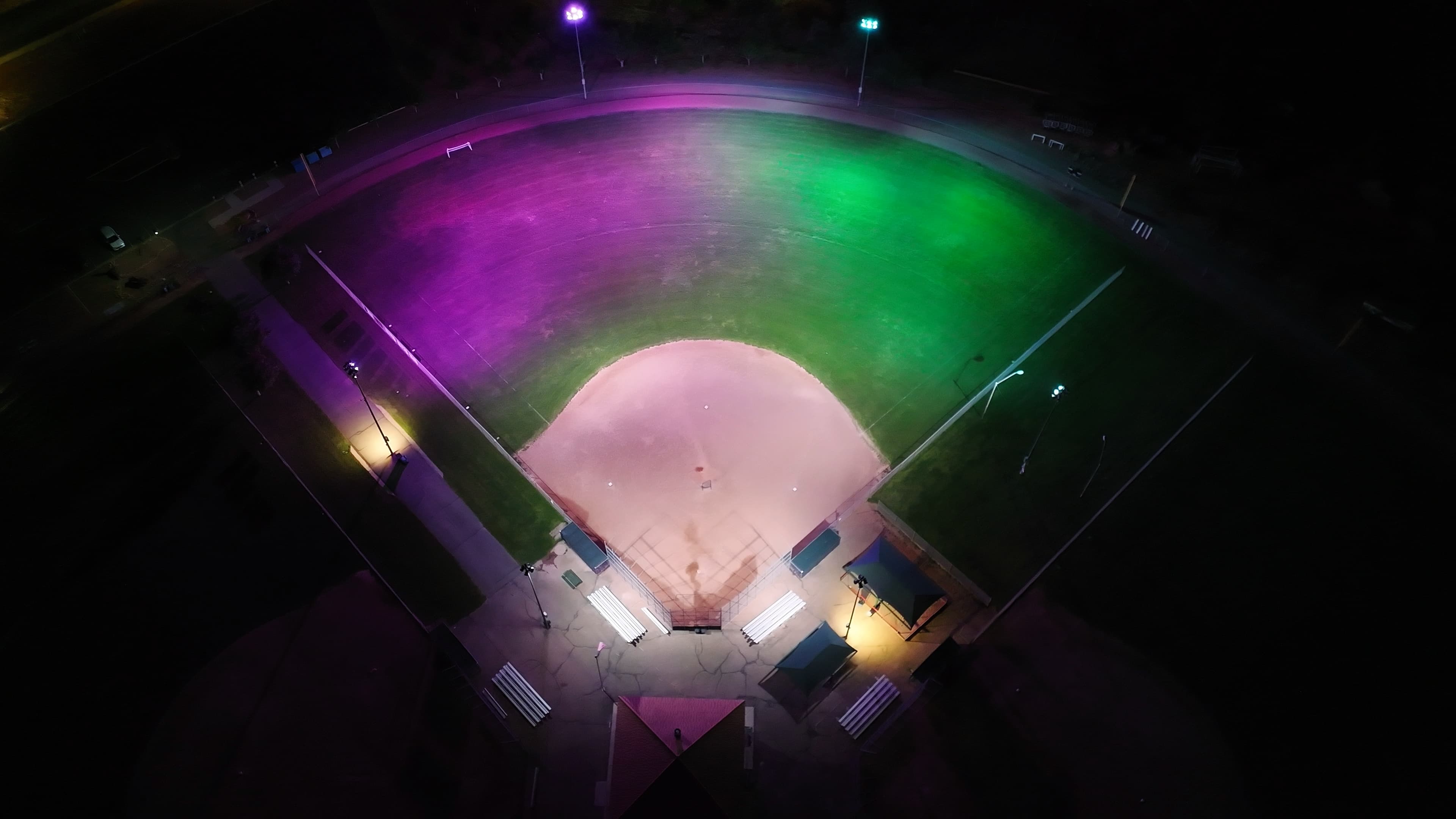
Why Baseball Field Lighting Is a Bigger Deal Than You Might Think
For communities like Wyoming, MI and the broader Greater Grand Rapids area, baseball and softball aren't just recreational activities — they're woven into neighborhood identity, school athletics programs, and municipal park systems that serve tens of thousands of residents. With a population of 76,000, Wyoming is one of the most active and densely populated communities in Kent County, sharing a metro area with Grand Rapids, Kentwood, Grandville, Walker, and Byron Center. That density means a lot of organized play — and a lot of athletic fields that need to perform after the sun goes down.
Yet lighting is often the last budget priority and the first thing that fails. Metal halide and high-pressure sodium (HPS) fixtures — the workhorses of outdoor sports lighting for decades — are aging out of practicality. They're expensive to operate, slow to warm up, and increasingly difficult to maintain as replacement parts become harder to source. For facility managers, park directors, and school athletic directors across the Grand Rapids metro, the question is no longer whether to upgrade to LED — it's when and how.
This article explores what a modern baseball LED lighting upgrade looks like, why it matters for your players and your operating budget, and what facility decision-makers in West Michigan should know before starting a project.
The State of Outdoor Sports Lighting in West Michigan
Michigan's sports seasons are unforgiving. Short summer windows, unpredictable spring weather, and compressed school athletic calendars mean that every night of usable field time is precious. Fields that go dark — due to lamp outages, extended warm-up delays, or uneven illumination — don't just inconvenience players. They cost money.
This is a challenge VOSS has seen firsthand across Michigan and the Midwest. At North Hills Middle School in Bloomfield, Michigan, an athletic director reached out after multiple lamp outages rendered the football field unusable for night games. The school had begun losing field rental revenue — a meaningful hit to an athletic budget — and player safety had become a concern. VOSS replaced all 68 of the existing 1,500-watt HID fixtures with 750-watt Keystone Sports Lighter LED fixtures and developed a full photometric layout to ensure uniform illumination across the entire playing surface.
The outcome was straightforward but powerful. Jacob McDermott, Director of Maintenance & Operations, described the results: "The new lights themselves are nothing short of amazing, providing brilliant and uniform illumination that dramatically enhances the field for both players and spectators."
While that project focused on a football field, the engineering principles and challenges are nearly identical for baseball and softball diamonds — and the West Michigan market faces the same pressures. Schools in the Wyoming-Grand Rapids corridor, municipal parks in Grandville, Walker, and Kentwood, and privately operated athletic complexes throughout Kent County are all candidates for the same type of transformative upgrade.
What Makes Baseball Lighting Uniquely Challenging
Baseball is one of the most technically demanding sports to light well. Unlike a basketball court or even a football field, a baseball diamond introduces complex geometry — irregular field dimensions, outfield fences at varying distances, and a mix of infield dirt and outfield grass that reflects light differently. Add in the critical safety considerations for batters tracking a pitch at 70–90+ mph, and it becomes clear that this isn't a commodity lighting purchase.
Effective baseball and softball LED lighting requires:
- Photometric design precision — Pole placement, mounting heights, aiming angles, and fixture counts must be engineered specifically for each field's dimensions and orientation
- Uniformity ratios that meet governing body standards — Little League, NFHS, NCAA, and professional leagues each define minimum foot-candle levels and uniformity requirements; non-compliant lighting can affect game eligibility and insurance coverage
- Glare control — Poorly aimed or over-lamped fixtures can blind batters, outfielders, and pitchers, creating both performance and safety issues
- Spill and trespass management — Fields in residential neighborhoods like many found throughout Wyoming and greater Grand Rapids must minimize light spill onto adjacent properties
- Controls integration — Modern LED systems can be integrated with smart controls, dimming schedules, and remote monitoring, reducing energy use during warm-ups, practice sessions, and post-game wind-down
These aren't details that can be figured out after the fixtures are ordered. They require upfront engineering — and a contractor with direct experience in sports lighting design, not just general electrical work.
The LED Upgrade Advantage: Real Numbers, Real Impact
The shift from legacy HID or HPS technology to LED is one of the most financially justified upgrades available to facility operators today. For a typical baseball complex, the performance improvements are measurable across multiple dimensions.
Energy consumption is the most obvious. LED fixtures typically draw 40–60% less wattage than the metal halide systems they replace — as demonstrated in the North Hills Middle School project, where 1,500-watt HID fixtures were replaced with 750-watt LED units, cutting fixture-level wattage in half. Across a full complex with multiple fields running two to three nights a week through a full spring and summer season, those savings compound quickly.
Maintenance costs are often an even bigger driver for facility managers. HID lamps require regular group relamping, ballast replacements, and fixture cleaning — all of which mean bucket truck time, contractor labor, and field closures. LED fixtures are rated for 100,000+ hours of operation with minimal maintenance intervention, freeing up budget and staff time for higher-priority needs.
Field availability improves because LED systems reach full output instantly. There's no 15–20 minute warm-up period, no restrike delay after a power interruption. Rain delays, late starts, and last-minute scheduling changes become far easier to manage — a practical benefit for tournament directors, school athletic administrators, and park and recreation departments throughout Kent County.
For public-sector organizations — school districts, municipalities, and park authorities across the Wyoming and Grand Rapids area — cooperative purchasing programs such as Sourcewell, BuyBoard, TIPS, AEPA, and Omnia Partners can streamline procurement and help stretch taxpayer dollars further. These programs provide pre-negotiated contract vehicles that eliminate the need for individual RFP processes, making it easier to move from planning to project award efficiently.
Trends Shaping the Future of Sports Lighting in 2024 and Beyond
The conversation around baseball and softball lighting has evolved significantly in recent years, driven by technology improvements, utility incentive programs, and changing expectations from players, parents, and communities.
Broadcast-quality lighting is no longer reserved for professional stadiums. High school and collegiate programs increasingly stream games for remote family members and recruitment purposes, and modern LED systems can be designed to meet the color rendering and flicker-free performance standards required for camera coverage — without requiring a separate broadcast lighting specification.
Smart controls and remote monitoring are becoming standard on new LED sports lighting installations. Facility managers can schedule field lighting from a mobile device, monitor energy consumption in real time, and receive alerts when a fixture underperforms — all without sending someone to the field. For multi-park systems managed by a single parks and recreation department, as is common across Grand Rapids, Grandville, and Wyoming, centralized controls can produce meaningful operational efficiencies.
Utility incentives and rebates remain an important factor in project economics. Michigan utility providers have supported commercial and municipal LED upgrade projects through incentive programs that can offset a meaningful portion of project costs. Working with a contractor who understands how to identify, apply for, and document these incentives — as outlined in the related articles on LED Lighting Rebates and Energy Audits, Incentives, and Rebate Navigation for Businesses in the Latest Lighting section — can make a material difference in total project cost.
Dark sky compliance is an emerging consideration in communities throughout West Michigan, where residential neighborhoods often border park and school athletic facilities. Modern LED optics allow precise beam control that minimizes upward light waste and light trespass, helping facilities meet community expectations and, in some jurisdictions, local ordinance requirements.
What to Look for in a Baseball Lighting Partner
Not all electrical contractors have the experience to execute a sports lighting project correctly the first time. Baseball field lighting is a specialized discipline that requires photometric modeling software, knowledge of governing body standards, experience with large-format pole installation, and a track record of successful project delivery.
When evaluating a partner for a baseball or softball lighting upgrade in the Wyoming or Grand Rapids area, facility managers and school administrators should ask:
- Can you provide a photometric study showing predicted foot-candle levels and uniformity ratios before the project begins?
- Have you completed comparable sports lighting projects in Michigan or the Midwest, and can you provide references?
- Do you manage the full project scope — design, permitting, procurement, installation, and commissioning — or will portions be subcontracted?
- Can you help us identify utility rebates or cooperative purchasing options that could reduce project cost?
- What is your post-commissioning support process if a fixture underperforms or a controls integration issue arises?
VOSS operates as a full-service commercial electrical contractor, managing every phase of a lighting project from initial audit through long-term support. Our Grand Rapids branch serves Wyoming, Kentwood, Grandville, Walker, Byron Center, Caledonia, and communities throughout Kent and Ottawa Counties.
Service Availability
While VOSS offers a comprehensive suite of national services, specific capabilities may vary by location. Please contact your local branch to confirm the current availability of specific services, technology solutions, or contracting capabilities in your immediate market.
Talk to VOSS About Your Baseball Lighting Project
Whether you're managing a single community park diamond in Wyoming, overseeing athletic facilities for a Kent County school district, or planning a multi-field complex upgrade across the Greater Grand Rapids area, VOSS brings the engineering expertise, project management experience, and local presence to help you make the right decision for your facility and your budget.
We invite you to connect with our Grand Rapids team to discuss your field's current conditions, your performance goals, and what a well-designed LED upgrade could mean for your players, your community, and your operating costs.
VOSS — Grand Rapids Branch Phone: (616) 975-9914 Toll-Free: (800) 706-8677
For more on related topics, explore the Latest Lighting section — including LED Gymnasium Lighting Solutions, Pickleball LED Lighting Solutions, LED Football Stadium Lights & Sports Field Lighting Solutions, and Energy Audits, Incentives, and Rebate Navigation for Businesses.