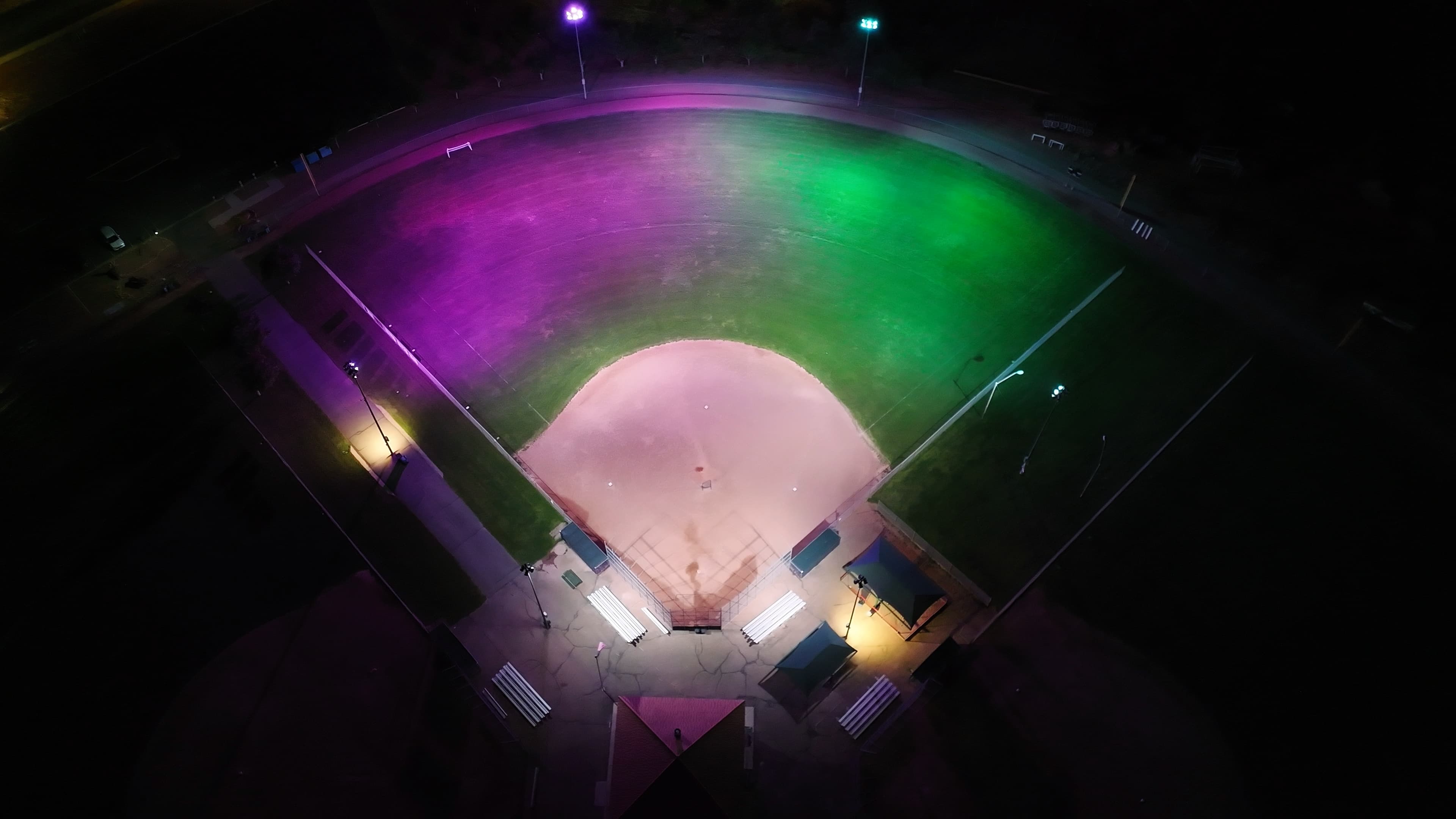
Why Baseball Lighting Deserves More Than a Standard Fixture Swap
When the sun sets over Kent County and teams take the field for a night game — whether at a community park in Kentwood, a high school diamond in Rockford, or a competitive travel ball complex near Byron Center — the quality of the lighting overhead shapes everything. It determines whether a center fielder can track a fly ball against a dark sky, whether a batter can read a breaking pitch, and whether the fans packed into the bleachers can follow every play.
Across Greater Grand Rapids and West Michigan, baseball and softball facilities are under increasing pressure to upgrade aging metal halide and high-pressure sodium (HPS) lighting systems. These legacy technologies are energy-intensive, slow to warm up, prone to outages, and increasingly difficult to maintain as parts grow scarce. LED sports lighting technology has matured rapidly, and the gap in performance, efficiency, and long-term cost is now too wide to ignore. This article explores what facility owners, athletic directors, parks administrators, and operations leaders in the Grand Rapids region should understand before planning their next lighting project.
The Technical Demands of Baseball and Softball Lighting
Baseball and softball present some of the most challenging lighting problems in all of sports. Unlike a basketball court or a soccer field, a baseball diamond requires light to reach dramatically different distances — from the tight geometry of the infield to the deep corners of the outfield warning track — all from a finite number of pole positions. A poorly designed system creates shadows in the gaps, glare in hitters' sightlines, and hot spots on the infield that make the game both dangerous and unwatchable.
Governing body standards add another layer of complexity. Organizations including USA Baseball, the NCAA, Little League International, and various state athletic associations each define minimum illumination levels — measured in foot-candles — for different levels of competition. A recreational youth league field requires a different lighting plan than a varsity high school diamond, and a college facility hosting televised games operates under an entirely different set of requirements. Meeting those standards is not simply a matter of selecting a bright fixture; it requires careful photometric engineering — modeling how light distributes across every square foot of the playing surface before a single pole goes in the ground.
Key design considerations for baseball LED lighting include:
- Pole placement and height — Positioning poles to minimize glare toward batters and outfielders while achieving required foot-candle uniformity ratios
- Optics and beam spread — Selecting fixtures with the right lens configurations to push light precisely where it's needed without spill onto neighboring properties or roadways
- Mounting and aiming angles — Engineered aiming diagrams that account for the specific geometry of each field
- Spill and glare control — Critical for fields in residential neighborhoods across communities like Ada, Caledonia, and Lowell, where lighting ordinances and neighbor relations matter
- Controls integration — Dimming, scheduling, and remote management capabilities that allow operators to reduce energy use during practice sessions versus game nights
LED Performance Advantages: What the Numbers Represent in Practice
The shift from metal halide to LED is not incremental — it is transformational. In practical terms, what does that mean for a facility in the Greater Grand Rapids area?
Energy consumption drops dramatically. LED fixtures typically use 50–70% less energy than the metal halide systems they replace. For a multi-field complex running night games and practices several evenings per week through a full spring and summer season, that reduction translates into meaningful utility savings — savings that compound year over year. Michigan facility managers working within tight operational budgets will recognize the significance of that ongoing cost reduction.
Instant-on performance changes how fields operate. Traditional metal halide lamps require 15–20 minutes to reach full brightness — and once extinguished, they need time to cool before restarting. LED fixtures reach full output in seconds. For facilities managing back-to-back game schedules, rain delays, or evening practices that start at dusk, this responsiveness is operationally significant.
Lamp life and maintenance costs shift the total cost of ownership conversation. Metal halide lamps may last 10,000–15,000 hours and degrade in output well before they fail entirely. Quality LED sports lighting systems carry rated lifespans of 100,000 hours or more, with far less lumen depreciation over time. For facilities in the Grand Rapids region — from Grand Haven to Sparta to Hudsonville — where maintenance staff resources are limited and bucket truck access to sports lighting poles is expensive, the reduction in relamping frequency represents a genuine operational benefit.
The proof is in the field. At North Hills Middle School in Bloomfield, Michigan, an aging HID sports lighting system had reached the point of failure — multiple lamp outages rendered the football field unusable for night games, costing the school lost rental revenue. VOSS replaced sixty-eight 1,500-watt HID fixtures with 750-watt Keystone Sports Lighter LED fixtures, creating a full photometric layout for the new system. The results were immediate and measurable. Jacob McDermott, Director of Maintenance & Operations, described the outcome: "The results are truly outstanding. The project unfolded seamlessly from start to finish, with VOSS Lighting demonstrating professionalism and efficiency throughout the process. The new lights themselves are nothing short of amazing, providing brilliant and uniform illumination that dramatically enhances the field for both players and spectators." While that project involved a football field, the core lighting engineering principles — pole count, fixture wattage reduction, photometric design, and uniformity — apply directly to baseball and softball facilities of comparable scale.
The West Michigan Baseball and Softball Landscape
Greater Grand Rapids is home to a diverse and active baseball and softball ecosystem. Kent County's park systems, the Grand Rapids Public Schools, the Forest Hills, Rockford, Lowell, and Grandville school districts, and dozens of municipal recreation departments across Ottawa and Allegan Counties collectively manage a significant inventory of lighted athletic fields. Add in the private travel ball organizations, faith-based leagues, and collegiate programs at institutions like Grand Valley State University, Aquinas College, and Calvin University, and the scope of the regional market becomes clear.
Many of these facilities were built or last upgraded during the 1990s and early 2000s — the era of metal halide dominance. Those systems are now 20–30 years old, and the maintenance burden is accelerating. Lamps are failing more frequently, ballasts are degrading, and the cost of keeping legacy systems operational is climbing even as utility rates in Michigan rise.
For parks and recreation directors in communities like Wyoming, Walker, Grandville, and Zeeland, the business case for LED retrofit is increasingly difficult to defer. For school athletic directors managing facilities that double as community rental assets, the calculus is similar: a dark field is a field that generates no revenue and serves no athletes.
Public sector organizations in West Michigan — school districts, municipalities, and county parks departments — may also have access to cooperative purchasing programs such as Sourcewell, BuyBoard, TIPS, and Omnia Partners, which can streamline procurement and help agencies move projects forward without a lengthy competitive bid process. Eligible organizations are encouraged to ask about these options when planning an upgrade.
What a Baseball LED Lighting Project Actually Looks Like
Understanding the process demystifies the investment and helps facility managers and administrators plan effectively. A well-executed baseball lighting project typically moves through several phases:
- Site Assessment and Audit — Evaluating the existing system, pole and foundation conditions, electrical service capacity, and current foot-candle levels against the governing standards for the intended use
- Photometric Design — Engineering a lighting layout that models light distribution across the entire playing surface, confirms compliance with league or governing body standards, and documents uniformity ratios
- Fixture and System Selection — Specifying LED fixtures with the appropriate optics, wattage, color temperature, and controls compatibility for the facility's needs
- Utility Incentive Identification — Reviewing available rebate programs through Consumers Energy or other applicable Michigan utility providers to offset project costs
- Installation and Commissioning — Managing the full construction process, including electrical service upgrades if required, pole work, fixture installation, and system testing
- Controls Integration — Programming dimming schedules, remote monitoring, and occupancy-based control sequences to maximize ongoing energy savings
VOSS manages this process from end to end — a single point of accountability for design, procurement, installation, and commissioning. That integration matters in a market like Greater Grand Rapids, where project timelines are often constrained by the weather window between early spring and the start of the playing season.
Sports Lighting as Part of a Broader Facility Strategy
Baseball and softball lighting upgrades rarely exist in isolation. Facility managers and operations leaders who are exploring field lighting improvements are often simultaneously evaluating gymnasium lighting, parking lot and outdoor LED lighting, EV charging infrastructure for athletic complexes, and broader energy efficiency initiatives.
VOSS brings that full-spectrum perspective to every engagement. Our work in sports lighting connects naturally to the broader topics we cover across the Latest Lighting content series — from LED gymnasium lighting solutions and pickleball and tennis court lighting to parking lot and outdoor LED lighting upgrades and energy audits, incentives, and rebate navigation for businesses. If your facility is planning a phased capital improvement program, understanding how these systems interact — and how utility incentives can be stacked across multiple project types — is a conversation worth having early.
Service Availability
While VOSS offers a comprehensive suite of national services, specific capabilities may vary by location. Please contact your local branch to confirm the current availability of specific services, technology solutions, or contracting capabilities in your immediate market.
Talk to the Grand Rapids Team About Your Field
Whether you manage a single community diamond in Comstock Park or a multi-field athletic complex serving thousands of players across West Michigan, the VOSS Grand Rapids team is ready to help you think through the lighting strategy that makes sense for your facility, your budget, and your timeline. We bring deep technical expertise in sports lighting design, a track record of successful LED retrofits across Michigan, and the project management capability to see complex installations through from first site visit to final commissioning.
Reach out to our Grand Rapids branch to schedule a consultation.
VOSS — Grand Rapids Phone: (616) 975-9914 Toll-Free: (800) 706-8677