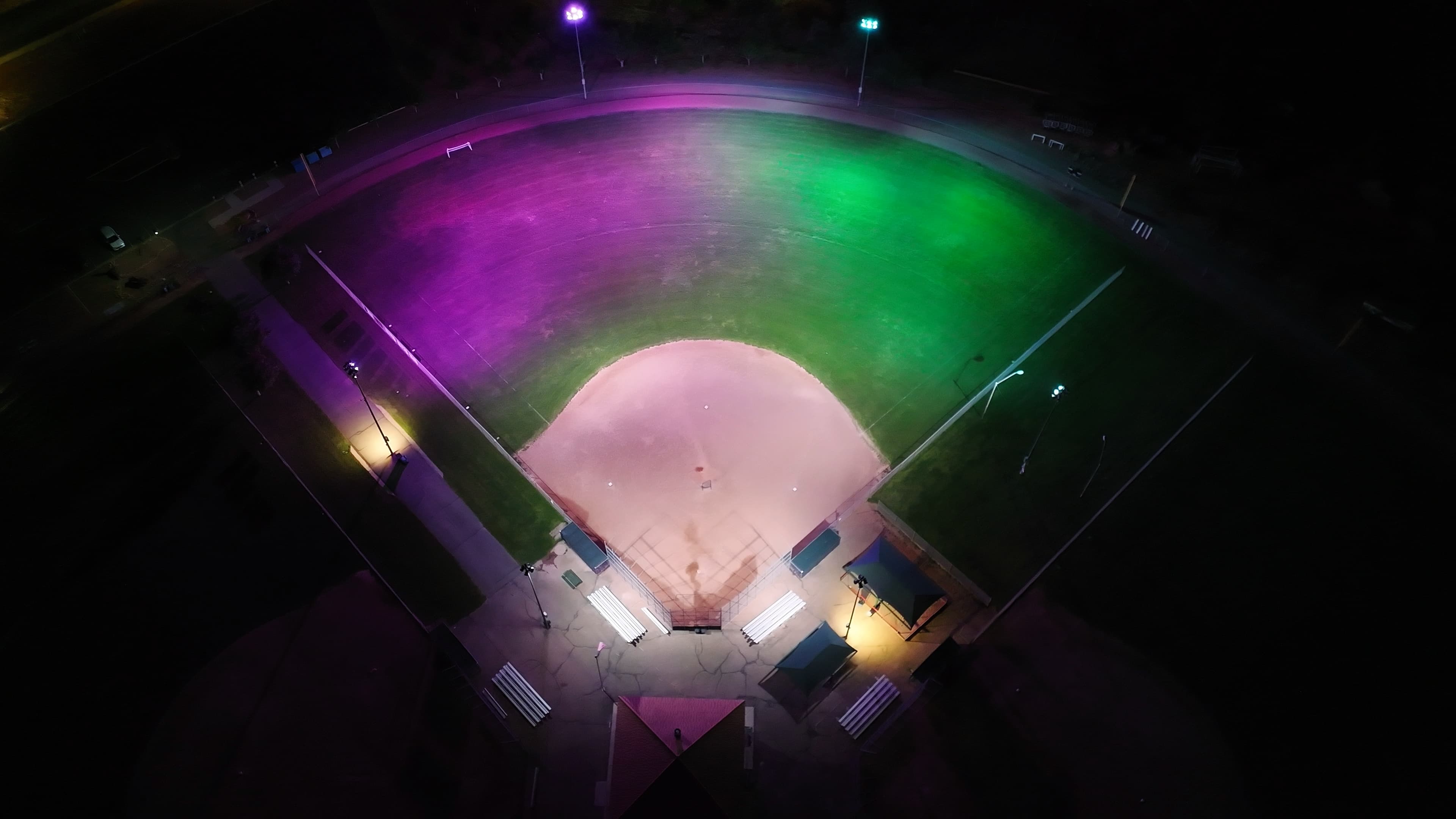
Why Baseball Lighting Deserves More Than a Standard Fixture Swap
For most facility managers and parks directors, the conversation about field lighting starts with a problem — lamps are failing, night games are getting cancelled, or a field that once worked well is falling short of league requirements. But the smarter conversation starts earlier than that, with a question: what does the right lighting system actually make possible for your facility, your athletes, and your community?
Across Kentwood and the broader Greater Grand Rapids region — a market that includes busy recreational corridors in Wyoming, Grandville, Caledonia, and Byron Township — baseball and softball fields are community anchors. They support youth travel leagues, high school programs, adult recreation leagues, and tournament events that draw regional traffic and generate real economic activity. When those fields are lit poorly, or not lit at all after dusk, the cost isn't just an energy bill — it's lost programming hours, lost rental revenue, and diminished community value.
This article explores what modern LED lighting technology means for athletic fields in West Michigan, and why the design and installation decisions you make today will shape how those fields perform for the next 25 years.
The Case for LED: What the Technology Actually Delivers
LED sports lighting has matured significantly over the past decade. What was once considered a premium option for professional and NCAA-level venues is now accessible — and financially compelling — for community parks, school districts, and municipal recreation departments of every size.
Here's what the technology delivers in practical terms:
- Uniform, High-Quality Illumination — Modern LED systems produce consistent light levels across the entire playing surface, from home plate through the outfield warning track. Batters face fewer shadows and less glare; fielders track fly balls against a cleaner background; umpires make calls on a well-lit, consistent field. This isn't cosmetic — it's a measurable improvement in playing conditions.
- Energy Consumption That Drops Dramatically — Traditional metal halide and high-pressure sodium (HPS) fixtures that power most older fields in the Grand Rapids area are significantly less efficient than today's LED alternatives. Projects like the North Hills Middle School Football Field LED Retrofit in Bloomfield, Michigan — where sixty-eight 1,500-watt HID fixtures were replaced with 750-watt LED units — demonstrate what that efficiency gap looks like in practice: cutting per-fixture wattage roughly in half while delivering superior, uniform light. The results at North Hills were described by the facility's Director of Maintenance and Operations as "nothing short of amazing, providing brilliant and uniform illumination that dramatically enhances the field for both players and spectators."
- Instant-On Performance — Unlike metal halide systems that require a warm-up period and a lengthy cool-down before restarting, LED fixtures reach full brightness the moment they're switched on. For fields managing multiple games per night, rain delays, or broadcast windows, this responsiveness matters.
- Reduced Maintenance Burden — LED fixtures carry substantially longer rated lifespans than traditional HID lamps. For facilities in Kentwood, Grand Rapids, Walker, and Rockford where maintenance staff cover multiple sites, fewer lamp replacements and service calls translate to real operational savings over time.
- Controls Integration — Today's best LED sports lighting systems pair with smart controls platforms that allow dimming, zone-based scheduling, and remote monitoring. A parks department managing fields across multiple sites can adjust lighting levels for practice versus game conditions, automate shutoff schedules, and receive alerts when a fixture needs attention — all from a centralized interface.
Designing for Baseball: Why Precision Matters More Than Wattage
One of the most important things to understand about sports lighting — and one that separates experienced contractors from commodity installers — is that raw wattage tells you very little about how a field will actually perform. Lighting design for baseball and softball is a precise engineering discipline, governed by specific standards from bodies including the Illuminating Engineering Society (IES), USA Baseball, NCAA, and various state athletic associations.
Photometric design is the foundation. Before a single fixture is specified or a pole is placed, a proper sports lighting project begins with a detailed photometric layout — a computer-modeled analysis that maps light levels, uniformity ratios, and glare indices across every zone of the playing surface. This process determines pole height, fixture aiming angles, and the number of fixtures required to meet the target foot-candle levels for the facility's class of play.
This is not a one-size-fits-all calculation. A Little League field in a Kentwood neighborhood park has different dimensional requirements and lighting standards than a high school varsity diamond, a travel-ball tournament complex, or a collegiate facility. Getting the design right means understanding those distinctions and engineering accordingly — not simply swapping in LED fixtures at existing pole positions.
Glare control is a player safety issue. Poorly designed sports lighting creates disabling glare — light that enters a player's line of sight and impairs their ability to track a ball. For outfielders chasing fly balls against a dark sky, or batters following a pitch from a 90 mph delivery, glare isn't just uncomfortable; it's dangerous. Proper fixture selection, aiming, and shielding are how experienced lighting designers eliminate this risk.
Spill light and light trespass affect your neighbors. In residential communities throughout the Kentwood and Grand Rapids metro area, fields adjacent to neighborhoods carry a responsibility to manage spill light — the illumination that extends beyond the field boundary. Modern LED optics and fixture shielding give designers precise control over light distribution, keeping illumination where it belongs and maintaining good relationships with surrounding properties.
What This Means for Facility Operators Across West Michigan
The Greater Grand Rapids region has a strong and diverse recreational sports infrastructure. Kent County parks, Kentwood city parks, school district athletic complexes, and private travel ball organizations all manage field assets that represent significant capital investment — and that serve thousands of participants each season.
For parks and recreation directors in communities like Kentwood, Wyoming, Grandville, and East Grand Rapids, LED lighting upgrades offer a direct path to extending programmable hours, increasing field rental revenue, and reducing the maintenance calls that consume staff time. Fields that couldn't host evening events due to failed or inadequate lighting become fully productive assets.
For school district facility managers across the Kent Intermediate School District region, the convergence of aging HID infrastructure and tightening operating budgets makes LED retrofits a financially and operationally sound decision. Michigan's utility landscape — served in this region by Consumers Energy — includes incentive and rebate programs that can meaningfully offset project costs. Eligible educational institutions should also be aware that cooperative purchasing programs such as Sourcewell, TIPS, AEPA, and Omnia Partners may provide pre-competed procurement pathways that simplify the contracting process and support compliance with public purchasing requirements.
For athletic directors and boosters at high school programs throughout the Grand Rapids metro, field lighting quality is increasingly tied to competitive positioning. Schools that can host evening home games, run efficient multi-game schedules, and provide a quality experience for athletes and visiting teams are simply better positioned — athletically and in terms of community engagement.
For private facility operators and tournament venues, the calculus is straightforward: better lighting enables more events, better events attract more participants, and lower energy costs improve the bottom line on every session booked.
A Note on Related Lighting Solutions
Baseball and softball fields are just one part of the broader athletic and recreational lighting conversation. If your organization manages multiple facility types, VOSS works across the full spectrum of sports and commercial lighting needs. Related topics explored elsewhere in our Latest Lighting resource section include LED gymnasium lighting solutions, pickleball LED lighting solutions, tennis court lighting and energy solutions, and LED football stadium lights and sports field lighting solutions — each addressing the specific design standards and operational considerations of those environments.
Service Availability
While VOSS offers a comprehensive suite of national services, specific capabilities may vary by location. Please contact your local branch to confirm the current availability of specific services, technology solutions, or contracting capabilities in your immediate market.
Talk to VOSS About Your Field Lighting Project
Whether you're planning a full LED retrofit of an aging complex, designing lighting for a new construction project, or simply trying to understand what your options look like and what they cost, VOSS is a resource — not just a contractor. Our Grand Rapids team brings local knowledge of the West Michigan market alongside the engineering depth and project management capability of a national organization with more than 85 years of experience.
We work with facility managers, parks directors, school district operations leaders, and private operators at every stage of the planning process — from early photometric design and budget development through installation, commissioning, and long-term support.
VOSS — Grand Rapids Branch
Phone: (616) 975-9914 Toll-Free: (800) 706-8677
Reach out to start a conversation about what modern LED lighting can do for your baseball or softball facility in Kentwood, Greater Grand Rapids, or anywhere across West Michigan.