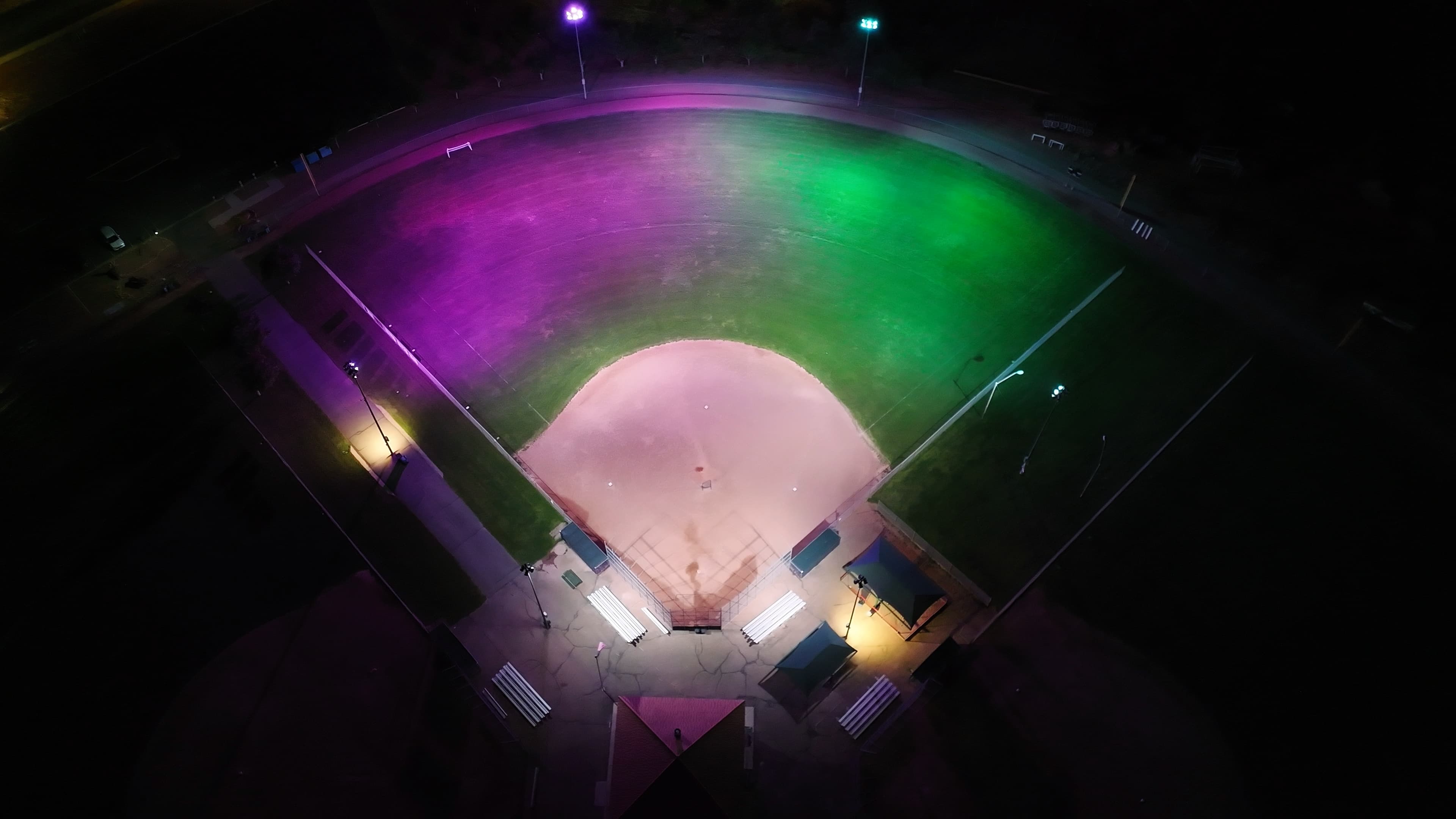
Why Warren and Greater Detroit Are Rethinking Baseball Field Lighting
Warren is one of Michigan's largest cities, and with a dense residential population of 138,000 and a robust network of parks, schools, and recreational facilities, it's home to active baseball and softball programs at every level — from youth travel leagues to high school varsity competition. Across the broader Greater Detroit region, including neighboring communities like Sterling Heights, Roseville, Clinton Township, Eastpointe, and St. Clair Shores, athletic departments and parks departments alike are confronting a shared challenge: aging metal halide and HPS field lighting systems that are expensive to operate, unreliable in performance, and increasingly out of step with what players, coaches, and spectators expect from a quality facility.
The shift to LED technology in sports lighting isn't a trend — it's a professional standard. Understanding what that shift means for Michigan facilities, and what it takes to do it right, is the starting point for any serious conversation about field lighting in this region.
The Hidden Cost of Outdated Baseball Field Lighting
Traditional metal halide and high-pressure sodium lighting systems were the industry standard for decades, but they come with significant operational liabilities that facility managers and athletic directors are increasingly unwilling to accept.
Lamp outages are more than an inconvenience. When fixtures fail on a baseball or softball field, the consequences are immediate: games get cancelled, field rental revenue disappears, and — in the worst cases — safety is compromised for players and officials. This was precisely the situation faced by North Hills Middle School in Bloomfield, Michigan, where multiple lamp outages had rendered the athletic field unusable for night games. The school's Director of Maintenance & Operations, Jacob McDermott, described the result after working with VOSS: "The results are truly outstanding. The project unfolded seamlessly from start to finish, with Voss Lighting demonstrating professionalism and efficiency throughout the process. The new lights themselves are nothing short of amazing, providing brilliant and uniform illumination that dramatically enhances the field for both players and spectators."
That project replaced sixty-eight 1,500-watt HID fixtures with new 750-watt Keystone Sports Lighter LED fixtures — cutting fixture wattage in half while delivering superior, uniform illumination across the field. For any Warren-area parks department or school district evaluating a similar situation, that kind of measurable outcome is exactly what responsible stewardship of public assets looks like.
Beyond outages, traditional systems carry ongoing costs that compound over time:
- High energy consumption — Metal halide systems draw significantly more power than equivalent LED installations, translating to higher monthly utility bills across every season of use
- Long warm-up and restrike times — HID systems can take 15–20 minutes to reach full brightness, and cannot be restarted immediately after a shutdown — a real operational problem during rain delays or multi-game schedules
- Frequent relamping cycles — Traditional fixtures require regular maintenance that LED systems largely eliminate, reducing both labor costs and the risk of mid-season failures
- Poor light uniformity — Older systems often create hot spots and shadow zones that compromise visibility for batters, fielders, and umpires — raising both safety and competitive fairness concerns
What a Purpose-Built Baseball LED Lighting Design Actually Involves
One of the most important things facility leaders in Warren and across Macomb County should understand is that sports lighting is not a commodity purchase. Dropping new fixtures onto existing poles is rarely the right answer — and in many cases, it's a path to substandard results.
Professional-grade baseball and softball lighting design involves a series of interdependent technical decisions:
Photometric layout and pole placement are foundational. The position, height, and aiming angle of each fixture determines whether the field achieves the illuminance levels required by governing bodies — whether that's Little League Baseball, NFHS, NCAA, or professional league standards. A full photometric design model calculates foot-candle levels across every zone of the playing surface, including the infield skin, outfield grass, warning track, and bullpen areas, before a single fixture is ordered.
Glare control is equally critical, particularly for facilities with residential neighbors — a common consideration in Warren's densely developed neighborhoods and adjacent communities like Center Line and Madison Heights. Modern LED optics allow precise beam control that limits light spill beyond the field boundary, which matters both for community relations and for compliance with local ordinance requirements.
Controls integration adds another dimension of value. Advanced sports lighting controls allow facility operators to set scene-based presets for different use cases — practice vs. game, broadcast vs. general admission, partial-field use — and to schedule and monitor systems remotely. For a parks department managing multiple facilities across a city like Warren, centralized controls can meaningfully reduce staff time and eliminate the risk of lights being left on unnecessarily.
Structural assessment rounds out the picture. Before any new LED fixtures are installed, existing pole condition, foundation integrity, and electrical service capacity must be evaluated. This is especially important in Michigan, where freeze-thaw cycles and decades of exposure take a toll on aging infrastructure.
The LED Upgrade Opportunity for Schools, Parks, and Athletic Clubs in Greater Detroit
Warren's schools, municipal parks, and private athletic organizations each approach field lighting decisions through a different lens — but they share a common interest in maximizing the usability and value of their facilities.
For school districts and athletic departments across Macomb and Oakland counties, a functioning, well-lit field is a revenue-generating asset. Field rentals, community events, and extended practice schedules all depend on reliable night lighting. LED upgrades pay back through energy savings, reduced maintenance costs, and the ability to schedule more events per season. Eligible school districts may also have access to cooperative purchasing programs — including Sourcewell, BuyBoard, TIPS, and AEPA — that streamline the procurement process and eliminate the need for a standalone competitive bid on qualified equipment and services.
For municipal parks departments, the calculus includes both operational efficiency and community impact. Warren's parks serve a diverse and active population, and providing quality athletic facilities is a direct quality-of-life investment. LED lighting extends usable hours into the evening, expands programming capacity, and signals to residents that the city is committed to maintaining competitive, modern facilities.
For private leagues, travel clubs, and sports complexes in the Greater Detroit area — including those operating in nearby Troy, Utica, Fraser, and Chesterfield Township — LED field lighting is increasingly a baseline expectation from players, parents, and tournament organizers. Facilities that can offer consistent, broadcast-quality illumination are better positioned to attract high-visibility events and the revenue that comes with them.
Michigan's Energy Landscape and the Case for Acting Now
Michigan utility customers, including those served by DTE Energy in the Warren area, have access to energy efficiency incentive programs that can offset a meaningful portion of LED upgrade project costs. While specific incentive amounts vary and change over time, LED sports lighting projects — with their substantial wattage reductions — often qualify for significant rebate consideration. Engaging an experienced contractor who understands utility program requirements and can support the application process is a practical way to capture available value.
It's also worth noting that the broader regulatory environment is evolving. Fluorescent lamp bans and increasing pressure on inefficient HID technologies are already reshaping the commercial lighting market. Facilities that delay LED transitions may find fewer incentive dollars available and face higher long-term operating costs as traditional lamp sources become harder to source. For Warren-area facility managers and athletic directors thinking about multi-year capital planning, the direction of travel is clear.
For a broader look at the LED rebate landscape in Michigan and across the Midwest, VOSS has published additional resources under the Latest Lighting section of our website — including articles on LED lighting rebates, fluorescent lamp bans, and energy audit navigation for commercial and institutional facilities.
Service Availability
While VOSS offers a comprehensive suite of national services, specific capabilities may vary by location. Please contact your local branch to confirm the current availability of specific services, technology solutions, or contracting capabilities in your immediate market.
Talk to VOSS About Your Warren-Area Baseball or Softball Facility
Whether you're managing a single community field in Warren, overseeing athletic facilities across a Macomb County school district, or developing a multi-diamond sports complex anywhere in Greater Detroit, VOSS is ready to bring engineering expertise, project management discipline, and local knowledge to your lighting project.
Our Grand Rapids branch serves Michigan facilities across the region. Reach out to start a conversation about your field, your timeline, and your goals.
VOSS — Grand Rapids Branch
Phone: (616) 975-9914 Toll-Free: (800) 706-8677
We're not here to sell you a fixture count — we're here to help you build a lighting solution that works for your players, your budget, and your community for years to come.