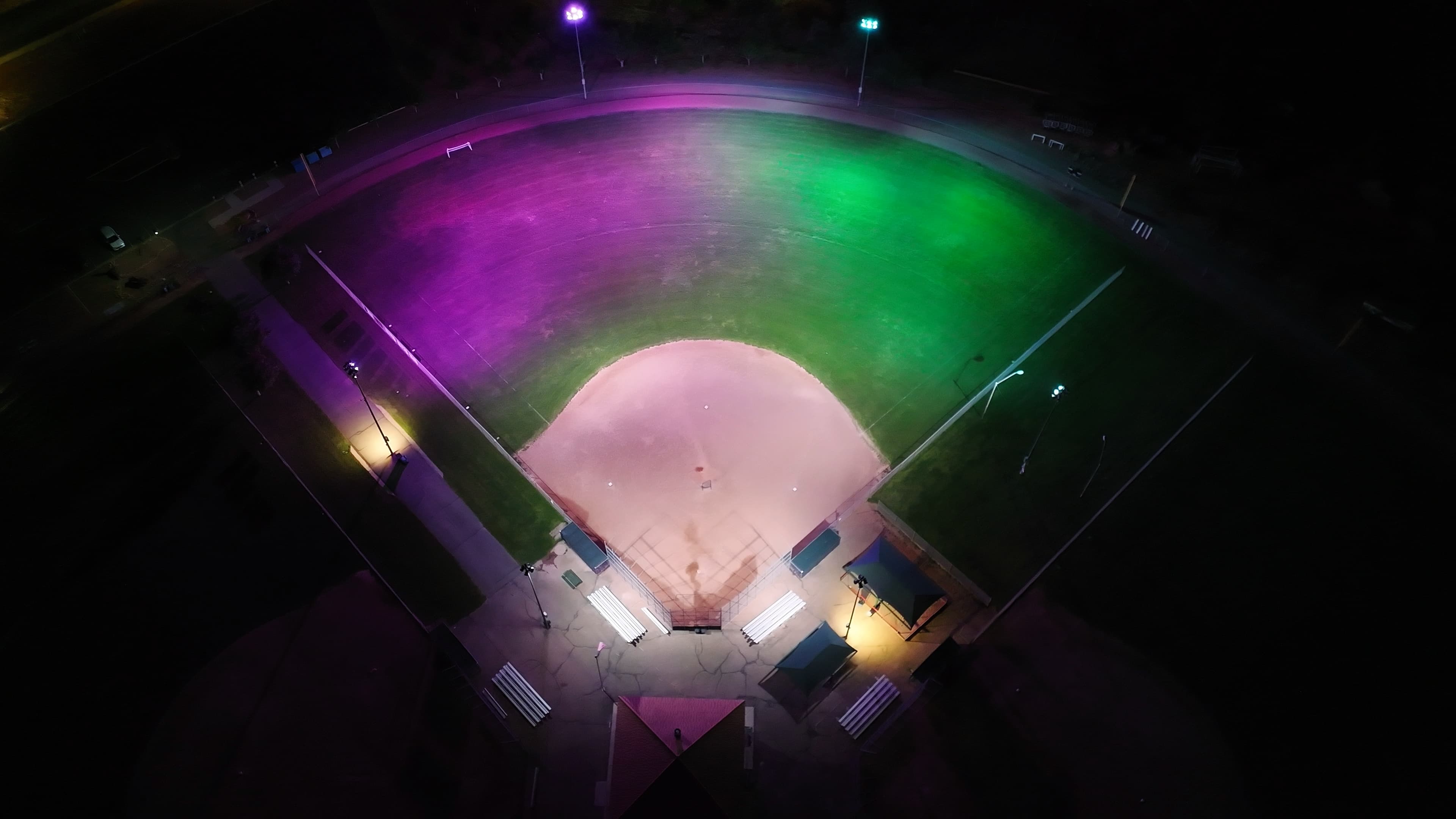
Why Baseball Lighting Is Becoming a Priority Across Greater Detroit
Troy, Michigan is one of Oakland County's most active communities — home to roughly 87,000 residents, a dense network of corporate campuses, and a robust parks and recreation system that supports everything from youth travel baseball to adult softball leagues. Across the broader Greater Detroit region, athletic facilities in communities like Sterling Heights, Rochester Hills, Clawson, Royal Oak, and Birmingham face a shared challenge: aging sports lighting infrastructure that no longer meets the demands of modern play, broadcast standards, or energy efficiency expectations.
Metal halide and high-pressure sodium (HPS) fixtures have served baseball and softball fields for decades, but the technology has reached a clear inflection point. These systems are slow to warm up, prone to outages as they age, and expensive to operate compared to today's LED alternatives. As municipalities, school districts, and private athletic clubs throughout Oakland and Macomb Counties weigh infrastructure investments, LED sports lighting has emerged as one of the highest-impact, fastest-payback upgrades available.
Understanding what makes a baseball LED lighting project successful — and what separates a well-engineered installation from one that creates new problems — is essential for any facility manager, athletic director, or parks administrator evaluating their options.
The Unique Engineering Demands of Baseball and Softball Lighting
Not all sports lighting projects are created equal, and baseball presents some of the most complex illumination challenges in the athletic world. Unlike a rectangular court or a football field with predictable geometry, a baseball diamond requires lighting designers to account for an asymmetric playing surface, a wide range of play zones — from the pitcher's mound to deep center field — and the critical need to eliminate glare along sight lines where batters track a pitched ball traveling at high speed.
Key engineering considerations for baseball and softball LED installations include:
- Pole placement and height — Poorly positioned poles create shadows in the infield or outfield gaps, and poles set at the wrong height can introduce glare that impairs batter vision or conflicts with adjacent fields
- Uniformity ratios — Governing bodies including Little League International, high school athletic associations, NCAA, and professional leagues each specify minimum foot-candle levels and uniformity ratios; a quality design meets or exceeds these standards across every zone of the field
- Spill and glare control — In dense suburban markets like Troy and the surrounding communities, minimizing light spill onto neighboring properties and residential streets is both a community relations concern and, increasingly, a municipal code requirement
- Controls integration — Modern LED systems can be paired with programmable controls that allow facility operators to adjust light levels by zone, schedule automatic on/off times, and reduce output during practice versus game conditions — a meaningful operational advantage for busy multi-field complexes
Photometric modeling — the process of simulating how light will distribute across a specific field layout before a single fixture is ordered — is the foundation of every successful installation. Facilities that skip this step often discover coverage gaps, uneven brightness, or compliance issues only after installation is complete.
Lessons from the Field: A Michigan Proof Point
The value of a well-executed sports lighting retrofit is not theoretical for communities in this region. At North Hills Middle School in Bloomfield, Michigan — just a short drive from Troy along Telegraph Road — VOSS was called in to address a sports lighting failure that had real operational consequences. Multiple lamp outages across the football field had rendered the facility unusable for night games, costing the school lost field rental revenue and disrupting athletic programming.
The VOSS team replaced all sixty-eight 1,500-watt HID fixtures with new 750-watt Keystone Sports Lighter LED fixtures — cutting per-fixture wattage in half — and developed a full photometric lighting layout to ensure proper coverage across the field.
The outcome spoke for itself. Jacob McDermott, Director of Maintenance and Operations, described the results: "The results are truly outstanding. The project unfolded seamlessly from start to finish, with VOSS Lighting demonstrating professionalism and efficiency throughout the process. The new lights themselves are nothing short of amazing, providing brilliant and uniform illumination that dramatically enhances the field for both players and spectators."
While that project focused on football, the underlying engineering disciplines — photometric design, fixture selection, wattage reduction, and installation management — translate directly to baseball and softball field upgrades. The Bloomfield project is a strong example of how facilities across Oakland County can achieve better performance while significantly reducing energy consumption.
What Facility Operators and Athletic Directors Should Know Before Starting a Project
For parks and recreation directors in Troy, athletic directors at schools in the Romeo, Warren, or Utica communities, or operations managers at private athletic clubs throughout Southeast Michigan, a few practical realities shape how these projects unfold:
Fixture selection matters more than brand alone. The LED sports lighting market has expanded rapidly, and not every fixture performs equally in real-world conditions. Factors like lumen maintenance over time, thermal management in Michigan's climate extremes, and optical precision all affect long-term satisfaction. Working with a contractor who has direct experience specifying and installing sports-grade fixtures — not just commercial LED products — is critical.
Utility incentives can meaningfully offset project costs. Michigan utilities, including DTE Energy and Consumers Energy, have historically offered commercial and institutional incentive programs for qualifying LED upgrades. Facilities that complete a lighting audit and work with a knowledgeable contractor can often identify rebate opportunities that reduce net project costs. VOSS helps clients navigate these programs as part of the project process. For more on maximizing LED rebate opportunities, the Maximize ROI with Commercial LED Lighting Rebates article in this series is a practical resource.
Public agencies have procurement options that simplify the process. School districts, municipal parks departments, and other public entities in the Troy and Greater Detroit area may be eligible to procure lighting and electrical services through cooperative purchasing programs including Sourcewell, TIPS, BuyBoard, Omnia Partners, AEPA, and PACE. These programs allow eligible organizations to leverage pre-negotiated contracts, streamlining the procurement process and reducing administrative burden without sacrificing competitive value.
Planning timelines matter for athletic calendars. A well-managed LED sports lighting project can typically be completed in a focused installation window, but photometric design, permitting, fixture lead times, and coordination with athletic schedules all require advance planning. Facilities that begin conversations in the fall or winter are well-positioned for spring or summer completion before their primary playing season begins.
A Growing Trend Across the Region's Athletic Landscape
The shift toward LED sports lighting is accelerating across Southeast Michigan for reasons that go beyond energy savings alone. Communities throughout Oakland, Macomb, and Wayne Counties are recognizing that well-lit athletic facilities are community assets — they extend the usable hours of a field, attract tournament play that generates local economic activity, support school programs that depend on evening practice time, and signal investment in the quality of life that defines competitive suburbs like Troy.
This trend is also visible at the collegiate and semi-professional level, where broadcast-quality lighting — capable of supporting high-definition video production — has become a baseline expectation for premier facilities. LED systems engineered for flicker-free performance at high camera frame rates are now accessible not just to professional venues, but to well-resourced high school and collegiate programs across the region.
For anyone managing or planning a baseball or softball facility in Troy, Sterling Heights, Madison Heights, Hazel Park, or the surrounding communities, the question is no longer whether LED is the right technology — it's how to execute the transition effectively.
Related topics in this content series worth exploring include LED Football Stadium Lights and Sports Field Lighting Solutions, Pickleball LED Lighting Solutions, and Tennis Court Lighting and Energy Solutions — each covering sport-specific design considerations that complement the principles discussed here.
Service Availability
While VOSS offers a comprehensive suite of national services, specific capabilities may vary by location. Please contact your local branch to confirm the current availability of specific services, technology solutions, or contracting capabilities in your immediate market.
Connect with VOSS in Greater Detroit
VOSS serves Troy, Michigan and the broader Greater Detroit region from our Grand Rapids branch. Whether you're managing a community park renovation, a school district athletic upgrade, or a multi-field complex improvement, our team is ready to discuss how a properly engineered LED lighting solution can transform your facility's performance and long-term operating costs.
Grand Rapids Branch Phone: (616) 975-9914 Toll-Free: (800) 706-8677
We invite you to reach out for a consultative conversation — not a sales pitch. Bring your field dimensions, your current fixture situation, and your operational goals, and we'll help you understand what a well-executed baseball LED lighting project looks like for your specific facility.