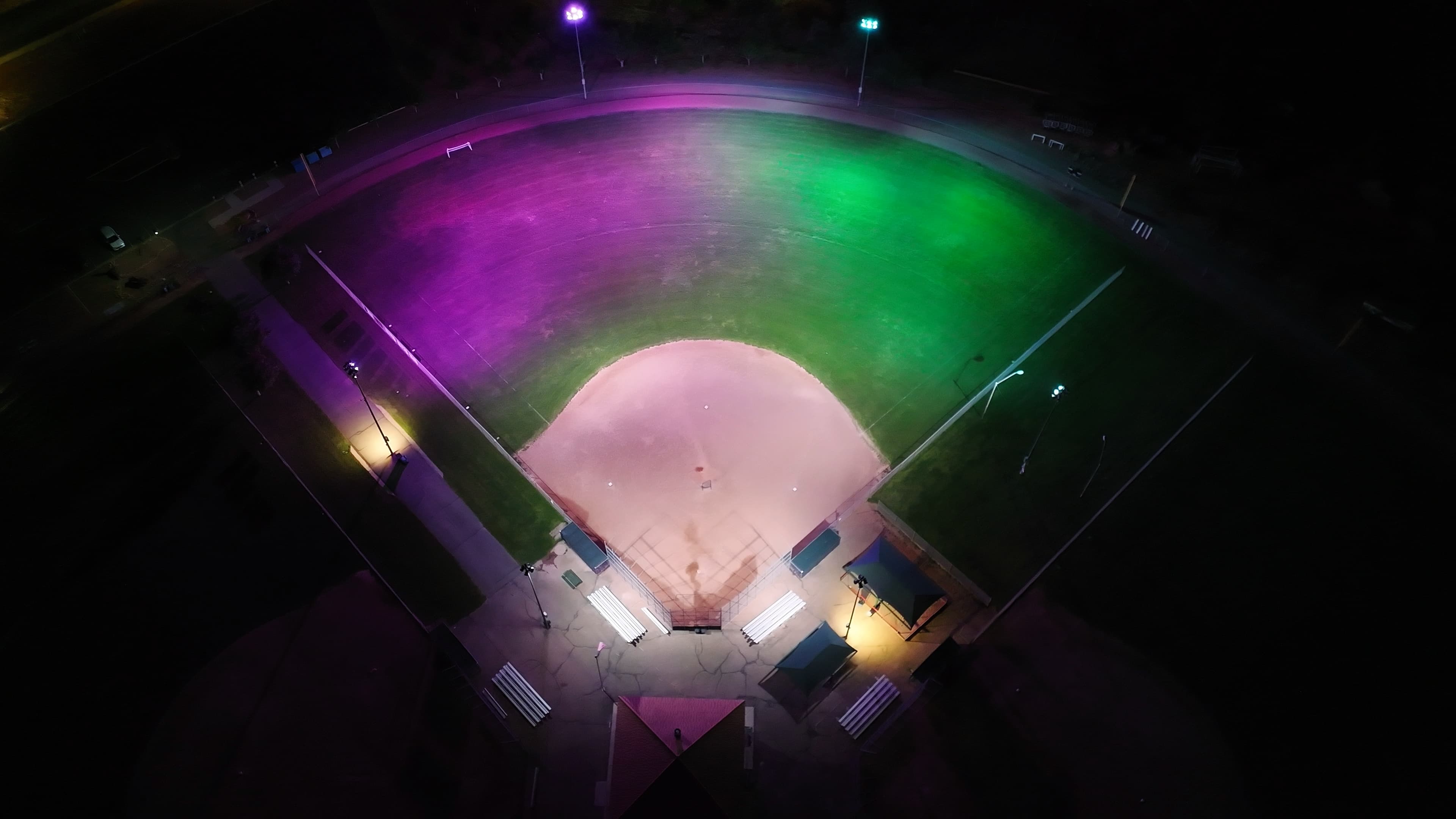
Why Baseball Lighting Is a Bigger Deal Than Most Facilities Realize
A well-lit baseball field is more than a convenience — it's a competitive necessity and a community asset. In Sterling Heights and across Macomb County, parks and recreation departments, school athletic programs, and private sports organizations manage some of the most active athletic facilities in the Greater Detroit region. Communities like Warren, Clinton Township, Shelby Township, and Utica all share the same challenge: aging metal halide and high-pressure sodium field lighting systems that were installed decades ago and are now failing, inefficient, or simply no longer meeting the expectations of players, coaches, and families.
The shift to LED technology in sports lighting isn't a trend — it's a standard. Governing bodies from Little League Baseball to the NCAA have updated their recommendations to reflect what LED systems now make possible: consistent, high-quality illumination across the infield, outfield, and warning track that dramatically reduces shadows and improves depth perception for every player on the field. For facility managers and parks directors evaluating their next capital improvement cycle, understanding what modern LED systems deliver — and what the upgrade process looks like — is the critical first step.
What Makes Baseball Lighting Uniquely Demanding
Not all sports lighting is created equal, and baseball presents some of the most technically complex illumination challenges in outdoor athletics. Unlike a rectangular court or football field, a baseball diamond's geometry — with its sweeping outfield arc, asymmetric foul territory, and multiple planes of play — requires precision photometric design to deliver uniform light levels without glare zones or dark spots.
Key design considerations for baseball and softball fields include:
- Pole placement and mounting height — Improper placement creates hot spots near the infield or leaves outfield corners underlit; engineered layouts account for field geometry at every level of play
- Glare control — Batters, infielders, and outfielders all track fast-moving balls against the sky and artificial light sources; glare management is essential to player safety and performance
- Uniformity ratios — League standards from recreational to professional levels specify minimum uniformity ratios; a photometric plan ensures compliance before a single pole is set
- Spill light management — In dense suburban communities like Sterling Heights, minimizing light trespass onto adjacent residential properties is both a community relations priority and a municipal code requirement
Traditional metal halide systems — still common on fields installed in the 1990s and 2000s — struggle with all of these demands as they age. Lamp failures become more frequent, color rendering degrades, and restrike times after a power interruption can stretch 15 to 20 minutes, disrupting games and frustrating everyone involved.
The LED Difference: From Energy Bills to Game-Night Experience
The case for LED in baseball and softball facilities rests on multiple pillars, and the conversation differs depending on who is making the decision. For a parks and recreation director in Sterling Heights managing a tight capital budget, the energy savings are the headline: LED fixtures typically consume 40–60% less energy than equivalent metal halide systems, and because they last significantly longer, maintenance costs drop substantially as well. Fewer lamp replacements mean fewer service calls, less staff time on lifts, and fewer games canceled due to sudden outages.
For an athletic director or a youth baseball league administrator, the performance story matters just as much. Modern LED systems deliver:
- Instant full brightness — No warm-up period, no restrike delay after a brief outage or rain delay; the lights are on when you need them
- Superior color rendering — Higher CRI (Color Rendering Index) values make the ball easier to track and the field easier to read for players, umpires, and spectators
- Consistent output over time — Unlike metal halide, which dims significantly as lamps age, quality LED fixtures maintain light levels throughout their rated lifespan
- Broadcast and video compatibility — For facilities hosting televised or streamed events, LED systems designed for high-speed camera compatibility eliminate the flicker that older technology can introduce
For community parks serving youth leagues across Sterling Heights, Warren, and the broader Macomb County area, these improvements translate directly into a better experience for the families who use these fields every spring and summer evening.
A Proof Point Close to Home: North Hills Middle School, Bloomfield, Michigan
The value of a well-executed LED sports lighting retrofit is perhaps best understood through a real project. At North Hills Middle School in Bloomfield, Michigan — just southwest of Sterling Heights — VOSS completed an athletic field LED lighting upgrade that illustrates exactly what's possible when the right expertise is applied to a failing system.
The challenge was straightforward but urgent: multiple lamp outages had rendered the field unusable for night games, costing the school lost field rental revenue and disrupting the athletic schedule. VOSS replaced all sixty-eight 1,500-watt HID fixtures with new 750-watt Keystone Sports Lighter LED fixtures — cutting the connected load in half — and developed a full photometric lighting layout to ensure optimal, uniform coverage across the field.
The results spoke for themselves. Jacob McDermott, Director of Maintenance & Operations, described the outcome: "The results are truly outstanding. The project unfolded seamlessly from start to finish, with Voss Lighting demonstrating professionalism and efficiency throughout the process. The new lights themselves are nothing short of amazing, providing brilliant and uniform illumination that dramatically enhances the field for both players and spectators."
For school districts and municipal park systems across the Greater Detroit area — from Sterling Heights and Clinton Township to Utica and Chesterfield Township — the North Hills project is a relevant, regional example of what a thoughtfully designed and professionally executed LED sports lighting retrofit delivers.
Planning a Baseball Lighting Project in the Greater Detroit Area
Whether you're managing a single Little League complex or overseeing a multi-field parks system, the path to a successful LED lighting project follows a consistent framework. Understanding that process helps facility owners and administrators ask the right questions and set realistic expectations.
Step 1: Lighting Audit and Field Assessment Before any fixture is specified, a thorough evaluation of the existing system — pole conditions, electrical infrastructure, current light levels, and compliance with applicable standards — forms the foundation of a responsible upgrade plan.
Step 2: Photometric Design A computer-modeled lighting layout calculates foot-candle levels across every zone of the field, validates uniformity ratios against governing body requirements, and identifies optimal pole heights and fixture aiming angles. This step is what separates a professional installation from a simple fixture swap.
Step 3: Controls Integration Modern LED systems pair naturally with intelligent controls — dimming, scheduling, occupancy sensing, and remote monitoring. For a parks department managing multiple facilities across Sterling Heights or Macomb County, centralized controls reduce staff burden and ensure lights aren't running on empty fields.
Step 4: Utility Incentive Navigation Michigan utilities including DTE Energy and Consumers Energy offer rebate programs for commercial and institutional LED upgrades. Capturing available incentives requires documentation and project sequencing that experienced contractors build into the process from the start — not as an afterthought.
Step 5: Installation and Commissioning Structural work, electrical connections, fixture aiming, and final photometric verification ensure the system performs as designed. Commissioning — often skipped on budget-driven projects — is what guarantees the numbers in the design match the numbers on the field.
For public-sector organizations in Sterling Heights and surrounding communities — school districts, park authorities, municipal recreation departments — cooperative purchasing programs including Sourcewell, BuyBoard, TIPS, AEPA, and Omnia Partners can streamline procurement and eliminate the need for a traditional competitive bid process, accelerating project timelines and simplifying contracting.
Related Topics Worth Exploring
Baseball and softball lighting sits within a broader conversation about athletic facility modernization and outdoor LED technology. Other articles in this series address related topics that may be relevant to your planning process — including LED solutions for gymnasium spaces, pickleball and tennis court lighting, football stadium upgrades, and strategies for maximizing LED lighting rebates in the commercial market. Exploring those resources alongside this one can help facility managers build a more comprehensive picture of what a full-campus lighting modernization effort might look like.
Service Availability
While VOSS offers a comprehensive suite of national services, specific capabilities may vary by location. Please contact your local branch to confirm the current availability of specific services, technology solutions, or contracting capabilities in your immediate market.
Talk to a Local Expert About Your Baseball Lighting Project
VOSS serves Sterling Heights, Macomb County, and the Greater Detroit region from our Grand Rapids branch. If you're evaluating a baseball or softball lighting upgrade — whether for a single community field or a multi-facility parks system — we'd welcome the conversation. Our team can walk through your current conditions, discuss what a photometric design process looks like, and help you understand what outcomes are realistic for your facility and budget.
VOSS — Grand Rapids Branch
Phone: (616) 975-9914 Toll-Free: (800) 706-8677