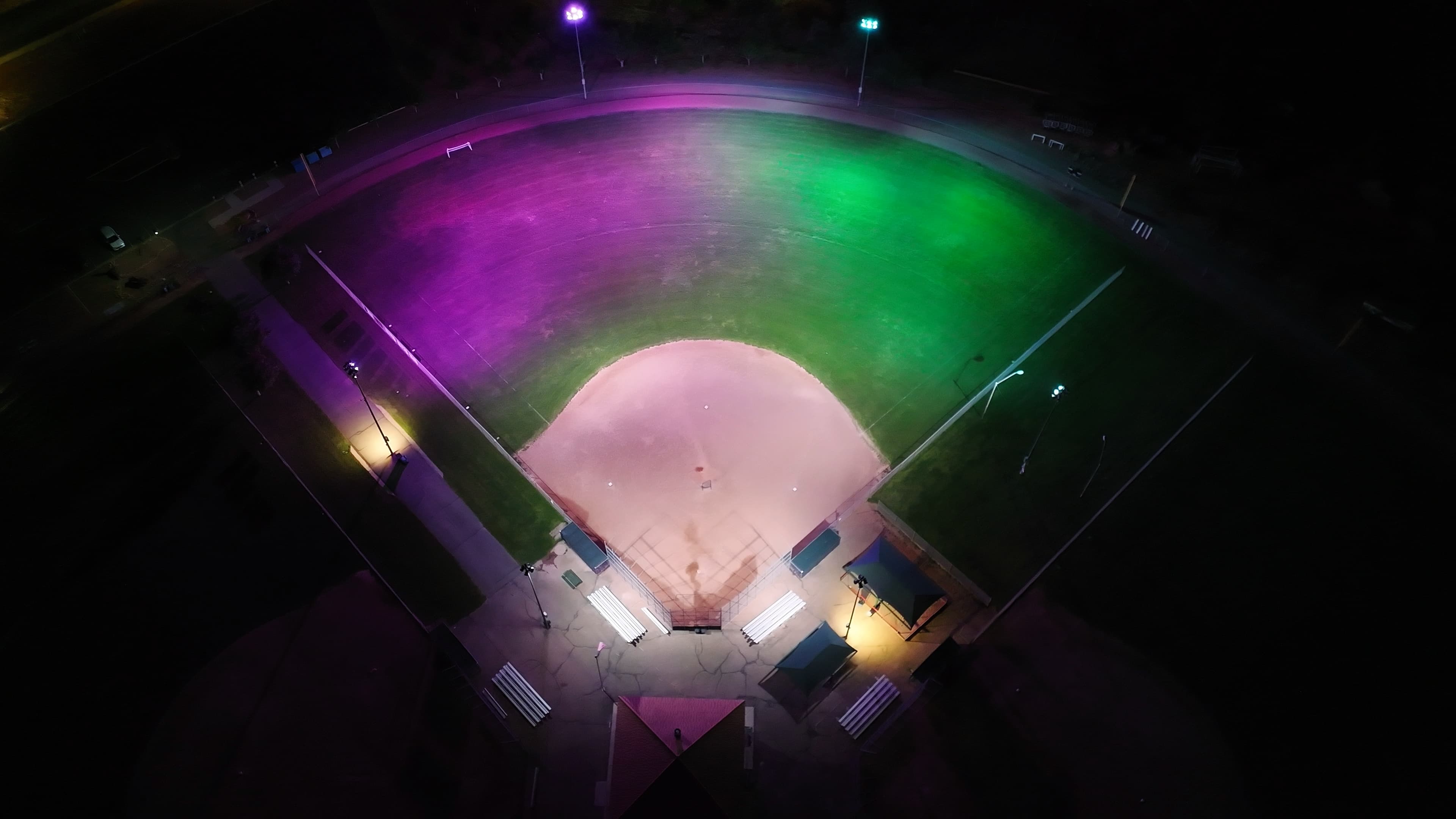
Why Livonia's Baseball and Softball Facilities Are Rethinking Their Lighting
Livonia, Michigan is a community that takes its recreational infrastructure seriously. Home to roughly 95,000 residents and a dense network of parks, schools, and athletic facilities spread across western Wayne County, Livonia supports active youth leagues, travel baseball programs, and school-level athletics that draw families from neighboring communities including Westland, Northville, Plymouth, and Farmington Hills. That level of activity puts real demand on the facilities that host it — and nothing exposes the limitations of aging field lighting faster than a full youth baseball schedule.
Across Southeast Michigan, many baseball and softball facilities still operate on aging metal halide (MHI) or high-pressure sodium (HPS) lighting systems installed decades ago. These systems come with significant drawbacks: long warm-up times, inconsistent light distribution, high energy consumption, and increasing maintenance costs as lamps and ballasts fail. For facility directors at Livonia public schools, parks administrators, and operators of private athletic complexes, the calculus is shifting. LED field lighting has crossed a threshold — it is no longer an emerging technology but an established standard, and the gap between legacy systems and modern LED performance is becoming harder to justify.
This article explores what that transition looks like in practice, what the standards actually require, and why facilities across communities like Livonia are making the move now.
What Makes Baseball Lighting a Technically Demanding Challenge
Not all sports lighting challenges are created equal, and baseball is among the most complex. The geometry of a baseball diamond — an open, asymmetrical playing surface that expands from a tight infield into a broad outfield — requires lighting designers to solve for a wide range of sight lines simultaneously. A batter tracking a 90-mile-per-hour fastball, an outfielder reading a fly ball against a night sky, and a fan in the third-base bleachers all have fundamentally different visual needs. Poor pole placement, inadequate mounting heights, or uneven light distribution creates shadows and glare that compromise safety and performance.
Well-engineered LED systems address these challenges through precise photometric design — a process that models light distribution across every square foot of the playing surface before a single fixture is ordered or a pole is set. Key design variables include:
- Mounting height and pole placement — Poles positioned too close together or at insufficient height create shadows in the outfield and glare in the batter's eye zone
- Foot-candle uniformity ratios — League and governing body standards specify not just average illuminance levels but the ratio between the brightest and darkest points on the field, ensuring consistent visibility across all positions
- Glare control and spill light management — Modern LED optics can dramatically reduce light trespass onto adjacent properties and neighborhoods, a meaningful concern in a residential community like Livonia
- Color rendering index (CRI) — Higher CRI values mean players, officials, and cameras see colors more accurately — important for tracking ball flight and reading field conditions
Amateur and recreational facilities typically target 30–50 foot-candles for practice and recreational play, while competitive high school and travel ball fields often require 50–100 foot-candles or more. Designs should align with standards published by the Illuminating Engineering Society (IES) and the specific requirements of governing bodies such as the Michigan High School Athletic Association (MHSAA) for interscholastic play.
The Energy and Operational Case for LED Upgrades
For facility managers and school district operations directors in Livonia and surrounding Wayne County communities, the financial case for LED field lighting upgrades has become compelling. Traditional HID systems running four to six fixtures per pole at 1,500 watts each consume enormous amounts of power over a full season of evening games and practices. Modern LED replacements typically deliver the same or better light levels at 40–60% lower energy consumption.
The operational benefits extend beyond the utility bill. LED fixtures carry rated lifespans of 100,000 hours or more — compared to 10,000–15,000 hours for metal halide lamps — dramatically reducing the frequency and cost of lamp replacements and the safety risks associated with working at height on older pole systems. LEDs reach full brightness instantly, with no warm-up period, which matters practically for rain delays, emergency restarts, and facilities that share fields across multiple user groups in a single evening.
A real-world example from nearby Southeast Michigan illustrates these benefits clearly. At North Hills Middle School in Bloomfield, Michigan, aging HID fixtures had failed to the point where the field could not be used for night games — costing the school both athletic program time and field rental revenue. VOSS replaced all sixty-eight 1,500-watt HID fixtures with 750-watt Keystone Sports Lighter LED fixtures and developed a full photometric layout to ensure proper coverage. The result was a fully functional, uniformly illuminated field. Jacob McDermott, Director of Maintenance and Operations, described the outcome: "The results are truly outstanding. The project unfolded seamlessly from start to finish, with VOSS demonstrating professionalism and efficiency throughout the process. The new lights themselves are nothing short of amazing, providing brilliant and uniform illumination that dramatically enhances the field for both players and spectators."
For school districts and park systems across Livonia, Dearborn, Westland, and Canton Township facing similar aging infrastructure, this kind of project represents a replicable model — not a theoretical promise.
Controls and Smart Systems: The Next Layer of Value
LED field lighting becomes even more powerful when paired with modern lighting controls. For baseball and softball facilities managing multiple user groups, variable rental rates, and seasonal schedules, smart controls add meaningful operational flexibility:
- Wireless scheduling and remote operation — Facility managers can turn fields on and off, adjust lighting levels, and monitor system status from a smartphone or web dashboard, eliminating the need for on-site staff presence for every evening session
- Dimming and multi-level presets — Operators can program different light levels for youth practice, competitive games, and broadcast events — optimizing energy use for each scenario rather than running at full power for every use
- Occupancy and timer-based shutoffs — Automated controls ensure lights are not left on after fields are vacated, a common source of unnecessary energy waste at parks and school facilities
- Integration with facility management platforms — Advanced systems can connect to broader building and campus management infrastructure, giving operations teams a unified view of energy consumption across a portfolio of facilities
For Livonia Parks and Recreation, the Livonia Public Schools district, or private sports complex operators serving families from across the I-96 corridor, controls integration represents a meaningful upgrade to both operations and stewardship.
A Note for Public-Sector and Educational Organizations in the Greater Detroit Area
School districts, municipal parks departments, and public recreational authorities in Livonia and Wayne County may have access to streamlined procurement pathways for LED lighting projects. Cooperative purchasing programs — including Sourcewell, BuyBoard, AEPA, TIPS, and Omnia Partners — allow eligible public-sector organizations to procure lighting and electrical services through pre-competed contracts, reducing administrative burden and accelerating project timelines without sacrificing competitive pricing. If your organization participates in any of these programs, our team can help you understand how to apply them to a field lighting project.
Separately, Michigan utilities offer energy efficiency incentive programs that can offset a meaningful portion of LED upgrade project costs. Our team is experienced in navigating these programs and can help identify applicable rebates during the early project planning phase. For further reading on how to structure an LED upgrade to maximize rebate capture, our article on Energy Audits, Incentives, and Rebate Navigation for Businesses in the Latest Lighting section covers this topic in depth.
Service Availability
While VOSS offers a comprehensive suite of national services, specific capabilities may vary by location. Please contact your local branch to confirm the current availability of specific services, technology solutions, or contracting capabilities in your immediate market.
Talk to a Local Expert About Your Livonia-Area Baseball Facility
Whether you manage a single youth baseball diamond at a Livonia community park or oversee a multi-field athletic complex serving teams across Wayne and Washtenaw counties, LED lighting is a conversation worth having now. The technology is proven, the financial case is strong, and the right design partner makes the difference between a project that delivers lasting value and one that falls short of expectations.
VOSS serves the Livonia and Greater Detroit market through our Grand Rapids branch, with the experience and resources to handle projects of any scale — from photometric design and fixture procurement through full electrical installation and commissioning.
Grand Rapids Branch Phone: (616) 975-9914 Toll-Free: (800) 706-8677
Contact us to schedule a no-obligation consultation. We'll start with your facility, your usage requirements, and your goals — and help you understand what a modern LED lighting solution looks like for your specific situation.