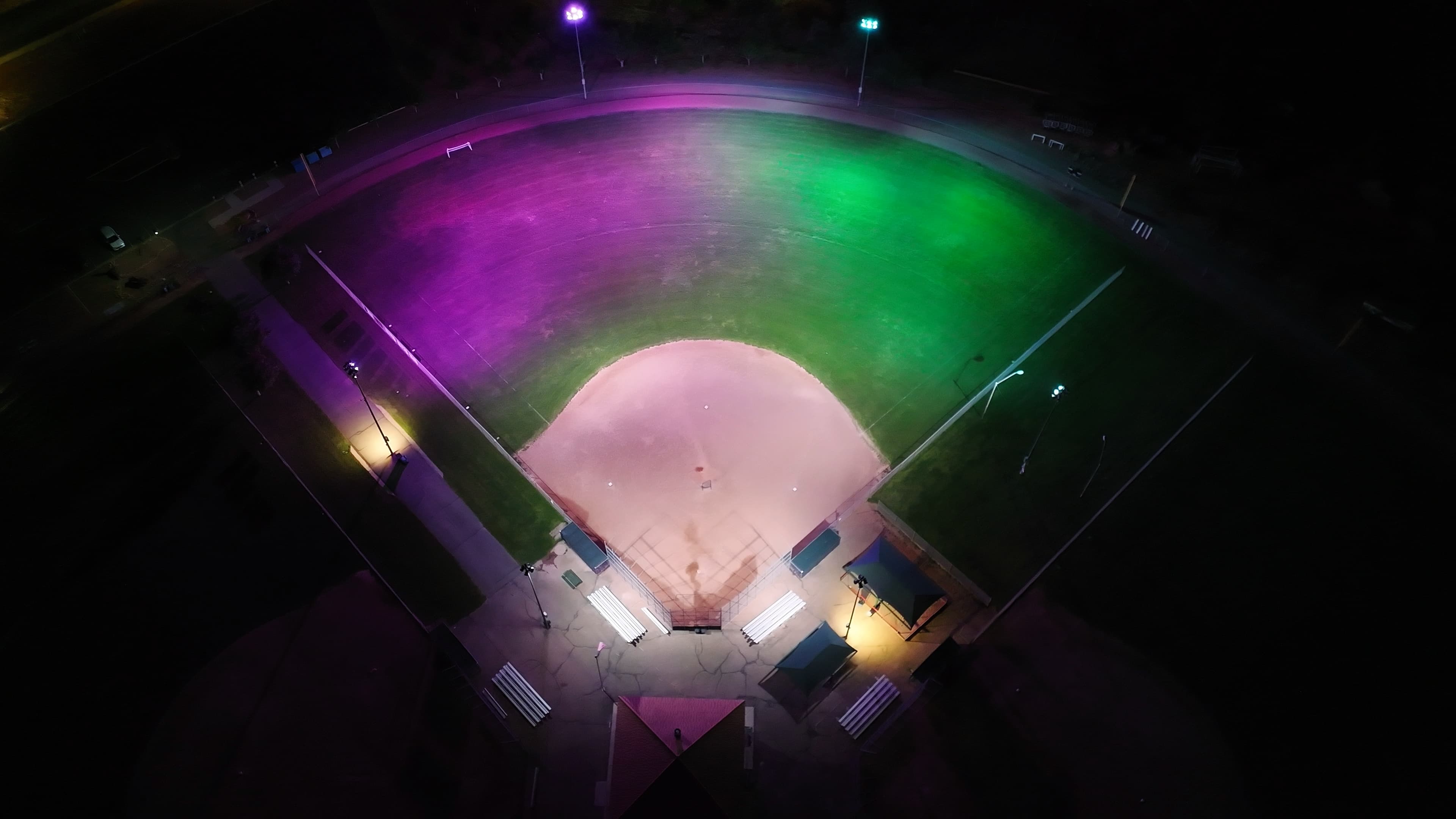
Why Baseball Lighting Is Having a Moment in Greater Detroit
Greater Detroit is a region with deep roots in athletic tradition. From the youth travel ball circuits in Macomb County and the competitive high school programs across Oakland, Wayne, and Washtenaw counties, to collegiate fields and municipal parks stretching from Ann Arbor to Mount Clemens — baseball and softball are woven into the fabric of this community. And right now, facility operators across the region are facing the same question: is the lighting system keeping up with the level of play?
The answer, in many cases, is no. A significant number of baseball and softball facilities in the Greater Detroit area still rely on aging metal halide (MHI) or high-pressure sodium (HPS) lighting systems — technology that was never engineered to meet today's standards for broadcast quality, player safety, or energy efficiency. As those systems age, lamp outages become more frequent, energy bills climb, and the field becomes harder to schedule for night events. The good news is that the industry has fundamentally shifted, and the case for LED has never been clearer.
What Makes Baseball Lighting Uniquely Demanding
Not all sports lighting challenges are created equal. Baseball and softball fields present a distinct set of engineering problems that separate a well-designed system from a merely adequate one.
The geometry is complex. Unlike a rectangular court or a football field, a baseball diamond requires lighting from multiple pole positions to cover the infield, outfield, warning track, and bullpen areas — each with different illuminance targets and viewing angles. Poorly positioned poles or underpowered fixtures create shadows in the outfield gaps and glare for batters, both of which affect player performance and safety.
Standards vary by level of play. Little League, high school associations governed by the Michigan High School Athletic Association (MHSAA), NCAA, and professional organizations each specify different minimum foot-candle requirements. A photometric design that meets recreational standards will fall short for competitive play. Getting this right requires expertise, not just a product catalog.
Glare control is non-negotiable. At the amateur level, glare from improperly aimed fixtures is one of the leading complaints from players and officials. Modern LED systems with precision optics and adjustable aiming hardware address this directly — but only when the system is properly designed and commissioned.
Broadcast and recording demands are growing. Even at the high school and travel ball level, games are increasingly being livestreamed and recorded for recruiting purposes. LED systems with high Color Rendering Index (CRI) values and flicker-free output produce dramatically better video quality than legacy HID systems — a consideration that matters to athletic directors and coaches across communities like Troy, Sterling Heights, Livonia, and Southfield.
The LED Advantage: What the Data Shows
The shift from HID to LED technology in sports lighting is one of the clearest examples of a technology transition delivering real, measurable outcomes — not just theoretical improvements.
Energy consumption drops dramatically. LED fixtures typically consume 40–60% less energy than equivalent metal halide systems. For a field that runs 20–30 hours of night operations per week through a full spring and summer season, that reduction translates into meaningful, recurring savings on utility bills — money that municipal parks departments, school districts, and private facilities can redirect toward other priorities.
Maintenance costs fall sharply. Metal halide lamps degrade significantly over their rated life, meaning a field that looks adequately lit at year one may be well below standard by year three — even if the lamps haven't fully failed. LED fixtures maintain a far higher percentage of their initial output over a longer service life, reducing the frequency and cost of re-lamping and lifting crews.
Instant-on performance changes operations. Traditional HID systems require 15–20 minutes of warm-up time before reaching full brightness — and cannot be restarted immediately after being switched off. LED systems reach full output the moment they're switched on. For facility managers dealing with rain delays, last-minute schedule changes, or shared-use fields in communities like Dearborn, Canton, or Westland, this is an operational advantage that compounds over an entire season.
Light quality improves the experience. Consistent, uniform illumination across the entire field — from the pitcher's mound to the warning track — reduces visual fatigue and improves depth perception. Players perform better. Fans see more clearly. Umpires make more confident calls. These are outcomes that matter to everyone from a Little League board president to a high school athletic director managing a program that feeds into college recruitment.
Proof in Practice: Lessons from the Field
VOSS has applied these principles in real projects across the Midwest, and the results speak directly to the challenges Greater Detroit facility operators face today.
At North Hills Middle School in Bloomfield, Michigan — right here in Oakland County — the athletic director's attention was drawn to multiple lamp outages across the football field that had rendered the facility unusable for night events, costing the school lost field rental revenue. VOSS responded with a complete photometric lighting layout and replaced all sixty-eight 1,500-watt HID fixtures with new 750-watt Keystone Sports Lighter LED fixtures — cutting fixture wattage in half while dramatically improving light quality and uniformity.
The results were immediate. Jacob McDermott, Director of Maintenance & Operations, described the outcome directly: "The results are truly outstanding. The project unfolded seamlessly from start to finish, with Voss Lighting demonstrating professionalism and efficiency throughout the process. The new lights themselves are nothing short of amazing, providing brilliant and uniform illumination that dramatically enhances the field for both players and spectators."
This project illustrates a pattern we see repeatedly across Michigan: aging HID systems that are quietly undermining facility utilization, followed by an LED retrofit that restores full functionality and opens the door to increased scheduling revenue. For baseball and softball field operators across communities like Bloomfield Hills, Clarkston, Rochester, and Novi, the parallel is direct.
VOSS has also completed sports lighting work in Page, Arizona, where the project demands required precision photometric design and compliance with governing body standards — experience that directly informs how we approach every baseball and softball project, regardless of scale.
Designing for Every Level of Play
One of the most important things to understand about baseball LED lighting is that the solution is not one-size-fits-all. The right system depends on the level of competition, the physical dimensions of the field, the utility infrastructure already in place, and the long-term goals of the organization operating the facility.
Recreational and youth leagues — including the hundreds of Little League and travel ball programs operating across Wayne, Oakland, and Macomb counties — typically require lower foot-candle levels but benefit enormously from LED's consistency and reliability. A field that works every night, without the risk of lamp failures mid-game, is a field that can be scheduled confidently.
High school programs governed by MHSAA standards require higher illuminance levels with specific uniformity ratios. Photometric design must be validated against those standards before a single pole is set. VOSS handles this process end-to-end — from initial design through final commissioning and documentation.
Municipal and parks department fields serving communities like Dearborn Heights, Taylor, and Romulus often operate under tight capital budgets, which makes the energy savings and reduced maintenance burden of LED particularly compelling. Utility incentive programs through providers like DTE Energy and Consumers Energy can meaningfully offset project costs — our team navigates those programs as part of every engagement.
Private and collegiate facilities have the added consideration of broadcast standards and recruiting visibility. High-CRI LED systems with controls integration allow for dimming, scheduled operation, and even zone-by-zone adjustability — capabilities that older HID infrastructure simply cannot match.
Public-sector organizations — including school districts, municipal parks departments, and community colleges across the Greater Detroit region — may also be eligible to access VOSS services through cooperative purchasing programs including Sourcewell, TIPS, BuyBoard, AEPA, Omnia Partners, and PACE. These programs streamline procurement and eliminate the need for a separate bid process, making it significantly faster to move from decision to installation.
The Controls Layer: Lighting That Works Smarter
Modern baseball field lighting is about more than fixtures and poles. The integration of smart lighting controls is increasingly standard on projects of every scale — and for good reason.
Wireless control systems allow facility managers to schedule field lighting remotely, dim zones independently, and receive real-time performance data on system health. For a parks department managing multiple fields across a municipality, this level of visibility and control is transformative. For a high school athletic director managing a shared-use facility with multiple teams and rental groups, it means no more driving to the field to turn the lights off at 11 PM.
Controls integration also opens the door to additional energy savings beyond the fixture-level efficiency gains of LED alone. Demand-response programs, occupancy-based operation, and automated scheduling can further reduce energy consumption — and in some cases generate utility incentives that help offset project costs.
VOSS designs controls solutions into baseball and softball lighting projects from the outset, ensuring that the electrical infrastructure, fixture selection, and control architecture work together as an integrated system rather than as separate afterthoughts. For readers exploring related topics, our articles on Pickleball LED Lighting Solutions, LED Gymnasium Lighting Solutions, and Tennis Court Lighting and Energy Solutions explore how similar principles apply across different athletic environments.
Service Availability
While VOSS offers a comprehensive suite of national services, specific capabilities may vary by location. Please contact your local branch to confirm the current availability of specific services, technology solutions, or contracting capabilities in your immediate market.
Connect with VOSS in Greater Detroit
Greater Detroit's baseball and softball facilities deserve lighting that matches the quality of play on the field. Whether you're managing a community park in Eastpointe, an athletic complex in Plymouth, a school district facility in Grosse Pointe, or a private travel ball venue in Milford — VOSS has the engineering expertise, product knowledge, and project management experience to deliver a system that performs.
We invite facility managers, athletic directors, parks and recreation directors, and operations leaders across the region to reach out for a consultative conversation. Our team will assess your current system, walk through photometric design options, identify applicable utility incentives, and help you build a project plan that fits your timeline and budget.
VOSS — Grand Rapids Branch
Phone: (616) 975-9914 Toll-Free: (800) 706-8677
Reach out today to discuss how a baseball or softball LED lighting upgrade could transform your facility — and your bottom line.