Why Baseball Lighting Deserves a Closer Look in Dearborn and Metro Detroit
Baseball is woven into the fabric of communities across Southeast Michigan. From youth rec leagues playing under the lights at local parks to high school varsity programs competing across Wayne, Oakland, and Macomb counties, the quality of a facility's lighting directly shapes the quality of the game. Yet across the region, many fields — whether in Dearborn, Dearborn Heights, Allen Park, or Lincoln Park — continue to rely on aging metal halide or high-pressure sodium (HPS) systems that are increasingly expensive to operate, difficult to maintain, and falling short of modern performance standards.
The trend toward LED sports lighting has accelerated significantly over the past decade, driven by dramatic improvements in fixture technology, steep reductions in energy consumption, and the growing availability of utility rebate programs that help offset upfront investment. For facility operators and athletic directors in Greater Detroit, the question is no longer whether to upgrade — it's when and how to do it right.
This article explores what makes baseball and softball LED lighting unique, what decision-makers in Southeast Michigan should look for in a lighting partner, and how communities nearby are already benefiting from modern sports lighting solutions.
What Makes Baseball Lighting Uniquely Challenging
Not all sports lighting projects are created equal. Baseball and softball fields present a distinct set of engineering challenges that require careful, sport-specific photometric design — not an off-the-shelf fixture package.
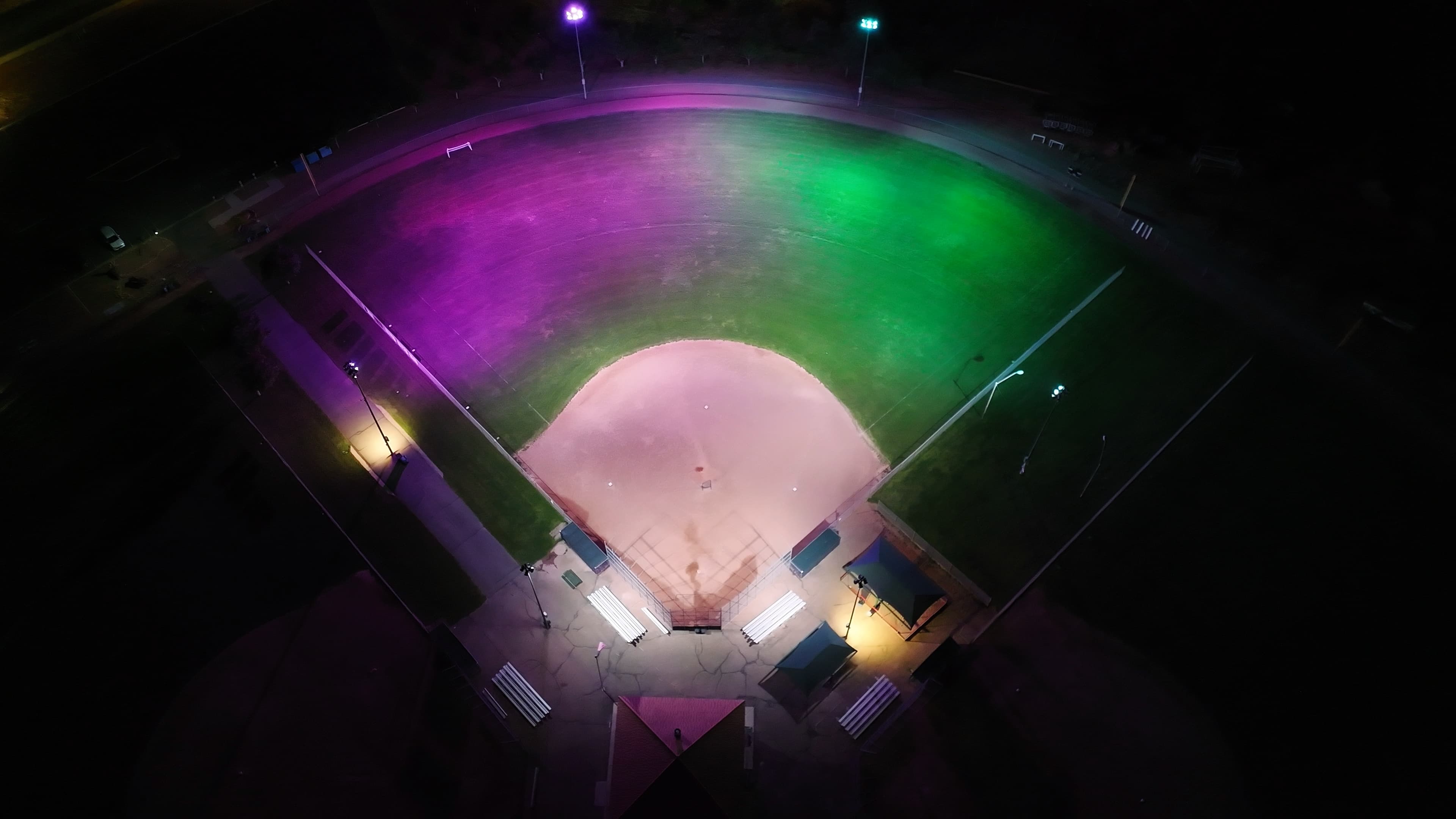
Irregular field geometry is the starting point. Unlike rectangular courts or rectangular football fields, a baseball diamond radiates outward at angles, with an infield, outfield, foul territories, and warning track all requiring different illumination levels and approaches. The batter's box and pitcher's mound demand especially precise lighting to eliminate vertical shadows that impair depth perception and reaction time.
Key technical considerations include:
- Pole placement and mounting height — Positioning poles at the correct distances and elevations is critical to achieving uniform light distribution without spill light into neighboring properties or residential areas — a real concern in denser communities like Dearborn.
- Foot-candle levels by classification — Whether a facility hosts recreational youth play or competitive high school athletics, different governing bodies (NFHS, IES, and others) specify minimum illuminance levels. A properly engineered design ensures compliance while avoiding over-lighting.
- Glare control — Outfield players tracking fly balls against a dark sky are acutely sensitive to glare from poorly aimed or poorly shielded fixtures. High-quality LED optics with precision aiming dramatically reduce this hazard.
- Uniformity ratios — The ratio between the brightest and darkest spots on the playing surface matters for both player safety and broadcast quality. LED systems with well-designed photometrics consistently outperform legacy HID technology on this metric.
For facility managers and parks and recreation directors overseeing multiple fields across communities like Dearborn, Melvindale, or Southgate, these engineering details are not abstract — they directly determine whether a field is usable for evening programming and league play, and whether it meets the standards required for sanctioned competition.
The Real Cost of Aging Field Lighting — A Lesson from Metro Detroit
A compelling example of what's at stake comes from a project our team completed at North Hills Middle School in Bloomfield, Michigan. The school's athletic director first noticed the problem through multiple lamp outages across their football field's lighting system — outages that rendered the field unusable for night games and cost the school valuable field rental revenue.
The existing system consisted of sixty-eight 1,500-watt HID fixtures — energy-intensive, maintenance-heavy, and increasingly unreliable. VOSS conducted a full photometric audit of the field, designed a replacement system using 750-watt Keystone Sports Lighter LED fixtures, and managed the complete installation. The result was a dramatic improvement in both light quality and operational reliability.
Jacob McDermott, Director of Maintenance & Operations, described the outcome: "The results are truly outstanding. The project unfolded seamlessly from start to finish, with VOSS Lighting demonstrating professionalism and efficiency throughout the process. The new lights themselves are nothing short of amazing, providing brilliant and uniform illumination that dramatically enhances the field for both players and spectators."
While that project was a football field, the lessons translate directly to baseball and softball facilities throughout Southeast Michigan. Lamp outages, rising energy costs, and deteriorating fixture performance are not isolated problems — they are the predictable end-state of aging HID systems that have exceeded their useful life. And the cost of inaction — in lost programming hours, emergency repair expenses, and foregone rental revenue — is often far greater than the cost of a planned upgrade.
LED Lighting Innovations Reshaping the Baseball Experience
Beyond simple energy savings, today's LED sports lighting platforms offer capabilities that were not economically feasible with legacy systems. Facility operators and athletic directors considering an upgrade in the Dearborn area should be aware of several key innovations now available at a range of budget points:
Wireless Lighting Controls Modern LED sports lighting systems can be paired with wireless control platforms that allow operators to schedule lighting, adjust brightness levels for different activities, and monitor system performance remotely — all from a smartphone or web dashboard. For parks and recreation departments managing multiple fields across Dearborn and surrounding communities, centralized controls reduce labor costs and eliminate the risk of lights being left on accidentally.
Dimming and Multi-Scene Programming LED systems can be programmed with multiple lighting "scenes" — full competition illumination for varsity games, reduced output for practice sessions, and a low-level maintenance mode for security lighting after hours. This flexibility is impossible with traditional HPS or metal halide systems, which cannot be dimmed without significant energy penalty.
Broadcast-Ready Illumination As local high school and collegiate programs increasingly stream games and host media coverage, lighting quality matters beyond the field of play. Modern LED systems can achieve the high, consistent foot-candle levels and color rendering indices (CRI) required for high-definition video capture — a meaningful upgrade for programs in Wayne County and throughout Metro Detroit looking to elevate their visibility.
Reduced Light Trespass In Dearborn's denser residential neighborhoods, controlling where light goes — and where it doesn't — is as important as illuminating the field itself. Precision LED optics minimize spill light beyond the field boundaries, reducing neighbor complaints and potential compliance issues with local ordinance.
These advances are explored in more depth in related topics within our Latest Lighting series, including our articles on LED Football Stadium Lights and Sports Field Lighting Solutions, Pickleball LED Lighting Solutions, and Tennis Court Lighting and Energy Solutions — all of which reflect similar principles applied to other athletic environments.
What Dearborn and Southeast Michigan Facilities Should Know Before Starting a Project
Whether you manage a single youth baseball diamond at a community park or oversee a multi-field complex serving thousands of players across Wayne County, the path to a successful LED lighting upgrade follows a consistent framework.
Start with a lighting audit. A professional audit establishes your current system's performance — foot-candle levels, uniformity, energy consumption — and creates a baseline for measuring improvement. It also identifies structural or electrical conditions that may affect the design.
Commission a photometric study. Before any fixtures are specified or purchased, a qualified lighting designer should model the proposed system in software that simulates real-world light distribution. This step is essential for validating compliance with league standards and eliminating surprises at installation.
Explore available incentives. DTE Energy and Consumers Energy serve much of Southeast Michigan and offer commercial lighting rebate programs that can meaningfully reduce the net cost of a LED upgrade. Eligible organizations should also ask about cooperative purchasing programs — including Sourcewell, BuyBoard, TIPS, and Omnia Partners — which allow public agencies, school districts, and municipalities to procure through pre-competed contracts, simplifying the procurement process and reducing administrative burden.
Plan for long-term performance. The best LED systems are backed by strong manufacturer warranties and supported by a local contractor capable of providing ongoing maintenance. VOSS has served the Greater Detroit region for decades — our proximity means that post-installation support is a phone call away, not a multi-day logistics challenge.
VOSS has a demonstrated history of delivering high-quality lighting solutions to organizations across Metro Detroit. Our work at Corewell Health in Dearborn, Michigan illustrates the depth of expertise we bring to complex projects in this market. When Corewell's facilities team faced deteriorating suspended and cove fixtures — with aging fluorescent lamps creating inconsistent light quality and brittle lenses falling apart during maintenance — VOSS designed and delivered a uniform linear LED replacement system that transformed the environment.
Luke Sandzik, Supervisor of Facilities Management Plant Operations, noted simply: "Everything looked really good. Thank you for your hard work in getting this completed. SSU looks amazing."
That same commitment to quality design, careful project management, and responsive service extends to every sports lighting project we undertake — whether it's a school district in Dearborn Heights, a municipal parks department in Taylor or Romulus, or a private facility in the broader Wayne County area.
Service Availability
While VOSS offers a comprehensive suite of national services, specific capabilities may vary by location. Please contact your local branch to confirm the current availability of specific services, technology solutions, or contracting capabilities in your immediate market.
Talk to Our Team About Your Field Lighting Project
If you manage a baseball or softball facility in Dearborn, Metro Detroit, or anywhere across Southeast Michigan, we'd welcome the opportunity to discuss what a modern LED lighting upgrade could mean for your program — in terms of player experience, energy savings, and long-term operational reliability.
Our Grand Rapids branch serves the Michigan market and is ready to schedule a consultation, review your existing system, or walk you through the design and incentive landscape.
VOSS — Grand Rapids Branch Phone: (616) 975-9914 Toll-Free: (800) 706-8677
Reach out today to start a conversation about your facility's lighting future. There's no obligation — just an honest assessment from a team that has been doing this work for more than 85 years.