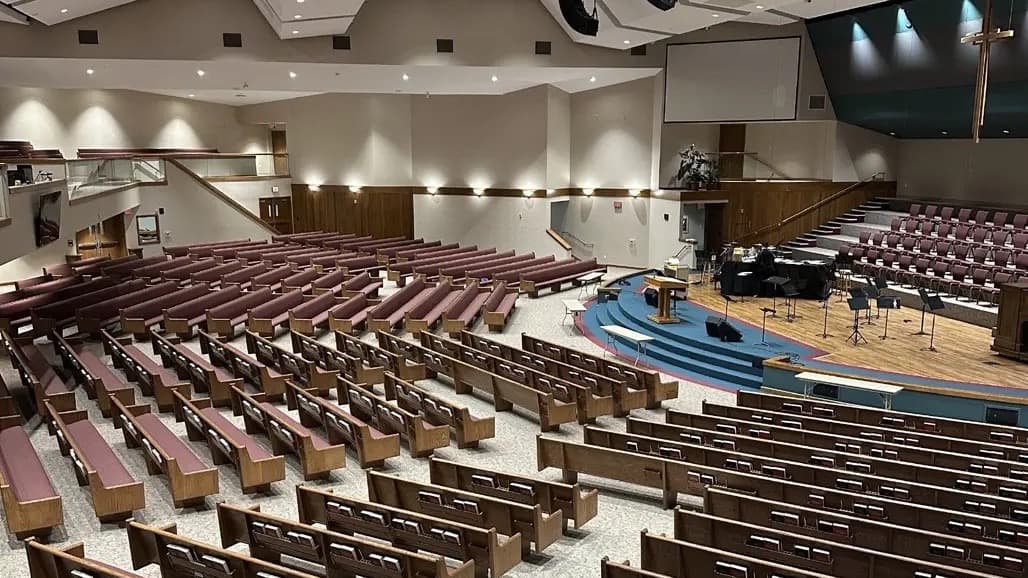
Why Sanctuary Lighting Is a Growing Priority for Plano-Area Churches
Plano, Texas is home to one of the most vibrant and diverse faith communities in the Dallas–Fort Worth metroplex. With a population of more than 285,000 residents spread across a city that borders Frisco, Allen, Richardson, and Garland, Plano supports hundreds of congregations ranging from historic neighborhood churches to large multisite campuses. Many of these facilities were built or last updated decades ago — and their lighting infrastructure shows it.
For church facility managers and operations leaders across the Plano area, sanctuary lighting is rarely a glamorous topic. But it is an increasingly urgent one. Aging incandescent, halogen, and fluorescent systems in high-ceiling sanctuaries are driving up maintenance labor costs, creating safety concerns, and delivering inconsistent light quality during services. As congregations in Plano and neighboring communities like Murphy, Wylie, and Sachse invest in worship experience improvements — including livestreaming and video production — the performance gap of outdated lighting becomes harder to ignore.
The good news is that the technology, incentives, and expertise to address these challenges are more accessible than ever. Understanding what's driving the problem — and what modern solutions look like — is the right starting point for any facility team evaluating a lighting upgrade.
The Real Cost of Deferred Sanctuary Lighting Maintenance
Church facility managers often face a difficult balancing act: keeping operational costs low while maintaining the spaces their congregation depends on week after week. Lighting maintenance is frequently deferred because the immediate cost of replacing a single burned-out bulb seems manageable. But this approach adds up quickly in sanctuary environments.
High ceilings are the central challenge. Many Plano-area church sanctuaries feature vaulted or cathedral ceilings ranging from 20 to 50 feet or higher. Each time a fixture fails, replacing it requires scaffolding, a lift, or a contracted crew — turning what should be a routine task into a costly, time-consuming event. When this happens multiple times per year across dozens of fixtures, the cumulative labor and equipment costs can rival the investment in a full LED retrofit.
Aging ballasts and dimming incompatibilities compound the problem. Flickering lights, buzzing fixtures, and unresponsive dimmer systems are common symptoms of ballasts that have exceeded their useful life. These issues are not just annoying — they create liability concerns and detract from the worship atmosphere that congregations expect. In sanctuaries where dramatic lighting transitions are part of the service design, unreliable dimming is particularly disruptive.
The energy burden is real. Traditional sanctuary fixtures — especially incandescent and halogen systems favored for their warm, aesthetic quality — consume significantly more electricity than modern LED alternatives. For a large congregation in Plano operating multiple services per week, plus rehearsals, events, and community programming, the energy cost of an outdated lighting system accumulates year-round.
What Modern Sanctuary Lighting Upgrades Actually Look Like
The transition to LED and smart lighting controls in church sanctuaries has matured significantly over the past decade. Early LED products were criticized for harsh color temperatures and poor dimming performance — concerns that are well-documented in the church community. Today's solutions are a different category entirely, and understanding what's available helps facility teams make better decisions.
LED retrofit and re-lamping options now span a wide range of color temperatures, including warm whites in the 2700K–3000K range that closely match the aesthetic of traditional incandescent sources. High-quality LED lamps designed for sanctuary environments can maintain consistent color rendering (CRI 90+) across their lifespan, ensuring that architectural details, stained glass, and congregation members are all rendered faithfully under artificial light.
Fixture-level controls and dimming systems have advanced alongside LED technology. Modern dimming controls — including DMX-based theatrical systems, 0–10V dimming, and wireless scene controllers — allow worship teams to program repeatable lighting scenes for different service elements: spoken word, music, prayer, or media presentation. For Plano churches that have invested in video production or livestreaming infrastructure, proper lighting control is not optional — it is a prerequisite for professional-quality output.
Maintenance-first design is a key principle for church facilities. Well-executed LED upgrades extend lamp life to 50,000 hours or more, dramatically reducing the frequency of ceiling-level maintenance interventions. This is especially meaningful for facilities with limited maintenance staff or volunteer-driven operations teams, which is common across congregations of all sizes in the Plano and greater DFW area.
For facilities navigating historic preservation requirements or architectural constraints — such as older church buildings in established Plano neighborhoods near Downtown Plano or along legacy corridors like Preston Road — thoughtful retrofit approaches can preserve visual character while delivering the performance and efficiency of modern lighting.
Energy Efficiency Incentives Available to Plano-Area Churches
One factor that often accelerates the decision-making process for church leadership is the availability of financial incentives for energy-efficient lighting upgrades. While churches are typically tax-exempt and cannot take advantage of certain federal tax credits directly, utility rebate programs and cooperative purchasing arrangements can meaningfully offset project costs.
Texas utility providers serving the Plano area — including Oncor Electric Delivery, which manages transmission and distribution infrastructure across much of the DFW region — support energy efficiency programs that may be applicable to commercial and institutional facilities. Church facility managers should work with their retail electric provider and a qualified lighting contractor to identify available rebates before beginning a project.
For churches that are affiliated with educational institutions, municipal campuses, or other public-sector organizations, cooperative purchasing programs can simplify procurement and deliver additional cost advantages. Eligible organizations in the Plano area may have access to programs including BuyBoard, TIPS, Sourcewell, Omnia Partners, and the Houston Church COOP — a program specifically structured for faith-based facilities seeking streamlined access to qualified vendors and pre-negotiated pricing.
For those unfamiliar with rebate navigation, the process can feel complex. A related article in this series — Energy Audits, Incentives, and Rebate Navigation for Businesses — provides a deeper look at how organizations can systematically identify and capture available incentives. Similarly, Maximize ROI with Commercial LED Lighting Rebates in Dallas, TX offers market-specific guidance relevant to the broader DFW area, including Plano.
Trends Shaping Church Lighting in the Greater Dallas Region
The DFW metroplex is one of the fastest-growing regions in the United States, and Plano sits at its northern edge alongside some of the most rapidly developing communities in the country. This growth has significant implications for the church facilities landscape.
Several trends are worth noting for facility managers and church leadership teams evaluating lighting investments:
- Multisite campuses and leased facilities are increasingly common as congregations grow and expand into converted retail, office, or event spaces across Plano, Frisco, and Allen. These environments often present unique lighting challenges — existing commercial fixtures that are unsuitable for worship, inadequate dimming infrastructure, or ceiling heights that were not designed with sanctuary use in mind.
- Livestreaming and content production have become standard ministry tools, accelerating dramatically in recent years. Sanctuary lighting systems that were designed purely for in-person worship often fall short of the requirements for on-camera environments. Color temperature consistency, shadow reduction, and controllability are now evaluated alongside energy efficiency when churches plan upgrades.
- Aging building stock across Plano's established neighborhoods means that many congregations are dealing with electrical infrastructure — not just fixtures — that requires attention. Ballast replacements, wiring upgrades, and panel capacity assessments are often part of a comprehensive sanctuary lighting project, not afterthoughts.
- Budgetary stewardship expectations from congregations and governing boards have intensified scrutiny of operational spending. Lighting upgrades that can demonstrate a clear payback through energy savings and reduced maintenance costs are increasingly viewed favorably as responsible stewardship — not discretionary spending.
These trends align closely with what VOSS observes across our work with faith-based facilities in Texas and nationally. With 85-plus years of experience and a local presence serving the Dallas–Fort Worth area, we bring both the technical knowledge and the regional context to help Plano-area churches navigate these decisions thoughtfully.
Related Topics in This Series
If your congregation is evaluating broader energy and lighting strategy, several related articles in the Latest Lighting series offer complementary perspective:
- Energy Efficient Church Lighting Upgrades provides a foundational look at the efficiency case for modern church lighting systems.
- Fluorescent Tube Bans and LED Lighting Rebates is essential reading for any facility still operating fluorescent fixtures, as regulatory timelines and rebate windows are narrowing.
- Commercial LED Lighting Fixtures covers the fixture selection landscape for commercial and institutional facilities.
Service Availability
While VOSS offers a comprehensive suite of national services, specific capabilities may vary by location. Please contact your local branch to confirm the current availability of specific services, technology solutions, or contracting capabilities in your immediate market.
Talk With Our Dallas Team About Your Sanctuary
If your congregation in Plano — or a nearby community like Allen, McKinney, Richardson, or Garland — is dealing with aging sanctuary lighting, rising maintenance demands, or questions about LED retrofit options, we welcome the conversation. Our Dallas branch team works with faith-based facilities of all sizes and can help you assess your current system, identify applicable incentives, and develop a practical upgrade path that respects your budget and timeline.
VOSS — Dallas Branch
Phone: (972) 432-8367 Toll-Free: (800) 736-8677
Reach out to start a consultative conversation about what modern sanctuary lighting could mean for your facility and your congregation.