Why Baseball Lighting Is Having a Moment in Plano and Greater Dallas
Plano, TX is one of the most athletically active communities in North Texas. With a population of more than 285,000 and a robust parks and recreation infrastructure, Plano supports youth recreational leagues, travel ball programs, high school athletics, and adult softball leagues across dozens of fields and complexes. The same energy runs through surrounding communities — Frisco, Allen, McKinney, Richardson, Garland, and The Colony — all of which have invested heavily in athletic facilities over the past decade to keep pace with the region's rapid growth.
That growth is creating a pressing question for facility managers, parks directors, athletic directors, and team operators across the area: are your field lighting systems keeping up? Across Greater Dallas, a significant share of baseball and softball fields still rely on aging metal halide or high-pressure sodium (HPS) fixtures — technology that was state of the art decades ago but is increasingly costly to operate and maintain. As LED technology has matured, the gap between what older systems deliver and what modern LED systems can achieve has become impossible to ignore.
This article explores what facility owners and operators across Plano and North Texas need to know about baseball LED lighting — the technical standards, the energy economics, the controls innovations, and the real-world results that are reshaping how fields get lit.
The Science Behind Sport-Specific LED Lighting for Baseball
Not all LED lighting is created equal, and baseball presents some of the most demanding lighting design challenges in all of sports. The geometry of the game — a diamond with a deep outfield, a pitcher's mound, a batter's eye zone, and warning tracks at varying distances — requires a level of photometric precision that general-purpose commercial lighting simply cannot deliver.
Professional and governing body standards, including guidelines from Little League Baseball, NFHS, NCAA, and MLB Advanced Media for broadcast-ready facilities, define specific requirements for:
- Horizontal and vertical illuminance levels — measured in foot-candles, these requirements escalate significantly from recreational fields to competitive and professional venues
- Uniformity ratios — the balance between the brightest and darkest points on the playing surface, which directly affects a batter's ability to track a pitch and a fielder's ability to judge fly balls
- Glare control — improperly aimed or inadequately shielded fixtures can create dangerous glare for players, umpires, and fans; LED optics have advanced dramatically in this area
- Color rendering index (CRI) — high-CRI LED sources reproduce colors more accurately under artificial light, which matters both for player performance and for broadcast quality
Pole placement, mounting height, aiming angles, and the number and wattage of fixtures all interact in complex ways. This is why professional photometric design — using software modeling to simulate light distribution across every square foot of a playing surface before a single fixture is installed — is standard practice for quality sports lighting projects. It is also why experience matters: a contractor who has designed and installed systems across multiple field configurations brings insight that no software tool alone can provide.
For facility operators in Plano and across the Dallas–Fort Worth Metroplex, this means the difference between a lighting upgrade that truly elevates the playing experience and one that simply replaces old hardware.
Energy Economics: What LED Means for Operating Costs in Texas
Texas is no stranger to energy cost volatility. Facilities operating on ERCOT — the Electric Reliability Council of Texas, which serves the vast majority of the state including Plano and Greater Dallas — have experienced both the benefits of deregulated energy markets and the risks of price spikes and grid stress events. For outdoor athletic facilities that operate evening games several nights a week across a long spring and summer season, lighting energy costs are a meaningful line item.
Traditional metal halide systems used on baseball fields are among the most energy-intensive light sources still in common use. A typical six-pole metal halide installation on a full-size baseball field might draw several hundred kilowatts per hour of operation. LED systems designed to the same light levels routinely achieve energy reductions of 50% to 70% compared to metal halide equivalents — a difference that compounds rapidly across a full season of play.
Beyond raw energy consumption, there are several other cost dimensions worth understanding:
- Maintenance savings — Metal halide lamps require replacement every few years, and the restrike time (the delay after a lamp is extinguished before it can be relit) creates operational headaches for rain delays and mid-game interruptions. LED fixtures have rated lifespans measured in tens of thousands of hours, with no restrike delay.
- Demand charge impacts — Commercial and municipal electric accounts in Texas often carry demand charges based on peak consumption. Wireless lighting controls that allow gradual dimming and smart scheduling can help facilities manage demand peaks.
- Utility incentives — Oncor Electric Delivery, which serves Plano and much of the Dallas–Fort Worth area, offers energy efficiency incentive programs for commercial and institutional customers. Qualifying LED upgrades at athletic facilities may be eligible for rebates that meaningfully offset project costs. Eligible public agencies and school districts in the area may also be able to access cooperative purchasing programs — including BuyBoard, TIPS, Sourcewell, and Omnia Partners — to streamline procurement.
The financial case for LED conversion at baseball and softball facilities across North Texas has never been stronger.
Controls and Technology: Smarter Field Lighting for Modern Facilities
One of the most significant advances in sports lighting over the past several years is not the LED fixture itself — it is the integration of intelligent controls systems that turn a lighting upgrade into a managed facility asset.
Modern sports lighting controls platforms offer capabilities that would have seemed remarkable just a decade ago:
- Wireless remote operation — Field operators can adjust lighting levels, trigger instant on/off, or switch between preset scenes from a smartphone or tablet, eliminating the need to manually operate breaker panels or timer boxes
- Programmable scheduling — Automated schedules can be configured for practice versus game levels, reducing unnecessary energy use during lighter-activity hours
- Dimming and multi-scene presets — Many facilities find it useful to maintain distinct lighting scenes: a lower-intensity practice setting, a full game setting, a post-game clear-out setting, and even a broadcast-ready configuration for facilities that host televised events
- Remote diagnostics and monitoring — Advanced systems can alert facility managers to fixture failures or performance degradation before they become problems on game night
For Plano's Parks and Recreation Department, school district athletic departments like Plano ISD, and private operators managing travel ball complexes or tournament facilities, these controls capabilities translate directly into reduced staff burden and better patron experience. For the many facilities across North Texas that host weekend tournaments drawing teams from Dallas, Frisco, McKinney, Allen, and beyond, the operational reliability that modern controls provide is a genuine competitive differentiator.
Proof in the Field: Real-World Results from a Baseball LED Project
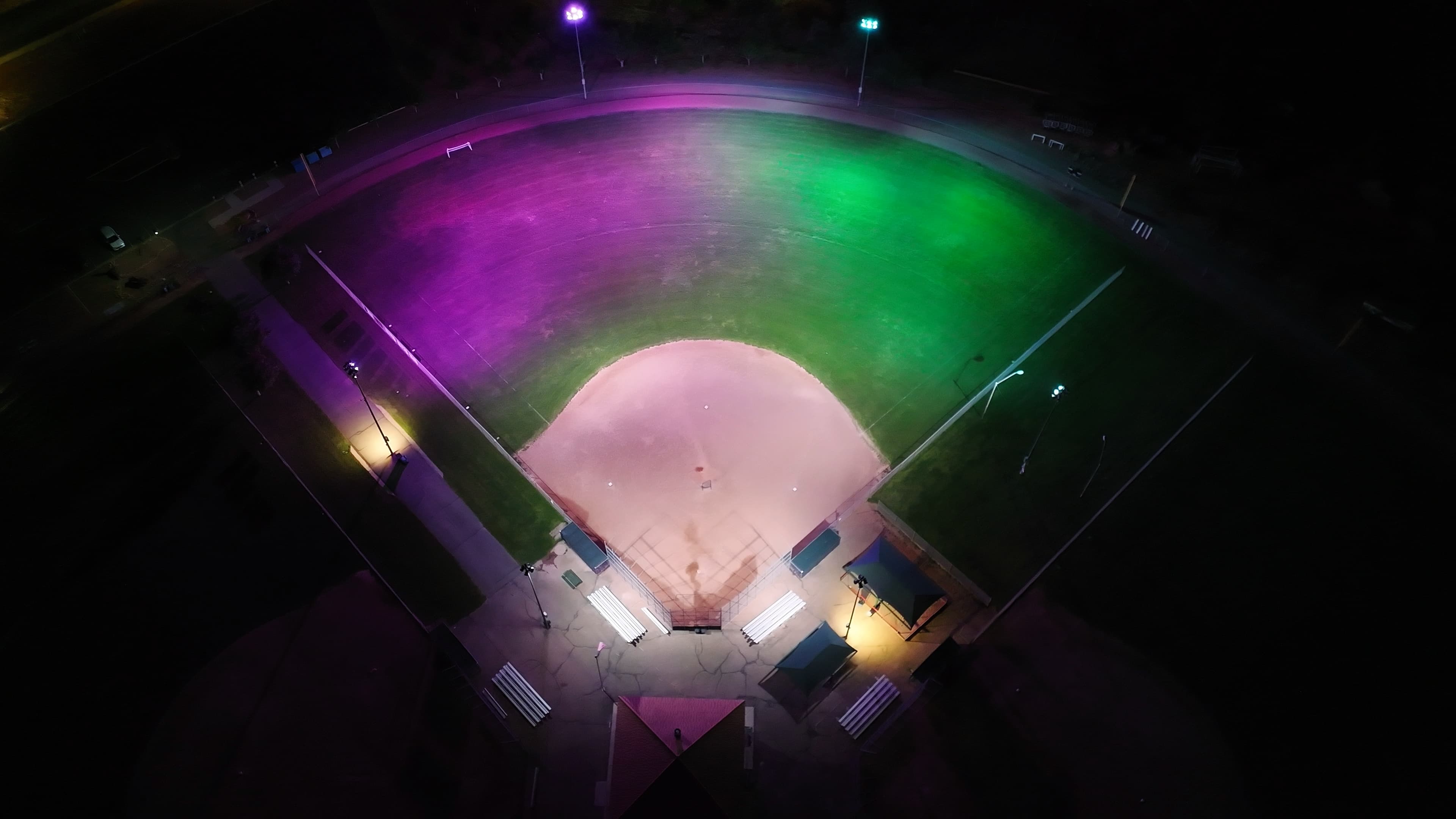
One of the clearest illustrations of what a well-executed baseball LED lighting project can deliver comes from a project VOSS completed in Page, Arizona — a community baseball facility that underwent a full LED conversion. The project involved replacing legacy sports lighting with a professionally engineered LED system designed to meet sport-specific illuminance and uniformity standards. The results demonstrated the kind of outcomes that well-designed sports LED systems deliver: dramatically improved light quality across the playing surface, meaningful reductions in energy consumption, and operational simplicity that the facility's staff immediately noticed.
While Page, AZ is geographically distant from Plano, the fundamentals translate directly. Baseball diamonds in North Texas face the same photometric challenges, the same energy cost pressures, and the same player and fan experience expectations. The project serves as a meaningful proof point that professional-grade LED systems, properly designed and installed, deliver on their promise — not just in theory but in practice.
For facility operators in Plano and across the Greater Dallas area who are evaluating whether an LED upgrade is the right investment, real project experience of this kind is far more instructive than product brochures alone.
What Facility Operators in Plano Should Be Asking Right Now
Whether you manage a city park complex in Plano, oversee athletic facilities for a school district, or operate a private baseball training or tournament venue somewhere in the North Texas corridor, there are several questions worth asking as you evaluate your current lighting infrastructure:
- How old are your existing fixtures? Metal halide systems older than ten to fifteen years are likely operating well below their original rated output due to lumen depreciation — your fields may be darker than you think, even if the lights appear to be working.
- What are your annual lighting energy costs? Many facility managers are surprised when they calculate the true cost of operating aging sports lighting systems across a full season.
- Do your current systems meet current league or governing body standards? Standards for recreational and competitive play have been updated over the years; a system that was compliant at installation may no longer meet current guidelines.
- Are your fields scheduled for any capital improvement or renovation work? LED lighting upgrades are often most cost-effective when coordinated with broader facility projects.
- Have you explored available incentives? Between utility rebate programs and cooperative purchasing vehicles available to public agencies and educational institutions, there are often mechanisms available to improve project economics significantly.
These are conversations our team has every week with facility operators across Texas and the broader region. The answers look different for every site, which is why a site-specific assessment — not a one-size-fits-all pitch — is always the right starting point.
Exploring Related Lighting Topics
Baseball and softball LED lighting is one piece of a broader landscape of sports and outdoor lighting innovation. If you manage multi-sport or multi-use facilities, you may also find value in exploring our articles on Pickleball LED Lighting Solutions, LED Gymnasium Lighting Solutions, Tennis Court Lighting and Energy Solutions, and LED Football Stadium Lights and Sports Field Lighting Solutions — all available within our Latest Lighting content section. For outdoor facility operators thinking about the broader energy picture, our pieces on Commercial LED Outdoor Lighting, Parking Lot and Outdoor LED Lighting Upgrades, and Energy Audits, Incentives, and Rebate Navigation for Businesses offer relevant context as well.
Service Availability
While VOSS offers a comprehensive suite of national services, specific capabilities may vary by location. Please contact your local branch to confirm the current availability of specific services, technology solutions, or contracting capabilities in your immediate market.
Talk to VOSS About Your Plano or North Texas Baseball Lighting Project
If your facility is ready for a smarter, more efficient, and higher-performing lighting system — or if you simply want to understand what a modern LED upgrade would look like for your specific site — we invite you to start a conversation with our Dallas team.
VOSS has been serving commercial, institutional, and public-sector clients across Texas and the nation for more than 85 years. Our Dallas branch serves Plano, Frisco, Allen, McKinney, Richardson, Garland, Carrollton, The Colony, and communities throughout the Greater Dallas–Fort Worth Metroplex.
VOSS — Dallas Branch
Phone: (972) 432-8367 Toll-Free: (800) 736-8677
Reach out to schedule a consultation or site assessment. There is no obligation — just an honest conversation about what your facility needs and what is possible.