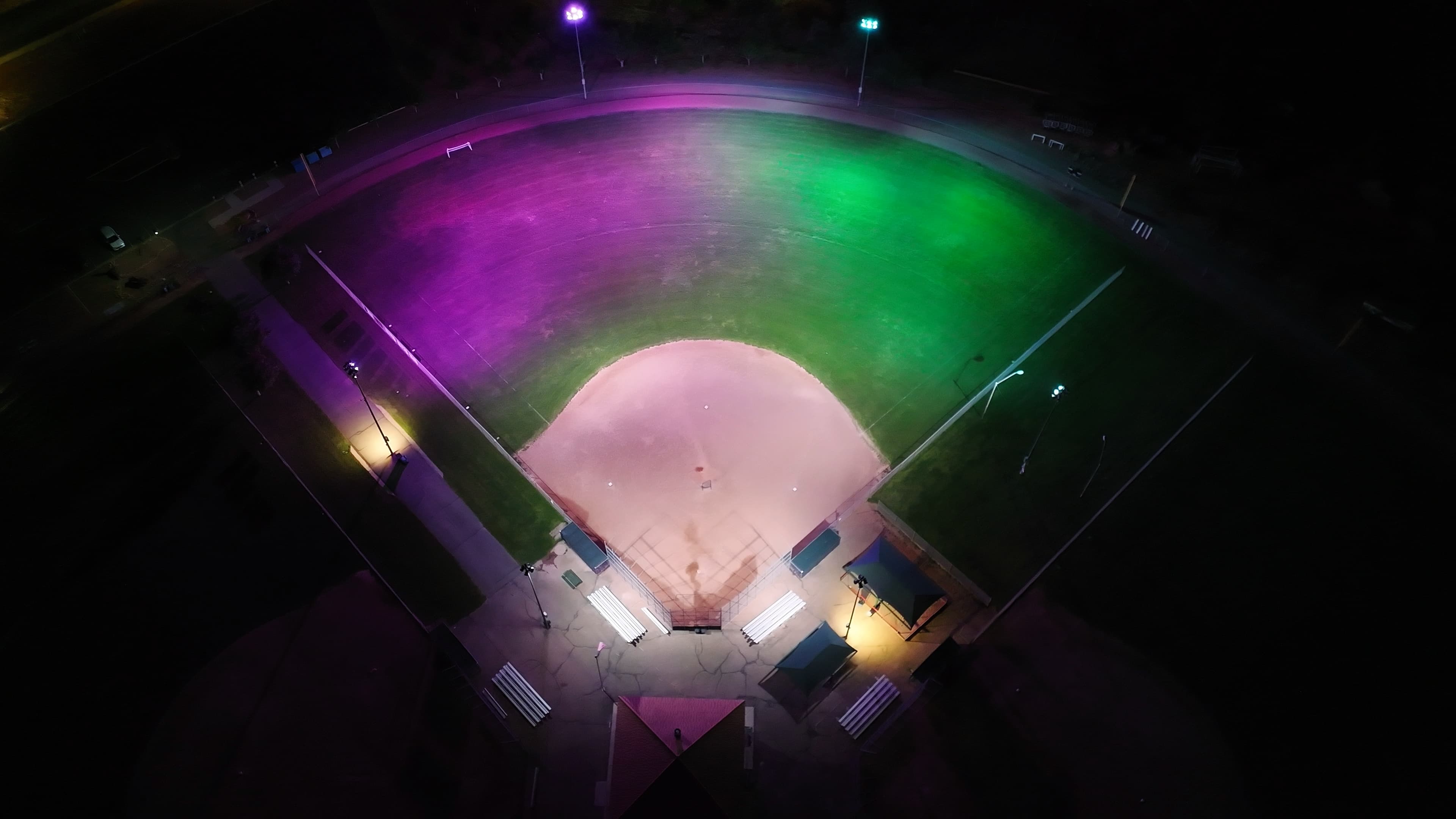
Why Baseball Field Lighting Deserves More Attention in McKinney
McKinney, Texas has grown into one of the most active youth and amateur sports communities in the Dallas-Fort Worth metroplex — and its ballparks are at the center of that story. With a population approaching 195,000 and sustained residential and commercial growth attracting families from across North Texas, the demand for high-quality recreational facilities has never been higher. Leagues are expanding, tournaments are multiplying, and fields are logging more hours under the lights than ever before.
Yet many of the baseball and softball facilities serving McKinney, Fairview, Prosper, and the surrounding Collin County communities were built with metal halide or high-pressure sodium lighting systems that are now decades old. These legacy systems consume far more energy than modern LED alternatives, require longer warm-up times, and deliver uneven light distribution that can create real visibility challenges for players — particularly batters and outfielders tracking fly balls against a dark sky. For facility managers and parks and recreation departments responsible for aging infrastructure, the cost and performance gap is becoming harder to ignore.
The shift to LED sports lighting isn't just a trend. It reflects a fundamental change in what players, coaches, officials, and fans expect from a well-run facility — and what governing bodies, from Little League International to the NCAA, are increasingly requiring in terms of lighting performance standards.
What Makes Baseball Lighting Uniquely Demanding
Not all sports lighting challenges are created equal. Baseball and softball fields present a distinct set of design complexities that separate them from, say, a basketball gym or a tennis court. Understanding these demands is the first step toward making a smart investment.
Field geometry creates asymmetric lighting challenges. Unlike a rectangular soccer or football field, a baseball diamond radiates outward from home plate at irregular angles. The infield, outfield, warning track, bullpen, and dugout areas each require different illumination levels — and the relationship between those zones has to be carefully balanced to avoid glare or dark spots that affect play.
Glare control is non-negotiable. Batters stand at home plate looking out toward the mound and beyond — directly into the lighting field if fixtures are poorly aimed or positioned. Outfielders tracking pop flies look almost directly toward the poles. In both cases, excessive glare doesn't just affect performance; it's a safety issue. Professional-grade LED systems use precisely engineered optics and spill-light controls to deliver high foot-candle levels where they're needed without blinding the people on the field.
Broadcast and tournament standards raise the bar. Community recreation fields have different requirements than competitive travel ball complexes or collegiate venues. Facilities that host regional tournaments, travel ball events, or broadcast productions — all increasingly common in the DFW market — must meet specific maintained illuminance levels and uniformity ratios set by governing bodies. An LED system designed and engineered to those standards from the outset saves costly retrofits down the road.
Pole placement and mounting height matter as much as the fixtures themselves. The geometry of how and where poles are positioned across the field directly affects coverage uniformity and glare performance. This is why photometric design — the science of modeling and predicting how light will behave across a specific field layout — is essential before a single fixture is specified or a hole is dug.
For facilities across McKinney and the greater Collin County area, working with a contractor who understands these dynamics from the design phase through commissioning is the difference between a lighting upgrade that performs and one that creates new problems.
A Proven Approach: Lessons from the Page, AZ Baseball Project
One of the clearest illustrations of what thoughtful LED sports lighting design can deliver comes from a completed VOSS project in Page, Arizona. The Page baseball facility required a complete lighting redesign — a project that demanded precise photometric planning, sport-specific fixture selection, and careful pole placement to meet the performance standards of a competitive athletic venue while delivering meaningful energy savings.
The result was a facility transformed — consistent, high-quality illumination across the entire field, dramatic reductions in energy consumption compared to the legacy system, and a playing environment that met governing body standards. The project demonstrated something that holds true whether the venue is in a small Arizona community or a rapidly growing Texas suburb: the fundamentals of great baseball lighting are universal, but the execution has to be tailored to the specific field, the specific community, and the specific standards that apply.
For parks and recreation departments in McKinney and surrounding cities like Allen, Celina, and Anna — many of which are managing multiple fields across growing athletic complexes — this kind of engineered, project-managed approach is exactly what large-scale upgrades require.
The Business Case for LED in McKinney's Sports Facilities
For facility operators and budget-conscious decision-makers, the financial rationale for LED baseball lighting upgrades has never been clearer — and it extends well beyond the energy bill.
Energy savings are substantial and immediate. LED systems typically consume 50–70% less energy than the metal halide systems they replace. For a ballpark running evening games four or five nights a week across a long Texas season, that reduction translates to meaningful, recurring savings from the first month of operation.
Maintenance costs drop significantly. Traditional high-intensity discharge lamps require periodic relamping — a costly and logistically complex process on tall sports lighting poles. LED fixtures carry dramatically longer rated lifespans, reducing both the frequency and cost of maintenance over the system's life. For municipally operated parks with limited maintenance staff and budgets, this is often as compelling as the energy savings themselves.
Rebates and incentive programs can offset upfront costs. Utility providers serving the DFW market offer energy efficiency rebates for qualifying LED upgrades — and navigating those programs is part of what VOSS brings to the table. Related resources in our Latest Lighting content section, including our articles on LED lighting rebates in Dallas and energy audits, incentives, and rebate navigation for businesses, offer deeper guidance on how to maximize available incentives.
Controls integration unlocks additional value. Modern LED sports lighting systems can be paired with smart controls — dimming, scheduling, occupancy-based adjustments, and remote monitoring — that allow facility operators to fine-tune energy use and respond dynamically to game schedules, weather delays, and off-hours security lighting needs. This is especially relevant for multi-field complexes where lighting across several fields needs to be managed efficiently.
Cooperative purchasing programs simplify procurement for public agencies. Municipalities, school districts, and parks and recreation departments in McKinney and across Collin County may be eligible to procure LED sports lighting projects through cooperative purchasing programs including BuyBoard, TIPS, Sourcewell, AEPA, and Omnia Partners. These vehicles allow eligible organizations to move faster and more cost-effectively without the time and expense of a standalone competitive bid process.
Serving McKinney and the Greater Collin County Region
VOSS operates from our Dallas branch, serving McKinney, Frisco, Allen, Plano, Prosper, Celina, Anna, Gunter, and communities throughout Collin and Denton counties. Whether your project involves a single Little League field in a neighborhood park, a multi-diamond tournament complex operated by a city parks department, or a competitive facility affiliated with a high school or college program, our team brings the design expertise, project management capability, and electrical contracting experience to deliver results.
Our work spans the full range of the Latest Lighting portfolio — from sports-specific applications like LED gymnasium lighting and pickleball and tennis court lighting to commercial outdoor lighting, parking lots, and energy audits. Baseball and softball lighting is one dimension of a broader capability set built for facilities of every type across North Texas.
Service Availability
While VOSS offers a comprehensive suite of national services, specific capabilities may vary by location. Please contact your local branch to confirm the current availability of specific services, technology solutions, or contracting capabilities in your immediate market.
Let's Talk About Your Field
If your baseball or softball facility in McKinney or the surrounding area is running on aging metal halide fixtures, experiencing uneven lighting, facing rising energy costs, or preparing for a capacity expansion, now is a strong time to explore what a professionally engineered LED upgrade could deliver.
Our Dallas team is ready to walk through your facility's specific needs — starting with a conversation about what you're trying to achieve, what standards apply, and what opportunities exist to offset project costs through rebates and incentive programs.
VOSS — Dallas Branch
Phone: (972) 432-8367 Toll-Free: (800) 736-8677