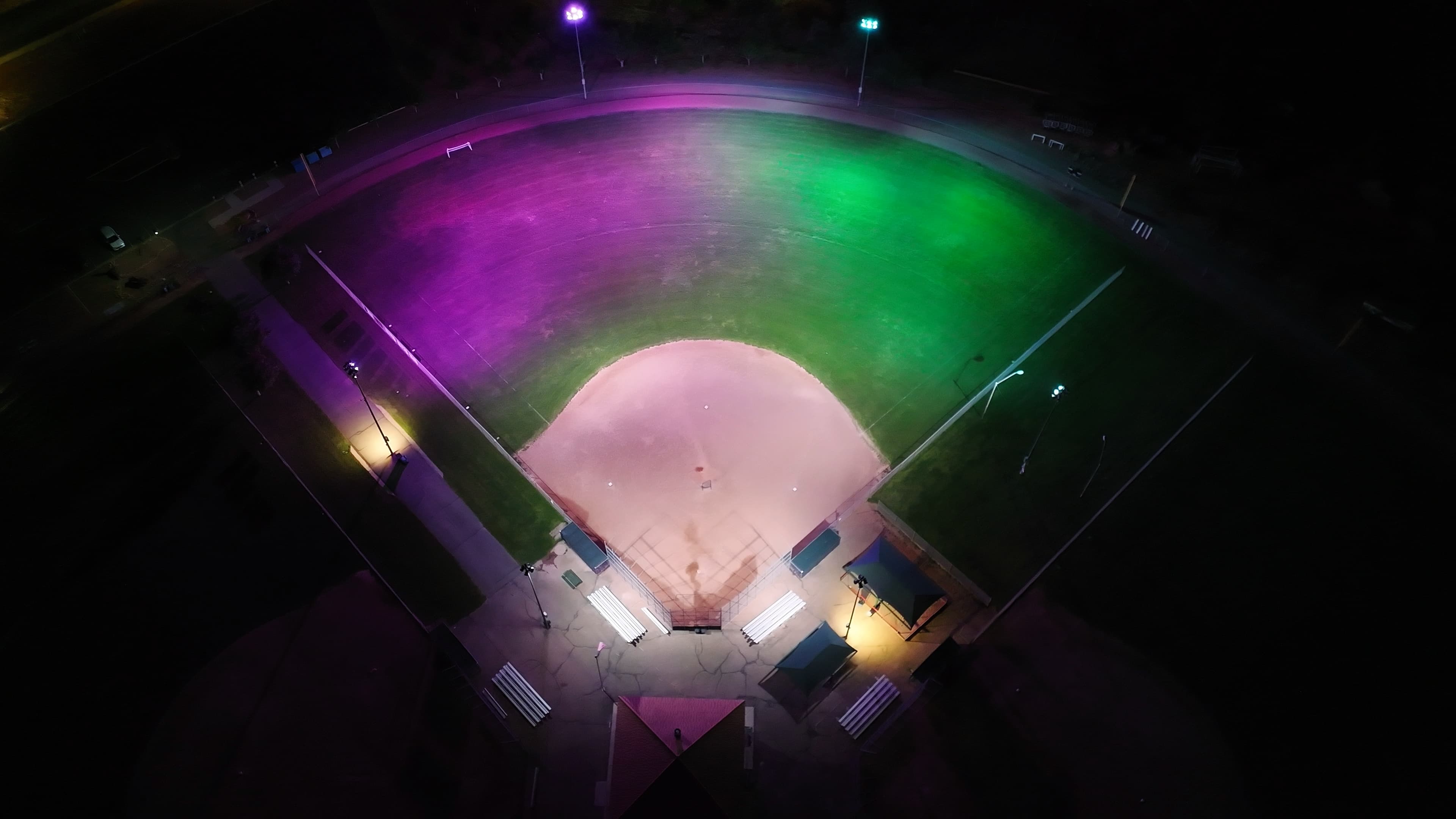
Why Baseball Lighting Is Having a Major Moment in Garland and Greater Dallas
Baseball is woven into the fabric of North Texas. From youth rec leagues running Saturday morning games at Audubon Park to competitive travel ball programs drawing teams from across the Metroplex, Garland's athletic fields see heavy use year-round. The same is true across the Greater Dallas region — in Mesquite, Rowlett, Sachse, Richardson, and Wylie, municipal and private baseball facilities are facing a shared challenge: aging metal halide and high-pressure sodium lighting systems that are expensive to operate, difficult to maintain, and increasingly out of step with the quality of play happening beneath them.
Across the country, a quiet but significant infrastructure shift is underway. LED technology has matured to the point where it is now the clear standard for sports field lighting at every level — from Little League to Major League. For facility managers, parks and recreation directors, and athletic program administrators in the Dallas–Fort Worth area, the question is no longer whether to upgrade to LED, but when and how to do it right.
This article breaks down what's driving that shift, what makes baseball lighting technically distinct from other sports applications, and what Garland-area organizations should know before starting a project.
What Makes Baseball Lighting Technically Unique
Not all sports lighting projects are created equal, and baseball presents some of the most demanding design challenges in the field. Understanding these nuances is essential to avoiding costly mistakes.
The geometry of the game creates complex lighting zones. Unlike a basketball court or a soccer pitch, a baseball diamond has an asymmetrical footprint. The infield, outfield, foul territory, warning track, and bullpen areas all have different illuminance requirements and viewing angles. A well-engineered photometric design must account for each zone individually — and ensure they work together seamlessly.
Glare control is critical — and often underestimated. Batters track a 90-mph fastball against a backdrop that may include light poles, stadium structures, or open sky. Poor glare management at the wrong pole angle can impair a batter's sightline in ways that affect both performance and safety. LED optics, when properly specified and aimed, offer far more precise glare control than traditional HID systems.
Pole placement and mounting height matter as much as fixture output. The number of poles, their height, and their position around the field directly determine light uniformity. Industry standards from organizations such as the Illuminating Engineering Society (IES) and governing bodies like USA Baseball provide illuminance targets that vary by competition level — from recreational youth play to NCAA and professional standards. Hitting these targets requires engineering discipline, not just selecting a bright fixture.
Broadcast and camera requirements add another layer. For facilities that host televised or livestreamed games — increasingly common even at the high school and collegiate level — lighting must meet color rendering and flicker-free performance thresholds that standard commercial fixtures simply don't address. High-CRI LED systems designed for sports broadcasting eliminate the strobing effects that appear on video even when invisible to the naked eye.
These technical realities are why baseball LED lighting projects benefit from a contractor with dedicated sports lighting design experience — not just general electrical expertise.
The LED Upgrade Opportunity: What Garland Facilities Stand to Gain
For parks and recreation departments, school districts, and private facility operators across Garland and the surrounding communities, the business case for LED retrofits has never been stronger.
Energy cost reduction is substantial and measurable. Traditional metal halide systems — still common on fields built in the 1990s and 2000s — consume significantly more energy than modern LED alternatives. A well-designed LED system can cut field lighting energy consumption by 50–70%, depending on the existing system and usage hours. For a facility running lights several evenings per week through a long Texas baseball season, that reduction translates to meaningful operating budget relief year after year.
Maintenance costs drop dramatically. Metal halide lamps require periodic relamping — a process that involves renting bucket trucks, purchasing replacement lamps, and scheduling maintenance windows that take fields out of service. LED fixtures carry rated lifespans of 100,000 hours or more, eliminating the relamping cycle almost entirely and reducing the total cost of ownership over a 15–20 year horizon.
Lighting controls unlock new operational flexibility. Modern LED sports lighting systems can be integrated with programmable controls and dimming technology, giving operators the ability to run lights at different output levels for practice versus game play, schedule automatic shutoffs, and monitor system performance remotely. This is particularly valuable for busy multi-field complexes — common in Garland's park system — where manual management of lighting schedules is a real operational burden.
Player and fan experience improves immediately. Consistent, uniform light across the field reduces shadows in the outfield gaps, improves depth perception for infielders and outfielders, and creates a better viewing environment for spectators. Instant on/off capability — no warm-up or cool-down time — is a practical advantage during rain delays and doubleheaders.
Proof in the Field: Lessons from Real LED Baseball Projects
VOSS has direct experience delivering LED lighting solutions for baseball facilities, and the results reflect what's possible when engineering rigor meets careful project management.
In Page, Arizona, VOSS completed a baseball field LED lighting project that demonstrated the full range of outcomes a well-executed upgrade can deliver — improved on-field visibility meeting sport-specific standards, significant energy savings, and a lighting system built to perform reliably in challenging outdoor conditions. Projects like this one illustrate that the benefits of LED sports lighting are not theoretical. They show up in energy bills, maintenance logs, and — most importantly — on the field itself.
For Greater Dallas facilities considering a similar path, the Page project is a useful reference point: the same principles of photometric design, pole layout engineering, and controls integration apply whether the project is a single community field in Garland or a multi-field complex serving a school district in Rowlett or Sachse.
Those exploring related sports lighting applications may also find value in the LED Gymnasium Lighting Solutions, Pickleball LED Lighting Solutions, and Tennis Court Lighting and Energy Solutions articles in our Latest Lighting series — each addresses the distinct design requirements of its sport while sharing the same core commitment to engineered performance.
Navigating Funding, Incentives, and Procurement in the Dallas Region
One of the most frequently asked questions from parks departments and school districts in the Greater Dallas area is: How do we pay for this? The good news is that the funding landscape for LED sports lighting projects has improved considerably.
Utility rebates can offset project costs. Texas utilities, including Oncor — which serves much of the Dallas–Fort Worth region including Garland — offer energy efficiency rebate programs for qualifying commercial and institutional LED upgrades. Rebate amounts vary based on the project scope and the energy savings calculation, but they can represent a meaningful reduction in net project cost. VOSS helps clients navigate rebate applications and ensure that systems are specified in ways that maximize eligible incentives. Our Maximize ROI with Commercial LED Lighting Rebates in Dallas, TX article covers this topic in depth and is worth reviewing as part of any project planning process.
Cooperative purchasing programs simplify procurement for public entities. For Garland ISD, the City of Garland Parks and Recreation Department, and other public-sector organizations, navigating competitive bid requirements can add time and complexity to projects. Cooperative purchasing programs provide an established, compliant procurement pathway. Eligible organizations in this region may have access to programs including BuyBoard, TIPS, Sourcewell, AEPA, Omnia Partners, and PACE, among others. VOSS is available through multiple cooperative contracts, which can significantly streamline the contracting process for qualifying public entities.
Financing and energy savings agreements are additional tools worth exploring for organizations that want to accelerate their upgrade without a large upfront capital expenditure. The energy savings generated by LED systems can often be structured to offset project costs over time.
What to Look for in a Baseball Lighting Partner
Selecting the right contractor for a baseball or softball LED lighting project is a consequential decision. A few factors to evaluate:
- Sports-specific design capability — Can the contractor produce and validate a photometric design that meets IES and governing body standards for your competition level? This requires specialized software and experience, not just general lighting knowledge.
- Full-service electrical contracting — Sports lighting projects involve more than fixtures. They require electrical infrastructure work, panel and service capacity evaluation, conduit and wiring, and often structural assessment of existing poles. A contractor who handles all of this under one roof reduces coordination risk.
- Project management experience at scale — Larger multi-field projects require sequencing, scheduling around playing seasons, and coordination with parks staff or school facilities teams. Ask about the contractor's project management process.
- Ongoing support and commissioning — The work isn't done at energization. Proper commissioning — verifying that fixtures are aimed correctly, that controls are programmed as designed, and that the photometric targets are actually being met — is essential to realizing the full value of the investment.
VOSS brings all of these capabilities to baseball and softball projects across Texas and nationwide, backed by 85+ years as a full-service commercial electrical contractor with deep roots in the Dallas–Fort Worth market.
Service Availability
While VOSS offers a comprehensive suite of national services, specific capabilities may vary by location. Please contact your local branch to confirm the current availability of specific services, technology solutions, or contracting capabilities in your immediate market.
Talk to Our Dallas Team About Your Field Lighting Project
Whether you're managing a single community ballfield in Garland, overseeing a multi-field athletic complex for a school district, or planning a major renovation for a private baseball facility anywhere in the Greater Dallas region, VOSS is ready to have a substantive conversation about what's possible — and what makes sense for your budget, timeline, and goals.
Our Dallas branch serves Garland and the surrounding communities, including Mesquite, Rowlett, Sachse, Richardson, Wylie, Rockwall, and the broader DFW Metroplex.
VOSS – Dallas Branch Phone: (972) 432-8367 Toll-Free: (800) 736-8677
Reach out to schedule a consultation with our sports lighting team. We'll start with your field, your usage patterns, and your objectives — and build from there.