Why Fort Worth Baseball Facilities Are Rethinking Their Lighting
Fort Worth is one of the fastest-growing cities in the United States, and with a population surpassing one million, the demand for high-quality athletic and recreational infrastructure has never been greater. From the youth leagues running games in Benbrook, Keller, and Burleson to the collegiate programs at TCU and Tarleton State's growing DFW presence, baseball is woven into the fabric of North Texas sports culture.
Yet many of the region's fields — including community park complexes in Haltom City, Saginaw, and Crowley — still rely on aging metal halide or high-pressure sodium (HPS) lighting systems that were designed for a different era. These technologies are increasingly out of step with what today's players, coaches, and facility operators need: consistent light quality, reliable performance, and manageable operating costs in a region where summer utility bills can be punishing.
The shift to LED technology isn't just a trend — it's a structural change in how athletic facilities manage long-term operational performance. Understanding what drives that shift, and what it takes to execute it well, is the first step toward making a smart decision for your facility.
The Technical Realities of Baseball Lighting — and Why They Matter
Baseball and softball present some of the most demanding lighting challenges in all of sports. Unlike basketball or tennis courts, a baseball field is asymmetrical, expansive, and requires illumination across dramatically different focal planes simultaneously — from the tight geometry of the infield to the deep reaches of the outfield warning track and foul territory.
Effective baseball lighting design must account for:
- Uniformity ratios — The ratio between the brightest and darkest points on the playing surface must meet governing body standards to eliminate the "hot spot and shadow" effect that impairs depth perception for batters and outfielders
- Pole placement and aiming angles — Poorly positioned poles create glare directly in players' lines of sight, particularly for outfielders tracking fly balls against a lit sky
- Vertical illuminance — Broadcasters, scouts, and even casual spectators increasingly expect lighting that performs vertically, not just horizontally — critical for video capture, livestreaming, and HD replay
- Spill light control — In dense suburban markets like North Richland Hills, Euless, or Mansfield, light trespass onto adjacent residential properties is a real regulatory and community concern
Modern LED systems, engineered specifically for sports applications, address each of these variables with a precision that legacy HID technology simply cannot match. Optical designs can be tuned at the fixture level to direct light exactly where it's needed — and nowhere it isn't.
Lessons from the Field: What Real Projects Reveal
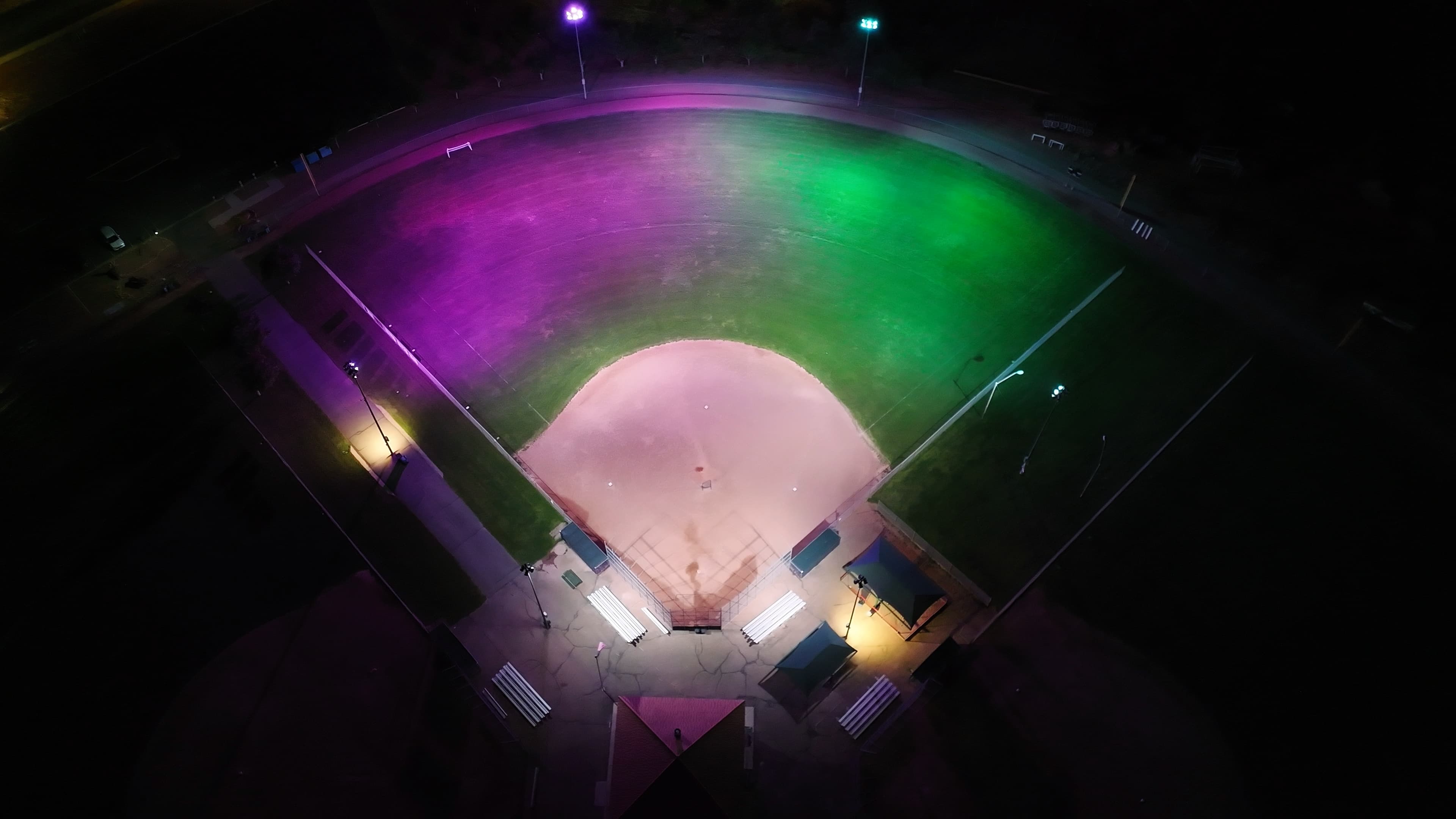
One of the clearest illustrations of what well-executed baseball LED lighting can accomplish comes from a project VOSS completed in Page, Arizona — a community-scale baseball facility that needed a full lighting upgrade to serve its local athletic programs. The project required careful photometric design to meet league standards, strategic pole and fixture placement to serve the unique geometry of the site, and a solution that would deliver long-term operational savings for the facility's operators.
The result was a system that met sport-specific illuminance requirements, reduced energy consumption compared to the prior HID installation, and delivered the kind of consistent, glare-controlled light quality that makes a night game genuinely enjoyable for players, coaches, and spectators alike.
For Fort Worth facilities, the takeaway is practical: the variables that define a successful baseball lighting project — design precision, engineering coordination, compliance with standards, and experienced installation — are the same regardless of whether the field sits in Arizona or Tarrant County. What changes is the local context: the utility rate environment, the applicable codes, and the community expectations that come with serving a major Texas metropolitan market.
What Fort Worth Facility Operators and Decision-Makers Should Know
Whether you're overseeing a municipal parks complex for the City of Fort Worth, managing athletics infrastructure for a school district in the Crowley ISD or Northwest ISD footprint, or operating a private multi-field tournament facility in the Alliance corridor, the considerations driving a lighting upgrade decision tend to cluster around a few core themes.
For operations and facilities leaders, the priority is reliability. LED systems carry significantly longer rated lifespans than metal halide lamps, which means fewer emergency re-lamp events mid-season, more predictable maintenance scheduling, and reduced burden on already-stretched facility staff. Instant-on/off capability is also operationally meaningful — there's no warm-up period waiting for fixtures to reach full output after a rain delay or a between-game reset.
For financial decision-makers, the case for LED centers on the full lifecycle cost picture. In a Texas energy market where commercial and municipal electric rates have seen sustained upward pressure, the energy efficiency gains from LED — which can be dramatic compared to legacy HPS or metal halide systems — translate directly into measurable reductions in utility spend. Combined with available rebate programs through local utilities and state energy efficiency initiatives, the financial case for LED upgrades has strengthened considerably in recent years. VOSS's article on LED lighting rebates in the Dallas market, available in the Latest Lighting section of our site, provides deeper context on how to navigate that landscape.
For parks and recreation directors and athletic directors, the player and fan experience dimensions are increasingly important. LED systems produce a color rendering quality (measured by CRI) that more accurately represents how the game looks under natural daylight. This matters for players tracking pitches and fly balls, and it matters for the parents, fans, and community members who fill the stands on a Friday night in Weatherford or Azle.
For public agencies and school districts, procurement pathways matter as much as the product itself. Eligible organizations in Fort Worth and across Tarrant County can access VOSS's services through cooperative purchasing programs including BuyBoard, TIPS, Sourcewell, Omnia Partners, AEPA, and PACE — simplifying the procurement process and reducing the administrative burden of competitive bidding for qualified projects.
Controls, Connectivity, and the Smart Field
One dimension of baseball LED lighting that is often underappreciated until it's missing: lighting controls. A well-designed controls system transforms a set of fixtures into a managed asset.
For a Fort Worth park complex running multiple fields simultaneously — common at facilities like the ones found throughout the Alliance Town Center area or along the Trinity Trail corridor — centralized controls allow operators to manage field-by-field scheduling, dim individual fields during lighter-use periods, and receive alerts when a fixture needs attention. This capability reduces both energy waste and the staffing burden of manual on/off management across a large campus.
For tournament-grade facilities and venues with broadcast or streaming requirements, controls integration also enables precise lighting cues, scene settings for different event types, and documentation for compliance audits. VOSS's broader expertise in controls and smart systems — covered in more depth in our LED Football Stadium Lights and Sports Field Lighting Solutions article — applies equally to baseball and softball venues seeking this level of operational sophistication.
Service Availability
While VOSS offers a comprehensive suite of national services, specific capabilities may vary by location. Please contact your local branch to confirm the current availability of specific services, technology solutions, or contracting capabilities in your immediate market.
Talk to VOSS About Your Fort Worth Baseball Lighting Project
If you're evaluating a lighting upgrade for a baseball or softball facility anywhere in the Greater Fort Worth area — from Azle and Weatherford to the east into Euless and Bedford — VOSS's Dallas branch is ready to help you think through the project. Our team brings engineering depth, regional market knowledge, and a track record of successful sports lighting installations to every conversation.
We don't lead with a product catalog. We start by understanding your field geometry, your operational priorities, your budget framework, and your timeline — and then we build a recommendation around what will actually perform in your specific context.
VOSS — Dallas Branch
Phone: (972) 432-8367 Toll-Free: (800) 736-8677
Reach out to schedule a consultation and learn how the right LED lighting design can elevate the experience on your field — for players, fans, and the community that shows up to watch.