Why Baseball Lighting Is a More Complex Problem Than Most Realize
Baseball is unlike any other sport when it comes to lighting design. The geometry of the field — a 90-degree wedge with vastly different depth requirements from home plate to the outfield warning track — creates one of the most technically demanding lighting challenges in recreational and professional facilities. Add in the critical need for batters to track a 90+ mph pitch, fielders to judge fly balls against a night sky, and broadcasters to capture fast-moving action on camera, and it becomes clear that lighting a baseball or softball field is an engineering challenge as much as an electrical one.
Across Arlington and the broader Greater Dallas region, many fields — from the community parks in Pantego and Grand Prairie to collegiate diamonds in Mansfield and Irving — are still operating on aging metal halide or high-pressure sodium (HPS) systems. These technologies were the standard for decades, but they come with real operational costs: slow warm-up times, high energy consumption, frequent relamping cycles, and light quality that simply doesn't match what modern LED systems can deliver. Understanding what's possible with today's LED technology is the first step toward making a smarter investment in your facility.
What Modern LED Technology Means for Baseball and Softball Fields
The LED revolution in sports lighting has matured significantly over the past decade. Today's professional-grade LED systems designed specifically for baseball and softball offer capabilities that would have been cost-prohibitive or technically impossible with legacy technologies.
Uniform Light Distribution and Glare Control
One of the most critical performance metrics for a baseball field is uniformity — the ratio of maximum to minimum illuminance across the playing surface. Poor uniformity creates bright spots and shadows that impair depth perception for batters and fielders alike. Modern LED systems, combined with precision photometric design, achieve uniformity ratios that far exceed what older metal halide arrays can produce. Equally important is glare control: strategic pole placement and advanced optical lens design reduce direct glare into batters' eyes and minimize spill light into neighboring properties — a growing concern in densely developed areas of the DFW Metroplex.
Instant-On Performance and Controls Integration
Traditional HID systems require 15–20 minutes to reach full brightness after a cold start, and can't simply be switched off and back on during a rain delay. LED systems reach full output instantaneously, giving facility operators the flexibility to manage games, delays, and practice schedules without compromise. When paired with advanced lighting controls — including dimming, scheduling, and remote monitoring — operators can fine-tune output levels for different uses (practice vs. game vs. broadcast), automate lighting schedules to eliminate waste, and receive real-time alerts for any system issues. This kind of controls integration is increasingly standard on new installations and is explored further in the LED Football Stadium Lights & Sports Field Lighting Solutions and Pickleball LED Lighting Solutions articles in our Latest Lighting series.
Energy Savings That Fund the Investment
The energy reduction from converting a baseball field from metal halide to LED is substantial — typically in the range of 50–70% depending on the existing system. For a multi-field complex operating several nights per week across a full season, that translates into meaningful operational savings year over year. In the Texas market, where summer temperatures drive significant cooling loads and energy costs are closely watched, those savings have a real impact on facility operating budgets. Organizations eligible for utility rebate programs or cooperative purchasing agreements can further reduce upfront project costs, accelerating the return on investment.
Proven Results: Lessons from Page, AZ
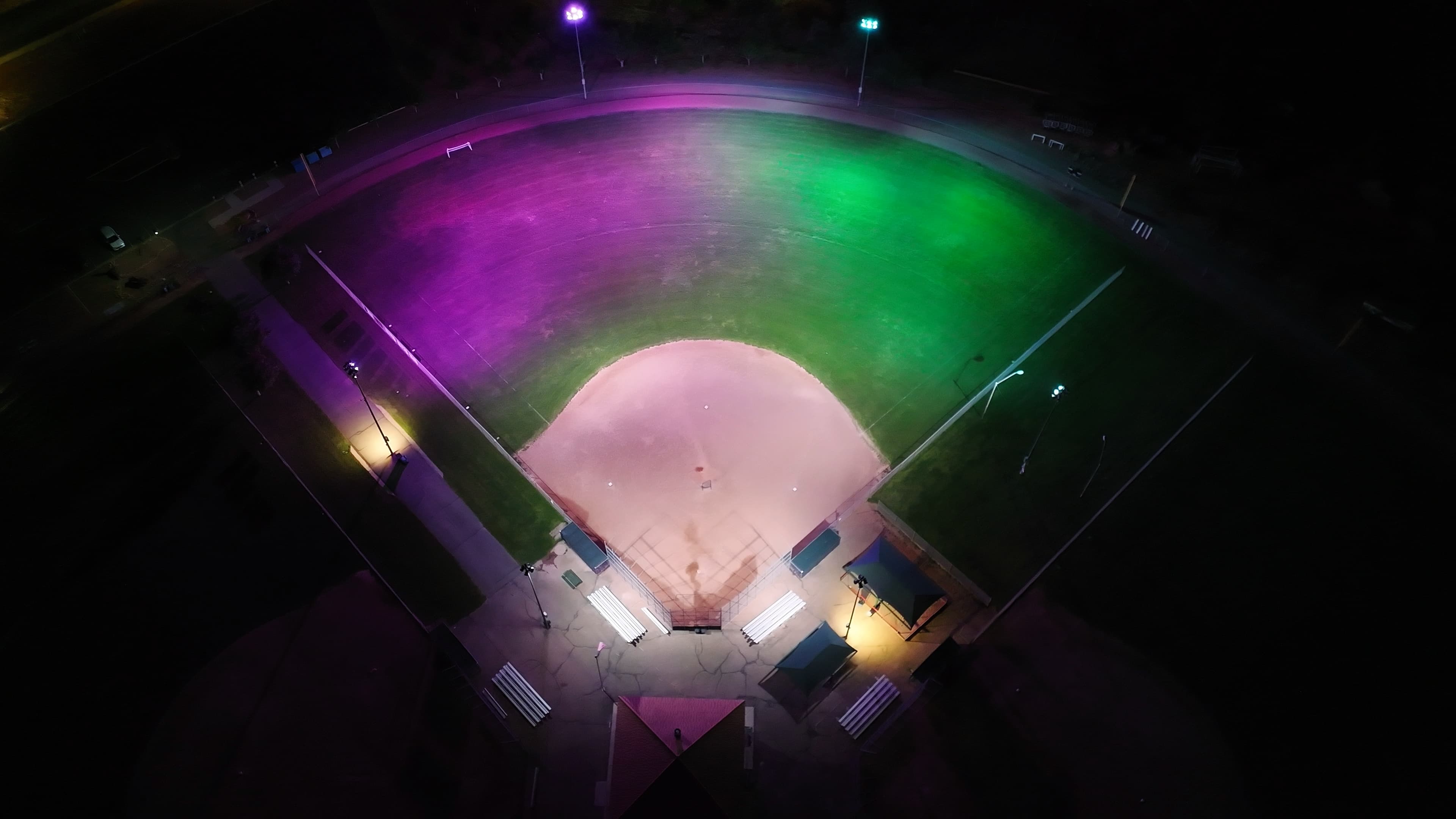
VOSS has delivered baseball LED lighting projects across the country, and the experience gained on each one informs the approach we bring to every new facility. A recent project in Page, Arizona illustrates the real-world impact of a well-executed LED upgrade for a community baseball facility.
The Page, AZ installation involved converting an existing baseball complex to a full LED system — addressing aging infrastructure, poor light levels, and high energy consumption. The project required careful photometric modeling to meet sport-specific illuminance standards while managing pole placement constraints on the existing site. The result was a dramatically improved playing environment for athletes and spectators, meaningfully lower energy costs for the facility operator, and a system designed for long-term reliability with minimal maintenance demands.
That kind of project complexity — navigating existing site conditions, coordinating with local utilities, and delivering a code-compliant, performance-optimized result — reflects what VOSS brings to every baseball and softball lighting engagement, whether it's a Little League park in Kennedale or a multi-field tournament complex serving teams from across the Metroplex.
The Arlington and Greater Dallas Baseball Landscape
Arlington occupies a unique position in American baseball culture. As the home of Globe Life Field and the Texas Rangers, the city has a deep connection to the sport at its highest level — and that passion for baseball extends through every layer of the community, from youth travel ball programs to adult recreational leagues. The Tarrant County region supports hundreds of baseball and softball fields operated by municipalities, school districts, parks and recreation departments, and private tournament facilities.
This density of facilities — spanning Arlington, Fort Worth, Mansfield, Grand Prairie, Euless, Bedford, Hurst, and surrounding communities — means there is significant demand for professional-grade sports lighting expertise. School districts throughout the region are managing aging athletic infrastructure alongside competing capital priorities. Municipal parks departments are under pressure to modernize facilities while controlling operational costs. Tournament venue operators are responding to the expectations of travel ball teams and families who have experienced premium facilities elsewhere.
For public-sector organizations — including school districts, municipalities, and parks departments — cooperative purchasing programs such as BuyBoard, TIPS, Sourcewell, and Omnia Partners can simplify the procurement process and help eligible entities access pre-negotiated pricing, reducing administrative burden and accelerating project timelines.
LED gymnasium lighting and court lighting are also part of the modernization conversation for many of these same facilities — explored in the LED Gymnasium Lighting Solutions and Transform Your Court into an Electrifying, Revenue-Generating Arena articles — making a holistic approach to athletic facility upgrades worth considering.
What a Professional Baseball LED Lighting Engagement Looks Like
The difference between a well-designed sports lighting system and a merely functional one often comes down to the rigor applied early in the design process. At VOSS, a baseball LED lighting project begins with a thorough assessment of the existing site: field dimensions, existing pole locations and heights, electrical infrastructure capacity, and the specific performance standards that apply — whether those are Little League of America guidelines, NFHS standards for high school play, NCAA specifications, or professional broadcast requirements.
From that foundation, our team develops a photometric model — a detailed computer simulation of how light will behave across the entire playing surface — before a single fixture is specified or a proposal is written. This model allows us to demonstrate exactly how the completed system will perform, validate compliance with applicable standards, and identify any design trade-offs early, when they're easiest to address.
Installation is managed by our licensed electrical crews, with project coordination that accounts for the seasonal realities of a working baseball facility. Commissioning includes full verification of light levels against the design model, and our ongoing support relationships mean that facility operators have a partner available when questions or issues arise long after the project is complete.
Service Availability
While VOSS offers a comprehensive suite of national services, specific capabilities may vary by location. Please contact your local branch to confirm the current availability of specific services, technology solutions, or contracting capabilities in your immediate market.
Talk to a Local Expert About Your Field
If you're managing a baseball or softball facility in Arlington, Grand Prairie, Mansfield, Fort Worth, or anywhere across the Greater Dallas region, VOSS is ready to help you think through what a lighting upgrade could mean for your facility — from energy savings and maintenance costs to player experience and long-term infrastructure planning. This is an educational conversation first: we'll help you understand your options, the standards that apply to your type of facility, and what a realistic project scope looks like before any commitments are made.
Reach our Dallas branch team to start the conversation:
(972) 432-8367 Toll-Free: (800) 736-8677