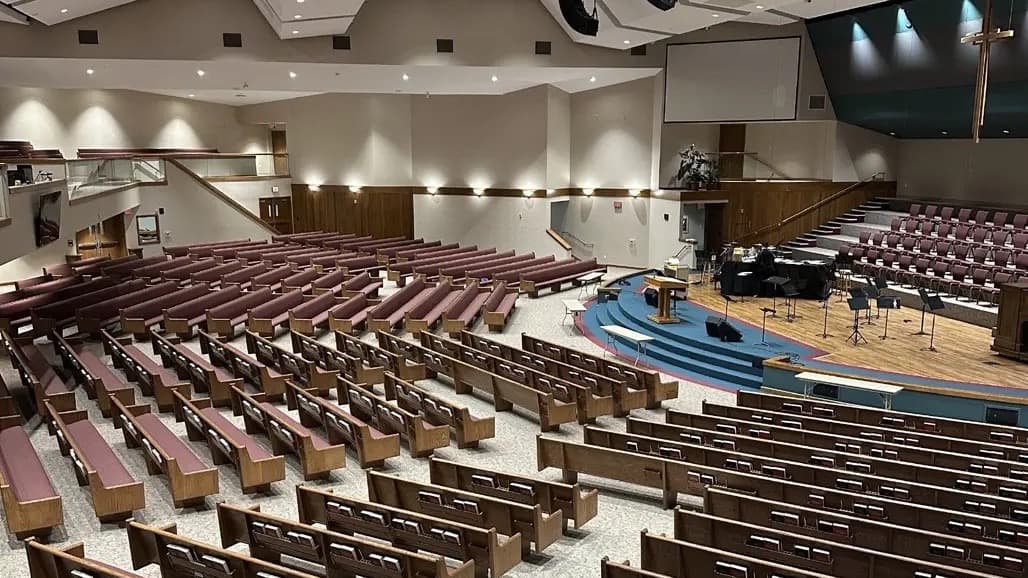
Why Sanctuary Lighting Is a Growing Priority for Charlotte-Area Churches
Greater Charlotte is one of the fastest-growing metro areas in the Southeast — and that growth is reshaping the region's faith communities, too. Congregations across Mecklenburg County and surrounding areas including Union, Cabarrus, and Gaston counties are expanding campuses, adding services, and increasingly livestreaming worship to reach members beyond their walls. At the same time, many of these facilities are operating with lighting systems that were installed a decade or more ago — fixtures that were never designed for today's demands.
For facility managers and operations leaders at churches in Charlotte, Concord, Mooresville, Matthews, Mint Hill, Belmont, and communities throughout the region, the challenges are real and recurring: burned-out bulbs in 30-foot vaulted ceilings, flickering lights during Sunday services, aging ballasts that buzz and dim, and energy bills that climb every year without a corresponding improvement in light quality. These aren't just inconveniences — they affect the experience of worship, the safety of congregants, and the financial sustainability of the ministry.
The good news is that LED technology, combined with thoughtful controls and professional installation, has matured to the point where a well-executed sanctuary lighting upgrade can solve all of these problems at once — and often pay for itself faster than most facilities teams expect.
The Unique Lighting Challenges of Church Sanctuaries
No two sanctuaries are exactly alike, and that's part of what makes church lighting so distinct from a standard commercial retrofit. Facility managers in the Charlotte area navigate a specific set of constraints that require careful planning and experienced execution.
High ceilings and difficult access are the most immediate operational issue. Many sanctuaries — particularly in established congregations in historic neighborhoods across Charlotte and in landmark churches in surrounding communities — feature ceiling heights of 20 to 40 feet or more. Traditional incandescent and halogen bulbs can burn out every few hundred hours, meaning that without a lift or scaffolding, every replacement becomes a significant labor and safety event. Over the course of a year, those cumulative maintenance hours and equipment costs add up substantially. Modern LED fixtures, by contrast, are rated for tens of thousands of hours of operation, dramatically reducing how often a facilities team needs to access those elevated positions.
Aging ballasts and dimming compatibility represent another widespread issue. Fluorescent and metal halide fixtures — still common in sanctuaries built or renovated in the 1990s and early 2000s — depend on ballasts that degrade over time. As ballasts age, they produce flickering, humming, and inconsistent light output. Many churches have also attempted to install dimmer switches without verifying compatibility with existing fluorescent technology, resulting in unreliable performance or accelerated fixture failure. LED retrofits, when specified correctly, are engineered for smooth, quiet dimming across a wide range of levels — an important capability for sanctuaries that transition from vibrant contemporary worship to quiet candlelight services in the same week.
Livestream and video production quality has become a critical consideration that didn't exist for most congregations even a decade ago. Charlotte-area churches that broadcast services online — whether through YouTube, Facebook Live, or dedicated platforms — find that uneven illumination, color temperature inconsistency, and harsh shadows create serious production challenges. Human eyes adapt to poor lighting naturally; cameras do not. A thoughtfully designed LED system with consistent color rendering and appropriate fixture placement creates a significantly better on-camera environment without requiring costly broadcast lighting add-ons.
Historic and architecturally sensitive buildings require a different kind of expertise. Some of Charlotte's older congregations occupy buildings with ornate woodwork, stained glass, plaster ceilings, and other elements that both constrain installation options and demand careful attention to the aesthetic character of the space. Retrofitting these environments requires experience with discreet fixture placement, appropriate color temperatures that complement warm wood tones and traditional décor, and installation methods that protect irreplaceable architectural details.
What a Modern Sanctuary Lighting System Looks Like
The most effective sanctuary lighting upgrades today are not simply one-for-one bulb replacements. They reflect a holistic approach to how light functions within a worship environment — technically, aesthetically, and operationally.
LED retrofit and fixture replacement remains the foundation of any upgrade. For high-bay sanctuaries, directional LED fixtures with appropriate beam angles and lumen output replace outdated incandescent, halogen, or high-intensity discharge (HID) sources. For cove and perimeter lighting, linear LED strip systems or integrated LED fixtures deliver consistent, even illumination without the maintenance demands of fluorescent tubes. The result is a significant reduction in energy consumption — often 50% or more compared to traditional sources — and a dramatic extension of useful fixture life.
Lighting controls and scene programming transform a sanctuary from a static environment into a flexible one. Programmable control systems allow facilities teams to create and recall preset scenes for different service types — bright and even illumination for traditional services, warmer and more directional lighting for contemporary worship, dramatic downlighting for special events, and softer ambient settings for memorial services or small gatherings. These scenes can be recalled with a single button, eliminating the need for staff to manually adjust multiple circuits before every service. For churches with regular Wednesday evening programming, Sunday morning multiple-service schedules, and special events throughout the year, this capability has practical operational value every single week.
Occupancy and daylight sensors add another layer of efficiency, ensuring that ancillary spaces — fellowship halls, corridors, classrooms, offices — operate at appropriate light levels only when they're being used. For a busy church campus in the greater Charlotte area that hosts weekday community programming, youth ministries, and school or childcare operations in addition to weekend worship, automated controls across the full facility can represent meaningful energy savings over the course of a year.
Color temperature selection is a design decision that significantly affects the character of the worship experience. Warmer color temperatures (2700K–3000K) create an inviting, intimate atmosphere well-suited to traditional sanctuaries and candlelit services. Cooler temperatures (3500K–4000K) render colors more accurately and provide a more energizing environment for contemporary worship. Many modern LED systems support tunable white technology, which allows the same fixtures to shift across a range of color temperatures — giving a single sanctuary the flexibility to adapt its character to different service styles.
Energy Incentives Available to Charlotte-Area Churches
One of the most important developments in the church lighting space is the increasing accessibility of utility rebates and tax incentives that can offset a significant portion of project costs. Charlotte-area churches served by Duke Energy Carolinas — the region's primary utility provider and a company headquartered in Charlotte itself — are eligible to explore the Duke Energy Carolinas Smart $aver Program, which provides commercial and institutional rebates for qualifying LED lighting upgrades and controls installations.
For nonprofit religious organizations, these incentives represent a meaningful opportunity to fund improvements that might otherwise require a capital campaign or deferred maintenance budget. By reducing the net cost of an upgrade through rebate capture, churches can often justify projects that deliver immediate operational benefits while remaining within existing budget constraints.
Additionally, qualifying organizations may benefit from the federal Section 179D commercial building energy efficiency tax deduction under the Inflation Reduction Act, which applies to energy-efficient lighting, HVAC, and building envelope improvements. While tax treatment varies by organization type and structure, it is worth exploring with a qualified advisor as part of any major facility upgrade plan.
VOSS has direct experience navigating utility rebate programs on behalf of clients — managing the documentation, application, and compliance processes so that facilities teams can focus on operations rather than paperwork. Our experience helping institutions like Lewis Central Community Schools in Iowa demonstrates how rebate strategy can be integrated into project planning from the outset, enabling smarter financial decisions and stronger community stewardship narratives.
Churches that are part of denominational networks or that participate in cooperative purchasing programs may also find that cooperative procurement vehicles — including Houston Church COOP, Sourcewell, TIPS, and Omnia Partners — provide a simplified, compliant path to project procurement that avoids the time and complexity of a standalone bid process.
VOSS and the Greater Charlotte Faith Community
VOSS has built its reputation over more than 85 years by understanding that every building type has its own demands — and that sacred spaces require a particularly thoughtful approach. We recognize that a sanctuary is not a warehouse or an office. It is the central gathering place of a community, and any work performed in it must be executed with minimal disruption, careful craftsmanship, and genuine respect for the environment.
Our experience with healthcare facilities — including the Corewell Health lighting retrofit in Michigan, where we replaced aging fluorescent fixtures with uniform LED systems that transformed both the function and the ambiance of the space — reflects the same discipline we bring to church environments: careful specification, professional installation, and a commitment to results that last. As the Corewell Health facilities team noted after that project, the space looked amazing — and was virtually maintenance-free going forward.
For Charlotte-area churches navigating these decisions, VOSS serves as a knowledgeable resource and trusted partner — helping facilities teams understand their options, evaluate tradeoffs, and build a project plan that reflects both the ministry's vision and its operational realities.
Our services related to church sanctuary lighting are one part of a broader range of lighting and energy solutions covered in our Latest Lighting resource section, which also addresses topics including energy-efficient church lighting upgrades, LED rebate navigation for commercial and institutional facilities, and energy audits and incentive programs for businesses — all relevant areas for church facility managers thinking about their facilities holistically.
Service Availability
While VOSS offers a comprehensive suite of national services, specific capabilities may vary by location. Please contact your local branch to confirm the current availability of specific services, technology solutions, or contracting capabilities in your immediate market.
VOSS serves the Greater Charlotte area — including communities throughout Mecklenburg, Union, Cabarrus, Gaston, Iredell, and Stanly counties — from our Raleigh branch location.
VOSS Raleigh Branch Phone: (919) 779-8777 Toll-Free: (866) 292-0529
Let's Talk About Your Sanctuary
Every church facility is different — different ceiling heights, different architectural constraints, different service schedules, different budgets. The right starting point is a conversation with someone who understands both the technical requirements of commercial lighting and the operational realities of a faith community.
We invite facility managers, operations directors, and church leadership teams throughout the Charlotte area to connect with our Raleigh team. Whether you're responding to an immediate maintenance problem, planning a longer-term capital improvement, or simply trying to understand what's possible, we're here to help you think it through — with no obligation and no sales pressure.
Reach out to VOSS today to start the conversation about what a sanctuary lighting upgrade could mean for your congregation.