Why Sanctuary Lighting Is a Growing Challenge for Greater Atlanta Churches
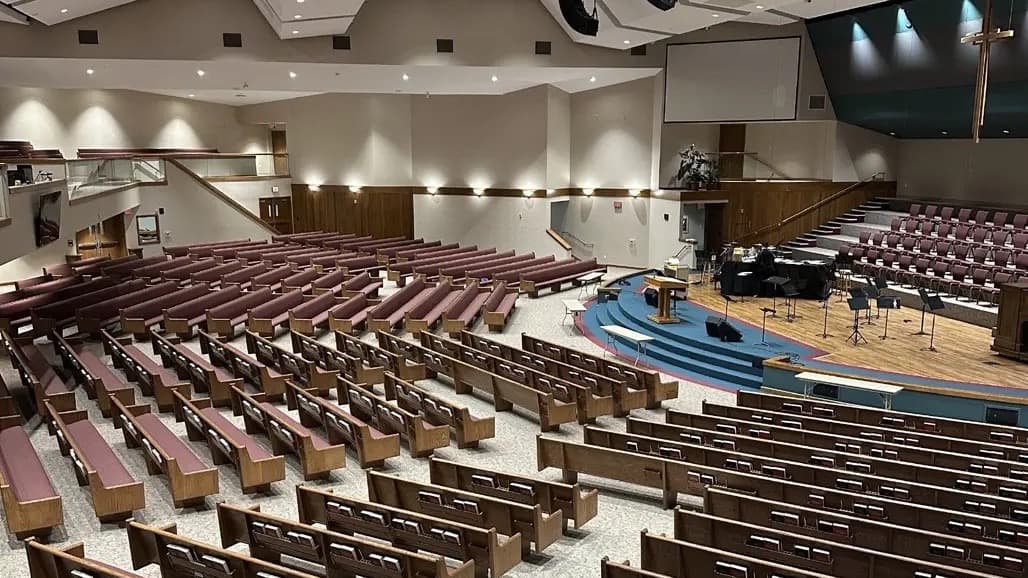
Faith communities across Roswell, Alpharetta, Johns Creek, and the broader North Fulton County corridor are navigating a lighting challenge that's easy to overlook — until it becomes urgent. Sanctuaries built decades ago were designed around incandescent, halogen, or fluorescent technology. As those systems age, the symptoms become increasingly difficult to ignore: bulbs burning out in fixtures mounted 30 or 40 feet overhead, flickering caused by failing ballasts, uneven light that leaves portions of the congregation in shadow, and energy bills that climb year after year.
For church facility managers and operations staff in the Roswell area, the maintenance burden is compounded by the architecture of the buildings themselves. High vaulted ceilings, ornate fixtures, and historic design elements make routine bulb changes a logistical event — requiring lifts, scaffolding, and coordination around packed service schedules. In a region with a large and active faith community, where sanctuaries host multiple services, events, and increasingly, livestreamed worship, consistent and high-quality lighting is no longer optional.
This article explores the key trends, best practices, and practical considerations that church facility leaders across Greater Atlanta should understand as they evaluate their sanctuary lighting systems.
The Hidden Costs of Deferred Sanctuary Lighting Maintenance
It's tempting to address sanctuary lighting on a break-fix basis — replace a bulb when it burns out, address a flickering fixture when a complaint comes in. But this reactive approach carries real costs that are often underestimated.
Labor and access costs add up quickly. Every time a fixture in a high-ceiling sanctuary requires attention, it may mean renting a lift, coordinating a vendor, and taking staff away from other priorities. In large sanctuaries common throughout the Roswell and Alpharetta corridor, this can happen dozens of times a year across a facility.
Aging ballasts create cascading failures. Fluorescent and HID systems rely on ballasts that degrade over time. A failing ballast doesn't just cause flickering — it can damage lamps and neighboring components, turning a simple maintenance call into a more complex repair.
Poor light quality has real consequences. Uneven illumination affects the experience of congregants, creates safety concerns in aisles and entry areas, and — for the growing number of churches producing video content or livestreaming services — results in footage that looks unprofessional regardless of the camera equipment used. Churches in Roswell and the surrounding communities invest heavily in their worship production; outdated lighting undermines that investment.
Energy inefficiency drains operating budgets. Older incandescent and halogen fixtures consume dramatically more power than modern LED alternatives. For a congregation managing facilities costs alongside ministry and outreach priorities, the long-term energy savings of an LED upgrade represent real dollars redirected toward mission.
What a Modern Sanctuary Lighting Upgrade Actually Involves
LED lighting technology has matured significantly, and modern fixtures are well-suited to the unique demands of worship environments. Understanding what an upgrade entails helps facility leaders and church leadership make informed decisions together.
Photometric planning is foundational. A well-designed sanctuary lighting system begins with a full photometric layout — a detailed analysis of how light will be distributed across the space at various mounting heights and angles. This ensures uniform coverage, appropriate foot-candle levels for reading and wayfinding, and the ability to create distinct lighting zones for the altar, congregation seating, and ancillary areas. VOSS brings this design discipline to every project, as demonstrated in our work on the North Hills Middle School Football Field LED Retrofit in Bloomfield, Michigan, where a complete photometric layout was developed before a single fixture was installed — resulting in what the facility's Director of Maintenance & Operations described as "brilliant and uniform illumination" that transformed the environment for everyone present. That same rigor applies to sanctuary environments.
Dimming compatibility matters more than many realize. Many churches rely on dimming systems to create appropriate ambiance for different types of services — full brightness for Sunday morning, softer settings for candlelight services or memorial observances. Not all LED fixtures are compatible with existing dimmer infrastructure, and mismatched components are a leading cause of the flickering problems that facility managers frequently report. A proper upgrade evaluates the full control ecosystem, not just the fixtures.
Historic and architectural constraints can be accommodated. Older sanctuaries often have fixture designs that are architecturally significant or beloved by the congregation. Modern LED retrofit solutions can often update the light source within an existing fixture housing, preserving the visual character of the space while delivering dramatically improved efficiency and light quality. This approach also reduces disruption during installation — a priority for any congregation with a full weekly programming calendar.
Controls and smart systems extend the value of the investment. Occupancy sensors, scheduled controls, and zone-based dimming systems reduce energy consumption during non-service hours and simplify day-to-day management for facility staff. For a church facility team managing a large campus — as many congregations across North Fulton County and Cherokee County do — this level of automation reduces the operational burden significantly.
Lessons from Commercial Lighting Projects That Apply to Faith Spaces
The lighting challenges that church facilities face are not unique in their underlying nature — they mirror the problems seen in commercial, healthcare, and educational facilities across the country. The solutions, likewise, draw from the same body of practice.
VOSS's work at Corewell Health in Dearborn, Michigan offers a useful illustration. The facility was dealing with aging suspended and cove fixtures where fluorescent lamps had become non-uniform over time, and the fixture lenses were deteriorating — brittle, dusty, and falling apart during routine maintenance. The solution replaced existing fixtures with uniform linear LED lighting and specified energy-efficient suspended fixtures with both up and downlighting to improve the overall character of the space. The result, as described by the facilities management supervisor, was that the space "looks amazing" — and the lighting is now virtually maintenance-free.
The parallel to sanctuary environments is direct: aging fluorescent or incandescent systems create the same pattern of non-uniform light, deteriorating components, and escalating maintenance labor. The path to resolution follows the same logic — a thoughtful retrofit that improves both the visual quality and the long-term maintainability of the system.
Cooperative Purchasing: A Practical Option for Eligible Faith Organizations
For churches affiliated with school districts, nonprofit networks, or other organizations that qualify for cooperative purchasing programs, there may be an efficient procurement pathway worth exploring. VOSS participates in several cooperative purchasing programs — including Houston Church COOP, Sourcewell, BuyBoard, TIPS, Omnia Partners, AEPA, PACE, and Nebraska ESU Co-Op — that allow eligible organizations to access pre-negotiated contracts and streamline the procurement process.
The Houston Church COOP in particular is designed with faith communities in mind. If your organization is eligible, this can simplify the process of moving from a lighting assessment to a funded, approved project — removing some of the administrative friction that can delay facility improvements.
Trends Shaping Church Lighting in the Greater Atlanta Region
The Greater Atlanta region's faith community is one of the largest and most active in the country, and the Roswell area reflects that vitality. Churches here range from historic congregations with architecturally significant sanctuaries to newer, large-format campuses that host thousands of worshippers each weekend across multiple services and venues. Across all of these contexts, several trends are shaping how facility leaders approach lighting:
- Livestreaming and video production have raised the bar for light quality. A congregation that broadcasts services — whether to a few hundred online viewers or tens of thousands — needs consistent, high-CRI lighting that renders skin tones accurately and eliminates the flicker that camera sensors detect even when the human eye does not.
- LED retrofit costs have declined while performance has improved. The economic case for upgrading is stronger than it was even five years ago, and the range of fixture options suited to worship environments has expanded considerably.
- Utility incentives remain available but require navigation. Georgia Power and other regional utilities periodically offer rebate programs for commercial LED upgrades. Understanding which fixtures and configurations qualify — and how to document the project properly — is a meaningful part of the planning process. Our sibling article on Maximize ROI with Commercial LED Lighting Rebates in Dallas, TX explores this topic in depth and offers a useful framework, and similar principles apply to Georgia-based projects.
- Phased upgrades are a viable strategy. Not every congregation can fund a full sanctuary overhaul in a single budget cycle. A well-structured phased approach — prioritizing the fixtures with the highest maintenance burden or the greatest energy impact — allows meaningful progress within real-world budget constraints.
For facility managers and church administrators across Roswell, Woodstock, Marietta, Canton, and the surrounding communities, these trends underscore the value of engaging with a lighting partner who understands both the technical landscape and the operational realities of faith-based facilities.
Service Availability
While VOSS offers a comprehensive suite of national services, specific capabilities may vary by location. Please contact your local branch to confirm the current availability of specific services, technology solutions, or contracting capabilities in your immediate market.
Talk with Our Atlanta Team About Your Sanctuary
If your congregation is navigating flickering fixtures, rising energy costs, or the challenge of maintaining lights in a high-ceiling sanctuary, we'd welcome the opportunity to discuss what a lighting assessment and upgrade path might look like for your facility.
Our Atlanta branch serves churches and faith communities throughout Roswell, Alpharetta, Johns Creek, Marietta, Canton, Woodstock, and across the Greater Atlanta region. Reach out to start a conversation — there's no obligation, and the insight from an initial consultation is often valuable on its own.
VOSS — Atlanta Branch Phone: (770) 438-8557 Toll-Free: (888) 725-8897
You can also explore related topics in our Latest Lighting resource section, including Energy Efficient Church Lighting Upgrades, Commercial LED Lighting Fixtures, and Energy Audits, Incentives, and Rebate Navigation for Businesses, all of which address topics relevant to faith-based facility planning.