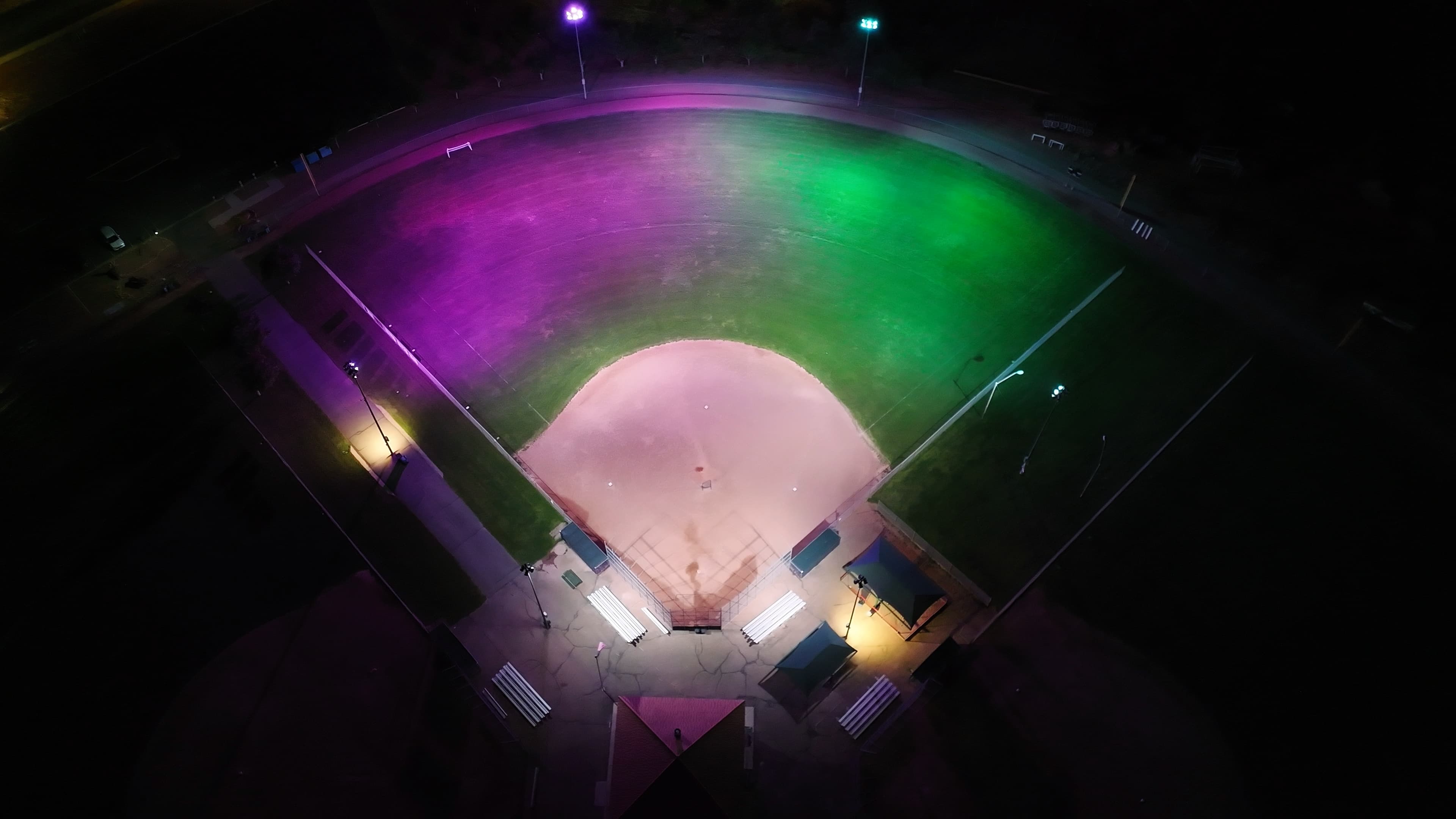
Why Baseball Field Lighting Is Having a Major Moment in Greater Atlanta
Youth sports participation in North Fulton County is booming. Roswell's parks and recreation programs, alongside the competitive travel ball culture that spans Alpharetta, Milton, Johns Creek, and Marietta, have put enormous pressure on the region's athletic infrastructure — and field lighting sits at the center of that conversation. Fields that can't support evening games are fields that can't generate revenue, serve growing registration rosters, or host the tournaments that bring families and spending into the community.
At the same time, the economics of running public and private athletic facilities have never been more scrutinized. For parks and recreation departments, school districts, and private sports complexes alike, operating costs matter — and the gap between legacy metal halide or high-pressure sodium systems and modern LED technology is now too significant to ignore.
This article explores what facility operators and decision-makers in Roswell and Greater Atlanta should know about the current state of baseball and softball LED lighting, and why now is a strategic moment to evaluate your infrastructure.
The Case Against Legacy Sports Lighting — and What's Replacing It
For decades, metal halide (MHI) and high-pressure sodium (HPS) fixtures were the default for outdoor athletic fields. They were the only game in town. But these legacy systems carry real operational liabilities that have become harder to justify as LED technology has matured:
- Warm-up and re-strike delays — Metal halide fixtures can take 15–20 minutes to reach full output, and if power is interrupted during a rain delay, you're waiting again. That's a scheduling and operations problem for busy multi-field facilities.
- Lamp degradation — HID lamps lose a significant portion of their output over their lifespan, meaning the field you illuminated at year one looks considerably different by year five — even if the lights are still technically "on."
- High energy consumption — Traditional 1,500-watt HID fixtures draw enormous amounts of power. For a facility running multiple fields several nights per week across a full season, those kilowatt-hours add up fast.
- Maintenance burden — Lamp and ballast replacements on elevated poles require lift equipment, labor coordination, and field downtime. Multiply that across a multi-field complex and the true cost of legacy systems becomes clear.
Modern LED sports lighting addresses every one of these pain points. LED fixtures deliver instant-on performance, maintain consistent output over a dramatically longer lifespan, consume a fraction of the energy of their HID predecessors, and are designed to minimize maintenance intervention for years after installation.
The North Hills Middle School Football Field retrofit in Bloomfield, Michigan illustrates the transformation well. The school's Athletic Director had been dealing with multiple lamp outages that rendered the field unusable for night games — costing the district field rental revenue and disrupting athletic programming. VOSS replaced sixty-eight 1,500-watt HID fixtures with 750-watt Keystone Sports Lighter LED fixtures, backed by a full photometric layout. The result was a fully functional, brilliantly illuminated field. As Jacob McDermott, Director of Maintenance & Operations, put it: "The results are truly outstanding... The new lights themselves are nothing short of amazing, providing brilliant and uniform illumination that dramatically enhances the field for both players and spectators." While that project was a football field, the engineering principles — precision photometrics, energy reduction, and elimination of maintenance headaches — apply directly to baseball and softball facilities of comparable scale.
What Makes Baseball and Softball Lighting Technically Demanding
Not all sports lighting challenges are created equal. Baseball and softball fields present a set of design requirements that demand careful engineering — and shortcuts in the design phase show up as real problems during play.
Infield and outfield uniformity is paramount. The transition from the tightly contained infield to the expansive outfield creates significant variation in the distances and angles that fixtures must cover. A photometric design that looks acceptable on paper can still produce hot spots near the pitcher's mound or dark zones along the warning track if pole placement and fixture aiming angles aren't precisely calculated.
Glare control is a safety and performance issue, not just a comfort one. A batter tracking a fastball or a center fielder judging a flyball cannot afford visual interference from improperly aimed fixtures. Modern LED sports lighting systems use precision optical control and carefully engineered beam distributions to deliver light where it belongs — on the field, not in the eyes of players or fans.
League and governing body compliance adds another layer of complexity. Whether a facility hosts recreational youth leagues, high school varsity competition, NCAA play, or professional events, there are defined foot-candle requirements and uniformity ratios that must be met. Designing to those standards — and documenting compliance — is a core part of a professional lighting engagement.
Pole placement and structural integration must account for foul territory geometry, sight lines, and local wind load requirements. In the Greater Atlanta region, where afternoon thunderstorms and seasonal weather events are routine, structural engineering is not an afterthought.
Roswell's Sports Infrastructure Context — and the Regional Opportunity
Roswell is home to an active parks and recreation department, multiple public athletic complexes, and a youth sports culture that draws families from across North Fulton County. The city's proximity to Alpharetta, Sandy Springs, Dunwoody, and East Cobb means that field availability and quality directly influence where leagues choose to play and where families choose to live and register.
Across Greater Atlanta, the demand for high-quality outdoor athletic facilities has accelerated in recent years. Municipalities and private operators are investing in parks infrastructure as both a quality-of-life asset and an economic driver — tournament hosting generates hotel stays, restaurant traffic, and retail spending. Facilities that can offer well-lit, professionally designed fields have a measurable competitive advantage in attracting those events.
For Roswell specifically, and for North Fulton County more broadly, LED field lighting upgrades represent a convergence of operational efficiency, community investment, and long-term infrastructure planning. Georgia Power's energy efficiency programs and utility incentives can further improve the financial case for qualifying projects — a point worth exploring with your VOSS project team.
Design, Controls, and the Smart Field of the Future
One trend reshaping how facility operators think about sports lighting is the integration of lighting controls and smart systems. Modern LED sports lighting isn't just about replacing fixtures — it's about gaining operational intelligence and flexibility that legacy systems never offered.
Networked lighting controls allow facility managers to:
- Schedule field lighting remotely — activate, dim, or shut off fields from a central dashboard or mobile device, eliminating the need for staff to be on-site for every event
- Set light levels by use case — practice sessions may not require the same foot-candle output as a varsity game or a televised event, and programmable controls let you match energy output to actual need
- Monitor system health in real time — connected systems can flag fixture anomalies before they become outages, giving maintenance teams advance notice rather than reactive scrambling
- Integrate with access control and event management platforms — for multi-field complexes, coordinated control across the entire facility is a significant operational upgrade
For facilities exploring a broader capital improvement strategy, it's worth noting that VOSS's work spans a wide range of related disciplines. Our Latest Lighting section covers topics from LED gymnasium lighting to pickleball and tennis court solutions, parking lot and outdoor LED upgrades, and energy audits with rebate navigation — all of which can intersect with a comprehensive athletic facility improvement plan.
A Note for Public Sector and Educational Facilities
For Roswell-area public school districts, municipal parks departments, and other government-funded organizations, procurement pathway matters as much as product selection. VOSS participates in several cooperative purchasing programs that can simplify the procurement process for eligible organizations — including Sourcewell, TIPS, BuyBoard, Omnia Partners, AEPA, and PACE, among others. These vehicles allow public entities to access pre-competed contract pricing without the time and administrative burden of a standalone bid process, which can be especially valuable when capital improvement windows are tight.
School athletic directors, facilities directors, and parks administrators in Roswell, Milton, Alpharetta, and surrounding North Fulton communities are encouraged to ask our team about which cooperative purchasing programs may apply to your organization.
Service Availability
While VOSS offers a comprehensive suite of national services, specific capabilities may vary by location. Please contact your local branch to confirm the current availability of specific services, technology solutions, or contracting capabilities in your immediate market.
Talk to VOSS About Your Roswell or Greater Atlanta Baseball Facility
Whether you're managing a single community field in Roswell, overseeing a multi-diamond complex serving families from Sandy Springs to Canton, or planning a capital improvement for a high school or collegiate program in the Greater Atlanta area, VOSS brings the engineering depth, project management discipline, and regional presence to deliver results.
We invite you to connect with our Atlanta team for a consultative conversation about your facility's current lighting infrastructure, your performance and compliance goals, and the options — including available utility incentives — that may apply to your project.
VOSS — Atlanta Branch
Phone: (770) 438-8557 Toll-Free: (888) 725-8897