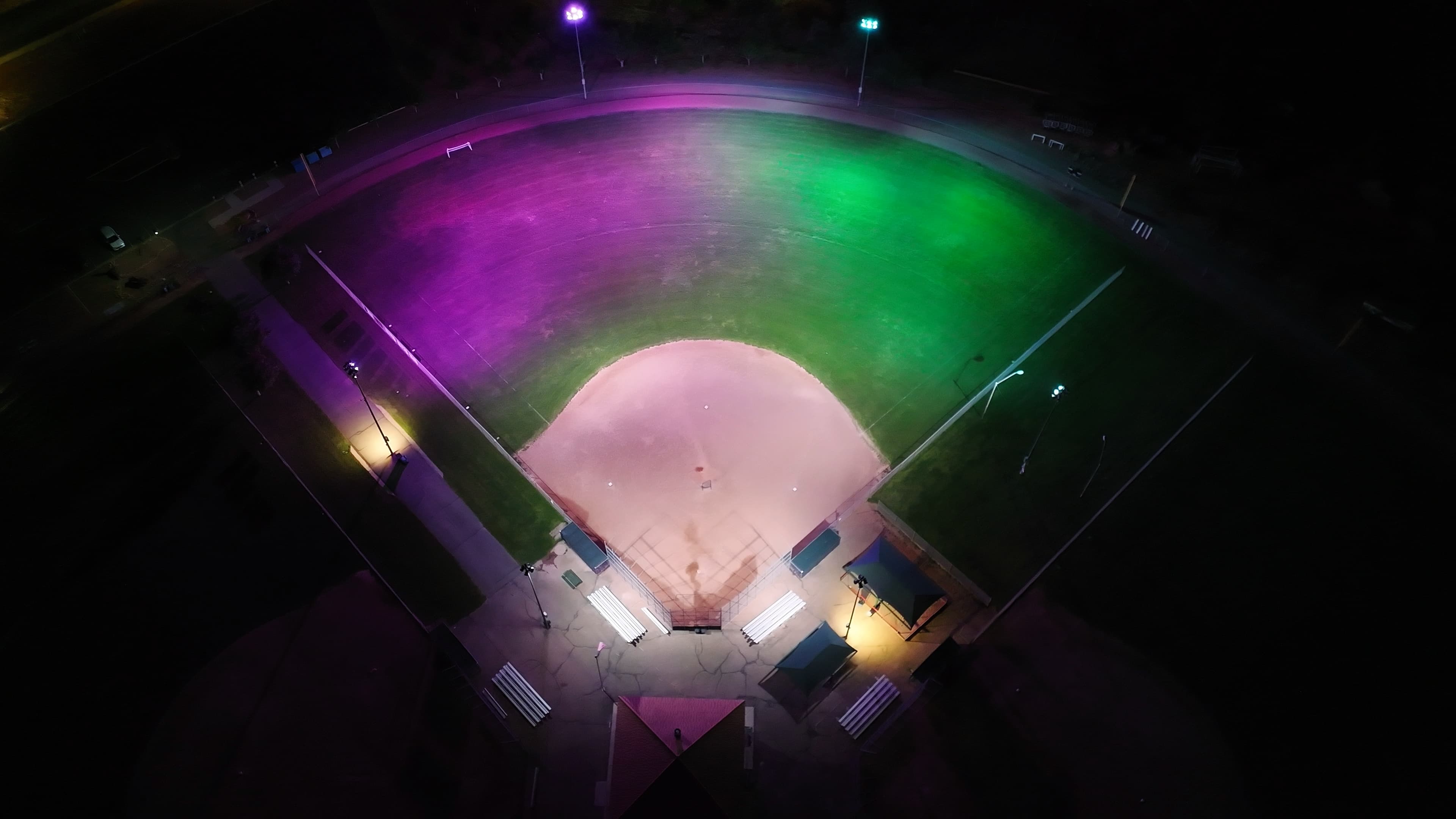
Why Baseball Lighting Matters More Than Most Facility Managers Realize
Baseball is a sport defined by split-second decisions — a batter tracking a 90-mph fastball, an outfielder reading a fly ball off the bat, an infielder reacting to a sharp grounder in the gap. Poor lighting doesn't just make the game look bad. It makes the game genuinely harder to play, and in some cases, genuinely unsafe.
For facility managers, parks directors, and athletic administrators across Peachtree Corners and the broader Gwinnett County area, lighting quality has long been a frustration. Many fields still rely on aging metal halide or high-pressure sodium (HPS) systems that were installed decades ago — fixtures that burn hot, take 15–20 minutes to warm up, deliver uneven illumination, and carry steep maintenance costs. As Greater Atlanta's competitive youth and amateur baseball market continues to grow, those limitations are becoming harder to justify.
The good news: modern LED sports lighting technology has matured to the point where a well-designed upgrade can solve virtually every one of those problems at once — while dramatically reducing long-term operating costs. This article explores what that transition looks like, why it matters specifically in the Peachtree Corners market, and what facility owners and operators should know before beginning a project.
The State of Baseball Lighting in Greater Atlanta
The Greater Atlanta metro — including communities like Peachtree Corners, Duluth, Norcross, Johns Creek, Alpharetta, and Suwanee — is home to one of the most active youth and amateur baseball ecosystems in the Southeast. Gwinnett County alone supports dozens of recreational and travel ball programs, with fields spread across municipal parks, school campuses, and privately operated complexes.
That density of activity creates real pressure on field infrastructure. Evening and weekend games are the norm, not the exception — which means lighting systems are logging hundreds of operational hours per season. Legacy HID systems under that kind of load face frequent lamp failures, rising utility bills, and increasing maintenance labor. When a field goes dark mid-season due to lamp outages, the consequences are immediate: canceled games, displaced teams, lost rental revenue, and frustrated families.
We've seen this scenario play out at facilities across the country. At North Hills Middle School in Bloomfield, Michigan, an Athletic Director faced exactly this problem — multiple lamp outages had rendered the field unusable for night games, directly costing the school in lost field rental income. The solution was a full LED retrofit: 68 legacy 1,500-watt HID fixtures were replaced with 750-watt Keystone Sports Lighter LED fixtures, cutting energy consumption in half while restoring full, uniform illumination across the field. The results spoke for themselves.
"The results are truly outstanding. The project unfolded seamlessly from start to finish, with VOSS demonstrating professionalism and efficiency throughout the process. The new lights themselves are nothing short of amazing, providing brilliant and uniform illumination that dramatically enhances the field for both players and spectators."— Jacob McDermott, Director, Maintenance & Operations, North Hills Middle School
For parks and recreation departments in Peachtree Corners and neighboring communities like Norcross and Duluth, that kind of outcome — reliable operation, lower wattage, and better light quality — is increasingly the standard that stakeholders expect.
What Makes Baseball Lighting Technically Demanding
Not all sports lighting is created equal, and baseball presents some of the most demanding optical and geometric challenges in the field. Unlike a basketball court or a soccer field, a baseball diamond has an asymmetrical layout with dramatically different lighting requirements across zones — the infield skin, the infield grass, the outfield, the warning track, and the dugout areas each have distinct needs.
Several factors make baseball lighting design a specialized discipline:
- Glare control is critical. Batters face the pitcher directly under the lights, and any spill or glare in their line of sight is a real safety issue. Proper aiming angles and fixture shielding are non-negotiable.
- Vertical illuminance matters as much as horizontal. A ball in flight is a vertical object — players tracking it in the air need consistent illumination at elevation, not just at ground level. LED systems engineered for sports applications account for this; general-purpose commercial fixtures do not.
- Pole placement and mounting heights shape everything. The geometry of where poles are sited and how high fixtures are mounted determines whether a field meets governing body standards for its level of play — from Little League and USSSA recreational fields to NFHS high school standards to NCAA competition requirements.
- Uniformity ratios define quality. A field with bright spots and dark patches creates visual inconsistency that affects player performance and can introduce liability concerns. Professional photometric design ensures the right uniformity ratios across every zone of the field.
- Controls integration adds operational value. Modern LED sports lighting systems can be paired with wireless controls platforms that allow instant on/off operation, dimming for practice vs. game modes, and remote management — a significant upgrade over the manual timers and ballast banks typical of legacy systems.
For facility owners managing multiple fields across a complex, or parks directors overseeing several sites across Gwinnett County, controls integration can also streamline operations significantly — reducing the staff time required to manage lighting schedules and enabling faster response to weather delays or schedule changes.
LED Sports Lighting Trends Shaping the Industry
The baseball lighting landscape has shifted considerably in recent years, driven by advances in LED technology, tighter utility incentive programs, and increasing demand from governing bodies for standardized lighting quality at sanctioned facilities.
Wattage reductions continue to improve. Today's purpose-built LED sports fixtures routinely deliver equivalent or superior illumination to legacy HID systems at 40–60% of the wattage. For a field that previously ran eight to twelve 1,500-watt metal halide fixtures per pole, that difference translates into meaningful utility savings season after season.
Fixture longevity is reshaping maintenance economics. Premium LED sports fixtures are rated for 100,000+ hours of operational life — far exceeding the 10,000–15,000 hour lifespan of typical metal halide lamps. For a field that operates 1,000 hours per year, that means a decade or more of service before relamping becomes a consideration. The labor savings alone often factor significantly into ROI calculations.
Photometric software has become the standard for design. Reputable lighting contractors now use professional photometric modeling software to simulate illumination across the entire field surface before a single fixture is ordered. This approach allows for precise pole placement, aiming angle optimization, and verification against governing body standards — reducing the risk of costly field corrections after installation.
Utility rebate programs are available in Georgia. Many LED sports lighting upgrades qualify for energy efficiency incentives through Georgia Power and other local utilities. These rebates can offset a meaningful portion of project costs, particularly for larger multi-field complexes. For parks departments and school districts in Peachtree Corners and Gwinnett County, understanding available incentive programs is a critical step in project planning. Our article on LED lighting rebates in the Atlanta market covers this topic in more depth and is worth reviewing alongside this one.
Cooperative purchasing programs simplify procurement for public agencies. For municipal parks departments, school districts, and other public-sector organizations in the Peachtree Corners area, cooperative purchasing programs — including Sourcewell, BuyBoard, TIPS, Omnia Partners, and AEPA — can streamline the procurement process and reduce administrative burden. Eligible organizations should ask about these options early in the planning process.
From Youth Rec Fields to Competitive Complexes: Scaling the Right Solution
One of the most important principles in baseball lighting is that there is no universal solution — the right system for a 200-foot fence Little League field in a Peachtree Corners city park is fundamentally different from what a competitive travel ball complex in Suwanee or a high school stadium in Duluth requires.
That distinction matters for budget planning, for timeline, and for long-term performance. A youth recreational field may require four to six poles, modest mounting heights, and illumination levels in the 30–50 foot-candle range. A high school varsity field with broadcast capability may demand eight or more poles, taller mounts, higher foot-candle targets, and more sophisticated controls integration. A multi-field tournament complex presents a different set of challenges again — coordinating lighting zones, managing power infrastructure across multiple fields, and ensuring consistent quality across every diamond.
What's consistent across all of these scenarios is the value of starting with an experienced partner who understands sports lighting as a discipline — not just a commercial electrical contractor who happens to install outdoor fixtures.
For related insight on adjacent sports applications, our articles on Pickleball LED Lighting Solutions and LED Gymnasium Lighting Solutions address the specific design considerations for those venues, many of which apply to multi-use athletic facilities managing several sports under one roof or within one complex.
Service Availability
While VOSS offers a comprehensive suite of national services, specific capabilities may vary by location. Please contact your local branch to confirm the current availability of specific services, technology solutions, or contracting capabilities in your immediate market.
Connect with VOSS in Greater Atlanta
VOSS serves Peachtree Corners and the surrounding Greater Atlanta region — including Gwinnett, Fulton, DeKalb, Cherokee, and Cobb counties — through our Atlanta branch. Whether you're planning a new field lighting installation, evaluating a retrofit for aging infrastructure, or simply looking for a professional assessment of your current system, our team is ready to help you think through the project.
Atlanta Branch Phone: (770) 438-8557 Toll-Free: (888) 725-8897
Start the Conversation
The best baseball and softball lighting projects begin well before a single fixture is specified — with a clear picture of how the field is used, what standards apply, what the utility environment looks like, and what the long-term operational goals are. We're here to help facility managers, parks directors, athletic administrators, and school district leaders in Peachtree Corners and across Greater Atlanta work through exactly those questions.
Reach out to our Atlanta team to schedule a consultation. Whether your project is a single community field or a multi-diamond complex, VOSS brings the engineering depth, installation experience, and local market knowledge to help you get it right — from the first photometric model to opening night under the lights.