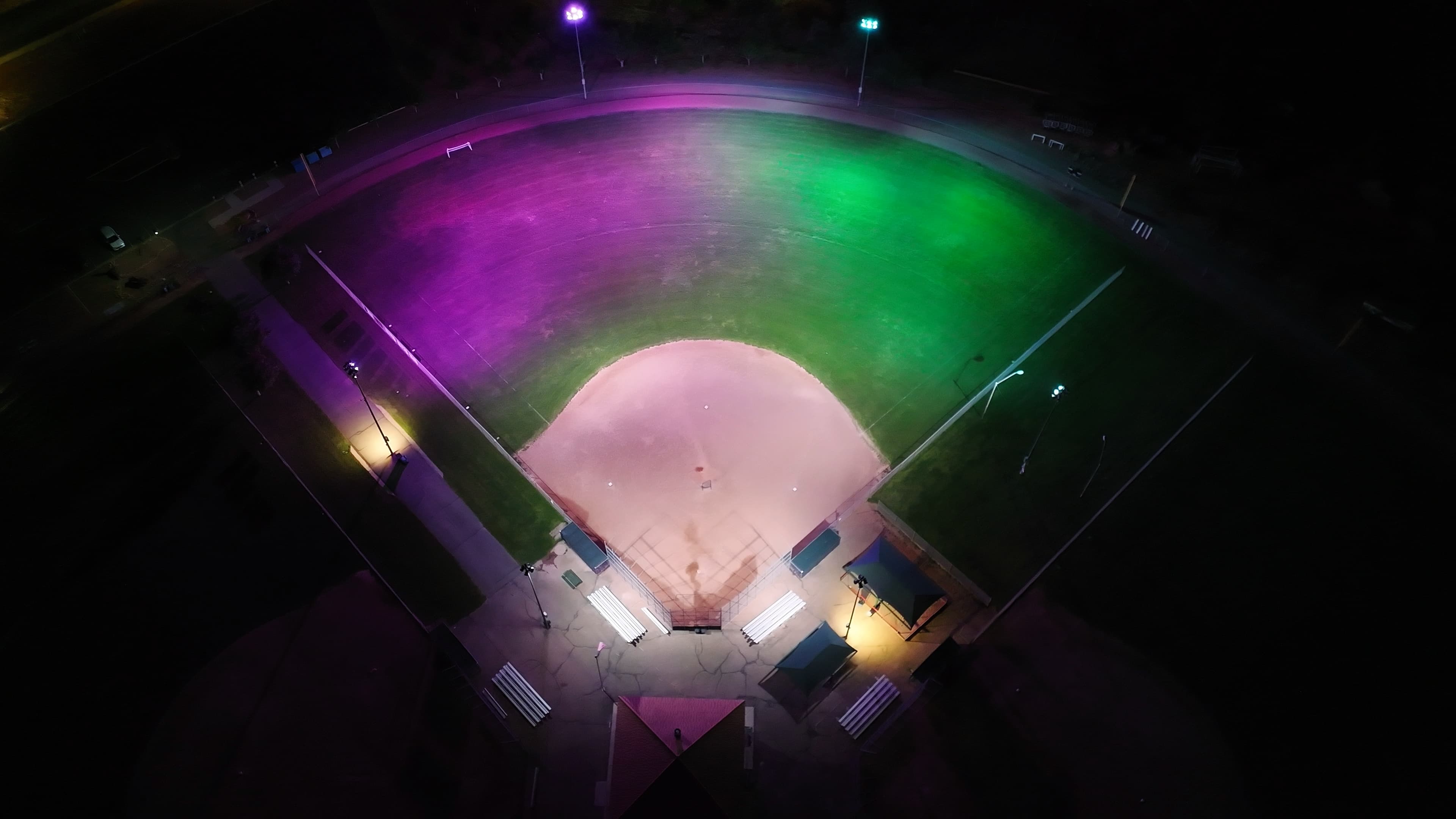
Why Baseball Lighting Is Having a Major League Moment in Greater Atlanta
Across Fulton County and the northern Atlanta suburbs, athletic facilities are quietly undergoing a transformation that is changing how communities experience America's pastime. From the well-maintained recreational complexes in Johns Creek to the competitive youth leagues stretching across Alpharetta, Cumming, Suwanee, and Duluth, the question facing parks directors, school athletic coordinators, and facility managers is no longer whether to upgrade to LED lighting — it is when and how to do it right.
Johns Creek is a community that takes its athletics seriously. With a population of roughly 81,000 and a strong culture of youth sports participation, the city's baseball and softball fields see heavy use across multiple seasons. That level of demand puts real pressure on aging metal halide and high-pressure sodium systems — and makes the case for a smarter lighting investment increasingly hard to ignore.
Understanding what LED technology actually delivers for a baseball-specific environment — and what separates a well-engineered installation from a generic fixture swap — is the starting point for any facility decision-maker in this region.
What Makes Baseball Lighting Uniquely Challenging
Not all sports lighting projects are created equal. Baseball fields present a distinct set of engineering challenges that set them apart from gymnasiums, tennis courts, or even football stadiums — topics explored separately in our LED Gymnasium Lighting Solutions and LED Football Stadium Lights content.
The geometry of a baseball diamond demands precise photometric design. Light must reach the infield uniformly while simultaneously providing adequate coverage of deep outfield gaps and warning tracks — all without creating glare that compromises a batter's ability to track a pitched ball. Pole placement, mounting heights, beam angles, and fixture spacing are all interdependent variables that require careful modeling before a single piece of equipment is ordered.
Key lighting challenges specific to baseball and softball include:
- Infield-to-outfield uniformity — Dramatic light level drop-offs between the infield skin and outfield grass create visual inconsistency that affects player performance and safety
- Vertical illuminance — Players tracking fly balls and pop-ups need sufficient vertical light, not just horizontal footcandles at ground level
- Glare control — Poorly aimed fixtures, even high-quality ones, can wash out a batter's sightline or create hotspots that distract outfielders
- Spill and overspill management — Residential neighborhoods surrounding many community parks in Fulton and Gwinnett Counties make light trespass a real operational and regulatory concern
- Broadcast and event readiness — Higher-level facilities must meet lighting standards for video recording, livestreaming, and televised play
Meeting these demands requires more than purchasing a fixture with the right wattage. It requires a disciplined design process — something that distinguishes professional sports lighting contractors from general electrical vendors.
The LED Advantage: What the Data Actually Shows
The shift to LED in athletic applications has been dramatic, and the results at real facilities tell the story clearly. When the North Hills Middle School football field in Bloomfield, Michigan needed to replace aging HID fixtures that were causing lamp outages and costing the school field rental revenue, VOSS replaced sixty-eight 1,500-watt HID fixtures with new 750-watt Keystone Sports Lighter LED fixtures — cutting the connected load nearly in half while producing a dramatically better result. Jacob McDermott, Director of Maintenance and Operations, described the outcome directly: "The new lights themselves are nothing short of amazing, providing brilliant and uniform illumination that dramatically enhances the field for both players and spectators."
While that project involved a football field, the underlying principles apply directly to baseball: aging HID technology creates maintenance headaches, creates uneven light levels as lamps age at different rates, and consumes energy at rates that modern LED systems simply cannot justify.
For baseball and softball facilities specifically, the LED advantage breaks down across several dimensions:
- Energy consumption — LED systems typically use 40–60% less energy than equivalent metal halide installations, a meaningful operating cost reduction for facilities running lights across multiple fields and extended evening schedules
- Lamp life and maintenance — Traditional HID sources require relamping cycles measured in thousands of hours; quality LED fixtures are rated for 100,000+ hours, dramatically reducing maintenance labor and material costs
- Instant-on capability — LED fixtures reach full brightness immediately, eliminating the warm-up delays that complicate rain-delay restarts, late-game extensions, and pre-game preparation schedules
- Light quality — Modern LED sources deliver high Color Rendering Index (CRI) values that make the field look more natural, improving both the player experience and the visual quality of video content
- Controls compatibility — LED systems integrate seamlessly with lighting controls platforms, enabling dimming, scheduling, motion-triggered activation, and remote management — capabilities that reduce unnecessary runtime and further cut energy costs
For parks and recreation departments managing multiple athletic facilities across Johns Creek and surrounding communities like Roswell, Johns Creek's neighbor to the west, or Sugar Hill to the north, the operational efficiency gains compound across an entire portfolio of fields.
Design Standards That Govern the Game
One dimension of baseball lighting that deserves specific attention from facility managers and athletic directors is the role of governing body standards. Different levels of play carry different photometric requirements, and designing to the wrong standard — either under-illuminating a higher-level field or over-spending on a recreational facility — represents a real planning risk.
The Illuminating Engineering Society (IES) publishes recommended practices for sports lighting, including baseball and softball. These recommendations define horizontal and vertical footcandle levels, uniformity ratios, and glare control requirements across amateur recreational, scholastic, collegiate, and professional classifications. Additionally, organizations like USA Baseball, the NCAA, and various state high school athletic associations carry their own lighting criteria.
VOSS designs to the applicable standard for each facility type, ensuring that a Johns Creek community park field, a Forsyth County high school complex, or a premier travel ball facility in the Gwinnett corridor meets the requirements for its intended use — not a one-size-fits-all specification.
This matters practically for several reasons:
- Permit and inspection alignment — Local jurisdictions in Fulton and Gwinnett Counties expect lighting plans to reference recognized standards; proper documentation streamlines the approval process
- Insurance and liability — Inadequate lighting on a sports field creates liability exposure for operators; documented compliance with IES standards provides defensible design rationale
- Future-proofing — Facilities that aspire to host higher-level competition or attract traveling tournaments need lighting systems that can support that ambition without immediate reinvestment
Public parks departments and school districts in Georgia may also find cooperative purchasing programs — including Sourcewell, BuyBoard, TIPS, and Omnia Partners — to be a valuable procurement pathway for qualifying LED lighting projects, simplifying the vendor selection process and expediting project timelines.
A Regional Perspective: What Greater Atlanta Facilities Are Navigating
Johns Creek sits within one of the most athletically active regions in the Southeast. The Greater Atlanta metro is home to a dense network of recreational leagues, travel ball organizations, and scholastic athletic programs that collectively operate hundreds of baseball and softball fields. That density creates both opportunity and competitive pressure for facility operators.
Parks and recreation facilities in Forsyth County to the north, Cherokee County to the northwest, and Hall County farther up the I-985 corridor are all investing in field infrastructure improvements to attract and retain the competitive youth sports programs that generate significant economic activity for local communities. Facilities that lag in lighting quality — in terms of both performance and energy cost — risk losing events, rentals, and league affiliations to better-equipped venues.
At the same time, Georgia Power's commercial energy efficiency programs create a financial incentive landscape that makes the economics of LED retrofits more favorable than they have ever been. Facility operators should engage early with utility rebate processes, as program structures and funding availability change regularly. VOSS has experience navigating the rebate and incentive landscape for commercial and institutional clients across Georgia, including coordinating documentation to support rebate applications — a process described in more detail in our Energy Audits, Incentives, and Rebate Navigation for Businesses content.
The convergence of aging HID infrastructure, rising energy costs, increasing field demand, and accessible utility incentives makes the current moment a particularly favorable window for LED investment across Greater Atlanta's baseball and softball communities.
Service Availability
While VOSS offers a comprehensive suite of national services, specific capabilities may vary by location. Please contact your local branch to confirm the current availability of specific services, technology solutions, or contracting capabilities in your immediate market.
Talk to VOSS About Your Field
If you manage a baseball or softball facility in Johns Creek, Alpharetta, Roswell, Cumming, Duluth, or anywhere across the Greater Atlanta region, and you are evaluating an LED lighting upgrade or planning a new field installation, VOSS welcomes the conversation. Our Atlanta team brings engineering expertise, sports lighting experience, and a practical understanding of what Georgia facility operators need to make informed decisions.
We are not here to sell you a fixture — we are here to help you build a lighting solution that performs for your players, your community, and your operating budget for the next twenty years.
VOSS — Atlanta Branch Phone: (770) 438-8557 Toll-Free: (888) 725-8897
Reach out to schedule a consultation with our Atlanta team and learn how a properly engineered LED lighting system can transform your baseball or softball facility.